Within an individual node (artificial neuron) of a neural network, inputs are multiplied by their respective weights, and a bias is added. What is the role of the mathematical function that is subsequently applied to this weighted sum to determine the final output value sent to the next layer?
Select an answer to reveal the explanation.
Short Explanation and Infographic
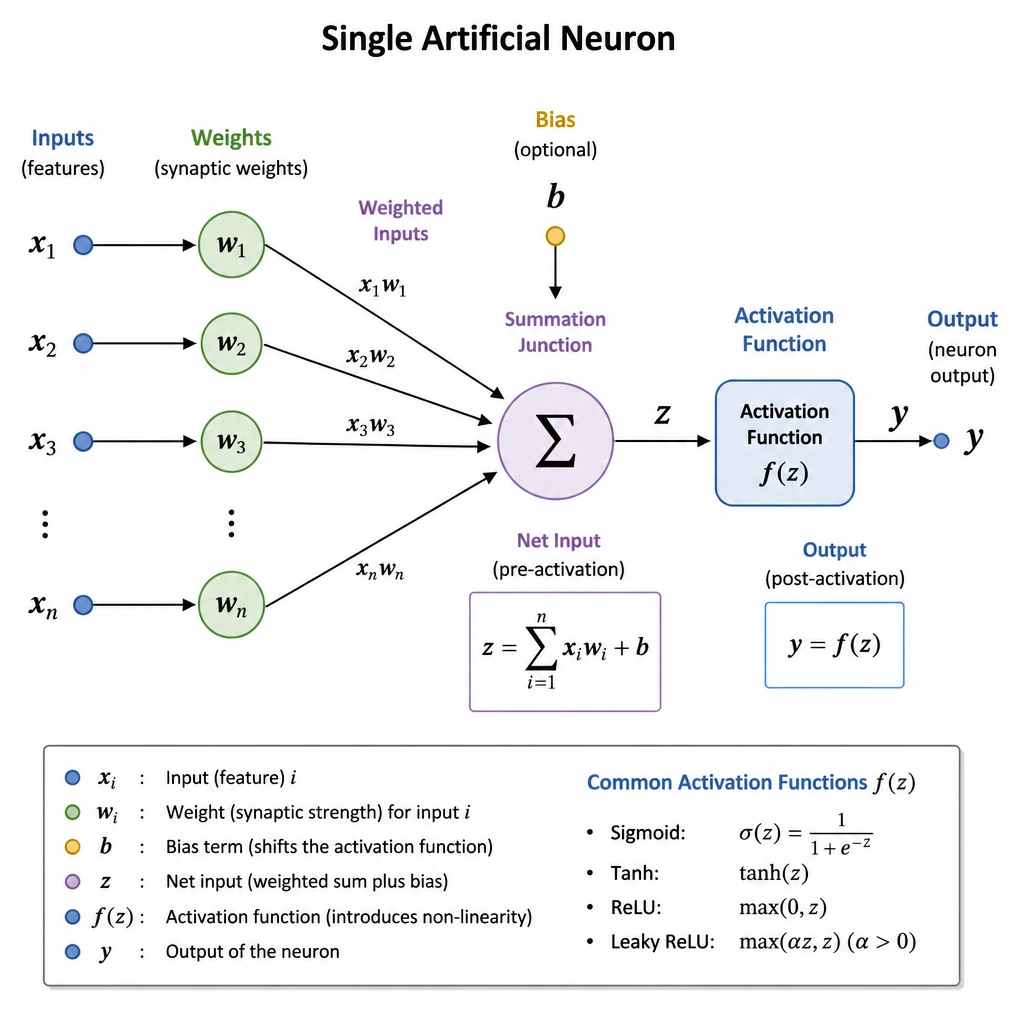
Think of an artificial neuron like a small switch. It takes in all these inputs, multiplies them by their weights, and adds a bias. But how does it decide whether to fire, and how strongly? That's the job of the activation function. It takes that raw weighted sum and squashes or transforms it into an output value. If we didn't have this, our networks wouldn't be able to handle complex, non-linear problems. Weight initialization happens before training starts, backpropagation happens when we adjust weights, and loss calculation happens at the very end to see how wrong we were. So, the gatekeeper at the end of the neuron is the activation function!
Full explanation below image
Full Explanation
In an artificial neural network, a single node (neuron) performs specific mathematical operations to process incoming signals. First, it calculates the weighted sum of its inputs and adds a bias term: z = \sum (x_i * w_i) + b. Where x_i represents the input values, w_i represents the weights, and b represents the bias. The Activation function (Option C) is then applied to this weighted sum (z) to generate the node's output: a = f(z). This function acts as a mathematical gatekeeper, determining the scale and activation level of the neuron's output. By mapping the input to an output range (such as between 0 and 1 for Sigmoid, or 0 and \infty for ReLU), it decides the strength of the signal propagated to the next layer. Error backpropagation (Option A) is the algorithm used to calculate the gradient of the loss function with respect to the weights of the network. It flows backward through the network, whereas the activation function operates during the forward pass. Weight initialization (Option B) is the process of setting the initial weights of the neural network before training begins to prevent issues like exploding or vanishing gradients. Loss calculation (Option D) evaluates the difference between the model's final predictions at the output layer and the actual target labels, occurring at the network level rather than inside individual hidden layer neurons. Therefore, the activation function is the component that determines the neuron's output based on its weighted inputs.