Your team is building a computer vision system to identify defects in manufacturing parts on a conveyor belt. A senior engineer recommends using a traditional machine learning approach like Support Vector Machines (SVMs) with hand-crafted descriptors like HOG (Histogram of Oriented Gradients). You advocate for a Deep Learning approach using a Convolutional Neural Network (CNN). What is the primary advantage of your proposed deep learning approach over the traditional pipeline?
Select an answer to reveal the explanation.
Short Explanation and Infographic
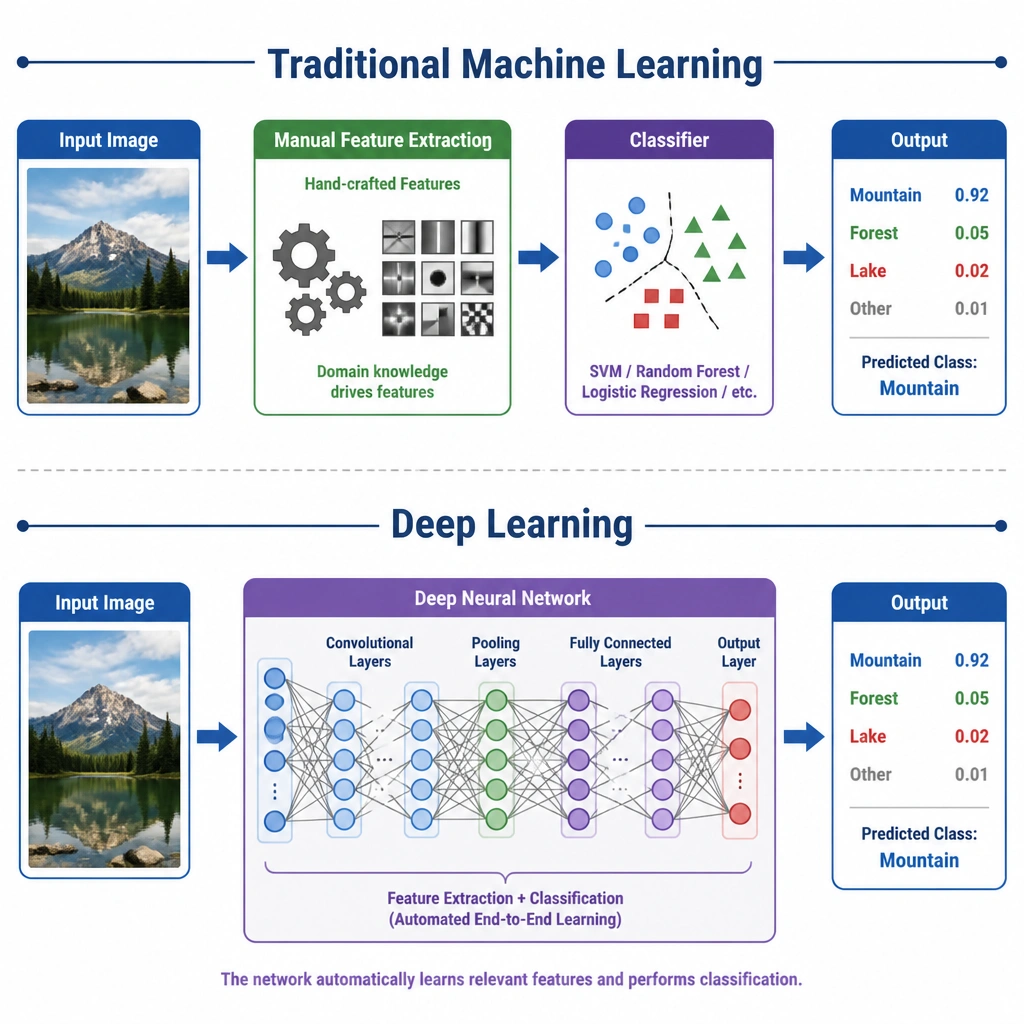
Check this out—in the old days of computer vision, you had to spend weeks, if not months, acting like a digital surgeon—hand-crafting mathematical formulas to detect edges, corners, and shapes (using things like SIFT or HOG). If the lighting changed or the object rotated, your hand-crafted features would break, and you'd be back to square one. Deep learning changed everything. With a CNN, you feed the raw image pixels straight into the network, and the model figures out the features on its own. The early layers find edges, the middle layers find shapes, and the deep layers recognize the actual objects. It does all the heavy lifting for you! Sure, it needs a lot of data and some beefy GPUs, but it saves you from the nightmare of manual feature engineering.
Full explanation below image
Full Explanation
The fundamental distinction between traditional machine learning and deep learning in computer vision lies in how features are extracted from raw data. Traditional computer vision pipelines rely heavily on manual feature engineering. Engineers use domain expertise to write algorithms that extract specific hand-crafted features, such as edges, textures, or keypoints (e.g., Scale-Invariant Feature Transform (SIFT) or Histogram of Oriented Gradients (HOG)). These extracted features are then passed into a classifier like a Support Vector Machine (SVM) or Random Forest. This approach is highly fragile, as the engineered features may not generalize well to variations in lighting, scale, orientation, or background clutter.
In contrast, deep learning architectures—specifically Convolutional Neural Networks (CNNs)—combine feature extraction and classification into a single, end-to-end learning pipeline. Through the process of backpropagation, the model automatically learns hierarchical representations directly from the raw pixel inputs. The lower convolutional layers detect low-level features such as edges and color gradients. The middle layers combine these to represent shapes and textures, and the higher layers construct complex semantic concepts corresponding to the target objects. This automatic feature extraction makes deep learning models highly robust and capable of achieving state-of-the-art accuracy on complex image recognition tasks.
Let's analyze why the other options are incorrect: - Deep learning models are notoriously difficult to interpret (Option A), often referred to as "black boxes" due to millions of parameters, unlike simpler decision trees or linear classifiers. - Deep learning models are extremely compute-intensive (Option D) and require powerful hardware like GPUs or TPUs to train. - Deep learning models generally require massive datasets (Option B) to generalize effectively without overfitting, whereas traditional ML models can sometimes perform reasonably well on smaller datasets.
Therefore, the automatic extraction of hierarchical features directly from raw data (Option C) is the main advantage of deep learning.