You are working on a project to generate realistic synthetic training data for an autonomous driving simulator, specifically creating realistic images of different weather conditions. Which of the following machine learning architectures is classified as a generative model and would be most appropriate for this task?
Select an answer to reveal the explanation.
Short Explanation and Infographic
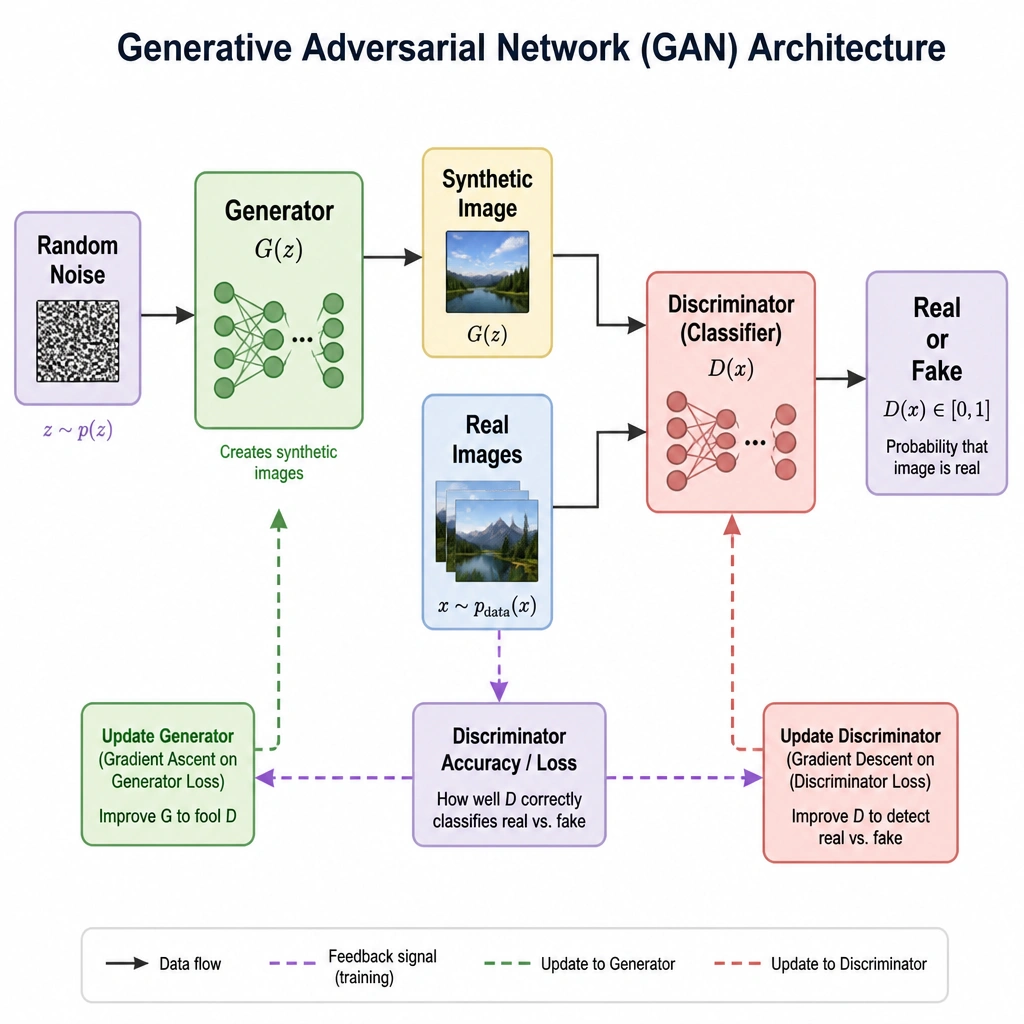
Check this out—in the machine learning world, models are generally split into two camps: discriminative and generative. Discriminative models are like referees—they look at an image and draw a line to decide if it's a dog or a cat. But generative models are like artists—they learn what a dog looks like and then paint a brand-new dog from scratch. A Generative Adversarial Network, or GAN, is the ultimate example of this. It sets up a high-stakes competition between two neural networks: the Generator (the counterfeiter trying to create fake images) and the Discriminator (the detective trying to spot the fakes). They keep battling and improving until the Generator's fake images are so good they look completely real. If you need to create synthetic images or text, GANs are the tool for the job.
Full explanation below image
Full Explanation
Generative models are a class of machine learning models that learn the underlying probability distribution of the input dataset in order to generate new, synthetic data points that resemble the training data. This contrasts with discriminative models, which learn the boundaries between classes to categorize input data.
A Generative Adversarial Network (GAN) is a prominent generative modeling architecture introduced by Ian Goodfellow and his colleagues in 2014. A GAN consists of two neural networks trained simultaneously in a zero-sum game: 1. The Generator: This network takes random noise as input and attempts to generate synthetic data (such as realistic images). 2. The Discriminator: This network takes both real training data and synthetic data from the generator and attempts to classify them as "real" or "fake".
During training, the generator becomes better at producing realistic data to fool the discriminator, while the discriminator becomes better at detecting fakes. This adversarial process continues until the generator produces highly authentic synthetic data that is indistinguishable from real data.
Let's review the incorrect options: - Support Vector Machines (SVMs) (Option A) are discriminative models used for classification and regression; they define decision boundaries rather than generating new data. - K-Means (Option B) is an unsupervised clustering algorithm that groups existing data points based on distance metrics; it does not generate new data. - Linear Regression (Option D) is a simple discriminative model used to predict continuous target values based on input features.
Therefore, the Generative Adversarial Network (Option C) is the correct choice as a generative model.