Imagine you have just trained a machine learning model, and it achieves a remarkable 99.8% accuracy on your training dataset. However, when you deploy this model to production and feed it fresh, real-world data, the accuracy drops to 52%. What phenomenon is your model experiencing?
Select an answer to reveal the explanation.
Short Explanation and Infographic
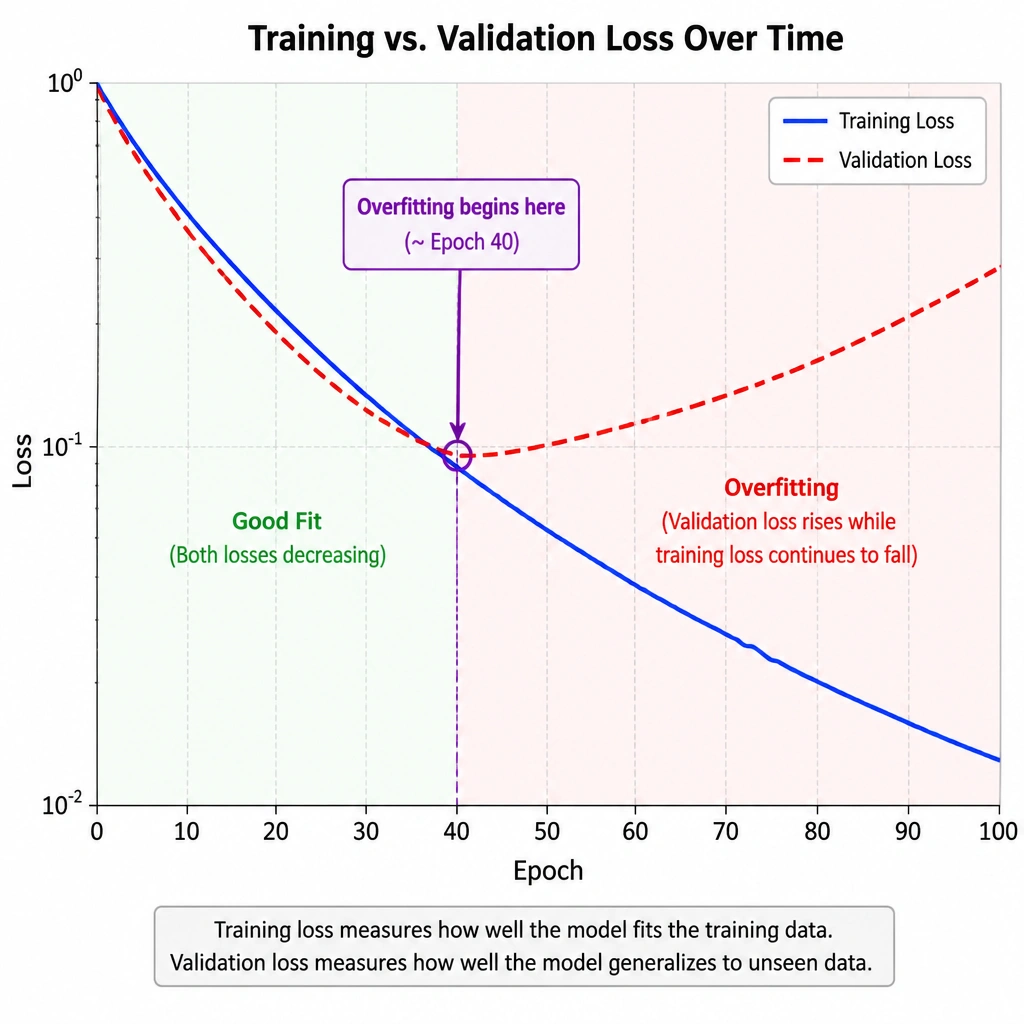
Here's the deal: overfitting is the ultimate fool's gold in machine learning. You train a model, and it looks like a genius because it memorized every tiny detail, wrinkle, and piece of noise in your training set. But the second you throw actual, unseen real-world data at it? It falls flat on its face. It's like memorizing the exact answers to a practice test instead of actually learning the math. Trust me, you want models that generalize, not models that just copy what they've already seen. Got it? Let's move on.
Full explanation below image
Full Explanation
Overfitting is a fundamental challenge in supervised machine learning where a model learns the training dataset too well. Specifically, it captures the noise, outliers, and random fluctuations in the training data rather than the underlying mathematical function that describes the relationship between the features and the target. As a result, while the training loss is extremely low and accuracy is exceptionally high, the model generalizes poorly to unseen validation or test datasets.
To understand the distractors: - Option A refers to underfitting, which is the opposite of overfitting. Underfitting occurs when the model is too simple (high bias) to capture the trend in the training data. - Option C, high bias, is another term related to underfitting; a model with high bias makes restrictive assumptions and cannot capture complex patterns, leading to poor performance on both training and test data. - Option D, data leakage, is a data preparation error where target information from the validation or test set is inadvertently mixed into the training set, causing inflated performance metrics during development but failure in production.
To mitigate overfitting, practitioners use techniques such as cross-validation, regularization (L1/L2), pruning (in decision trees), dropout (in neural networks), or simply gathering more training data.