During the training phase of a deep neural network, you decide to implement a dropout rate of 0.3 on your hidden layers. What is the primary objective of this technique?
Select an answer to reveal the explanation.
Short Explanation and Infographic
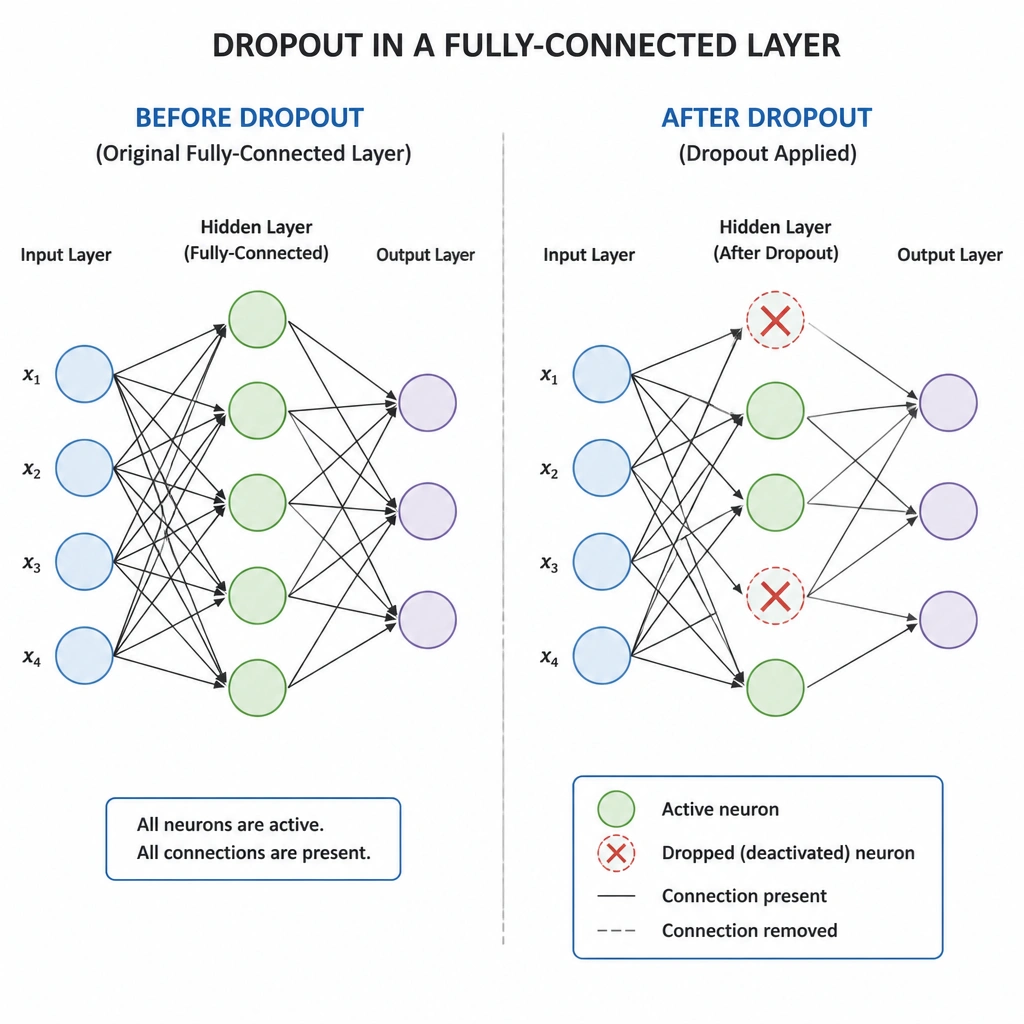
Imagine you're running a business and you have a couple of superstar employees who do all the work, while the rest of the team just sits back and nods. If those superstars get sick, your business crashes. That's what happens when a neural network relies too much on just a few neurons. By using dropout, you're randomly telling 30% of your neurons to 'take the day off' during training. This forces the remaining neurons to step up and learn the features themselves, making the whole network way more robust and preventing it from overfitting. Got it? Sweet.
Full explanation below image
Full Explanation
Dropout is a widely used regularization technique for deep neural networks. During training, at each gradient update step, dropout randomly 'drops out' (deactivates) a specified percentage of neurons (nodes) in the network's layers along with their incoming and outgoing connections. The selection of deactivated nodes changes at every training iteration.
This mechanism prevents neurons from co-adapting too closely. Co-adaptation occurs when some neurons rely on the specific outputs of other neurons to correct their errors, which leads to overfitting on the training data. By forcing the network to learn redundant representations with different subsets of active neurons, dropout improves the model's ability to generalize to new, unseen datasets. During inference (testing/prediction), dropout is turned off, and all neurons are active, with their weights scaled by the dropout probability to account for the lack of dropped nodes.
To address the distractors: - Option A is incorrect because dropout does not permanently change the structure or size of the model; the full network is preserved and utilized during inference. - Option C is incorrect because dropout actually tends to increase the total number of training epochs required to converge, even though it reduces the computation per epoch slightly. - Option D is incorrect because dropout is a regularization method and is unrelated to adjusting the optimizer's learning rate.