You need to group unlabeled network flow data points into distinct, non-overlapping subsets based on numerical feature similarity. Which of the following algorithms is designed specifically to perform this unsupervised clustering task?
Select an answer to reveal the explanation.
Short Explanation and Infographic
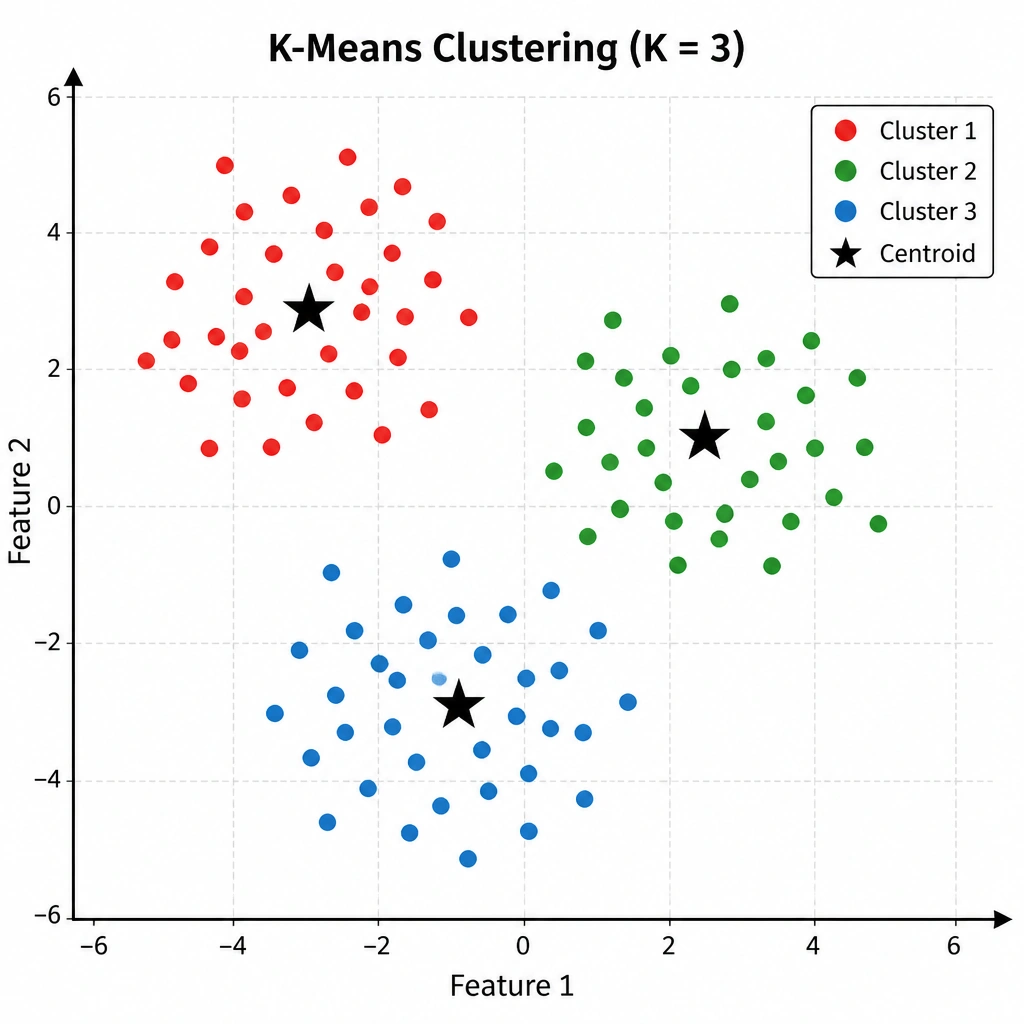
Okay, let's clear up a major confusion that trips up a ton of people on the exam. K-Means and K-Nearest Neighbors (KNN) sound almost identical, but they're completely different beasts. KNN is a supervised learning classifier—it looks at the "K" nearest neighbors to label a new data point. K-Means, on the other hand, is the king of unsupervised clustering. It takes a big cloud of unlabeled data, drops "K" center points (centroids) into it, and groups the data based on how close they are to those centers. If your boss asks you to partition your network traffic into five natural groups without any starting labels, K-Means is your go-to tool.
Full explanation below image
Full Explanation
K-Means is one of the most popular and straightforward unsupervised learning algorithms used for clustering. The goal of K-Means is simple: group similar data points together to discover underlying patterns. It achieves this by partitioning $n$ observations into $K$ clusters, where each observation belongs to the cluster with the nearest mean (acting as a prototype or centroid of the cluster).
It is crucial to distinguish K-Means from supervised algorithms that have similar names or are used for classification: - K-Means (Clustering): Unsupervised. Groups unlabeled data points based on feature similarity (Euclidean distance to centroids). - K-Nearest Neighbors (KNN): Supervised. Used for classification or regression. It classifies a new data point based on the majority vote of its "K" nearest labeled neighbors. - Decision Trees: Supervised. Builds a flowchart-like structure to predict a target class or continuous value. - Support Vector Machine (SVM): Supervised. Finds an optimal hyperplane that maximizes the margin between different classes of data.
- Option A is incorrect because K-Nearest Neighbors is a supervised classification/regression algorithm, not an unsupervised clustering algorithm. - Option C is incorrect because a Support Vector Machine is a supervised algorithm designed primarily for classification and regression. - Option D is incorrect because a Decision Tree is a supervised learning algorithm used for classification and regression tasks.