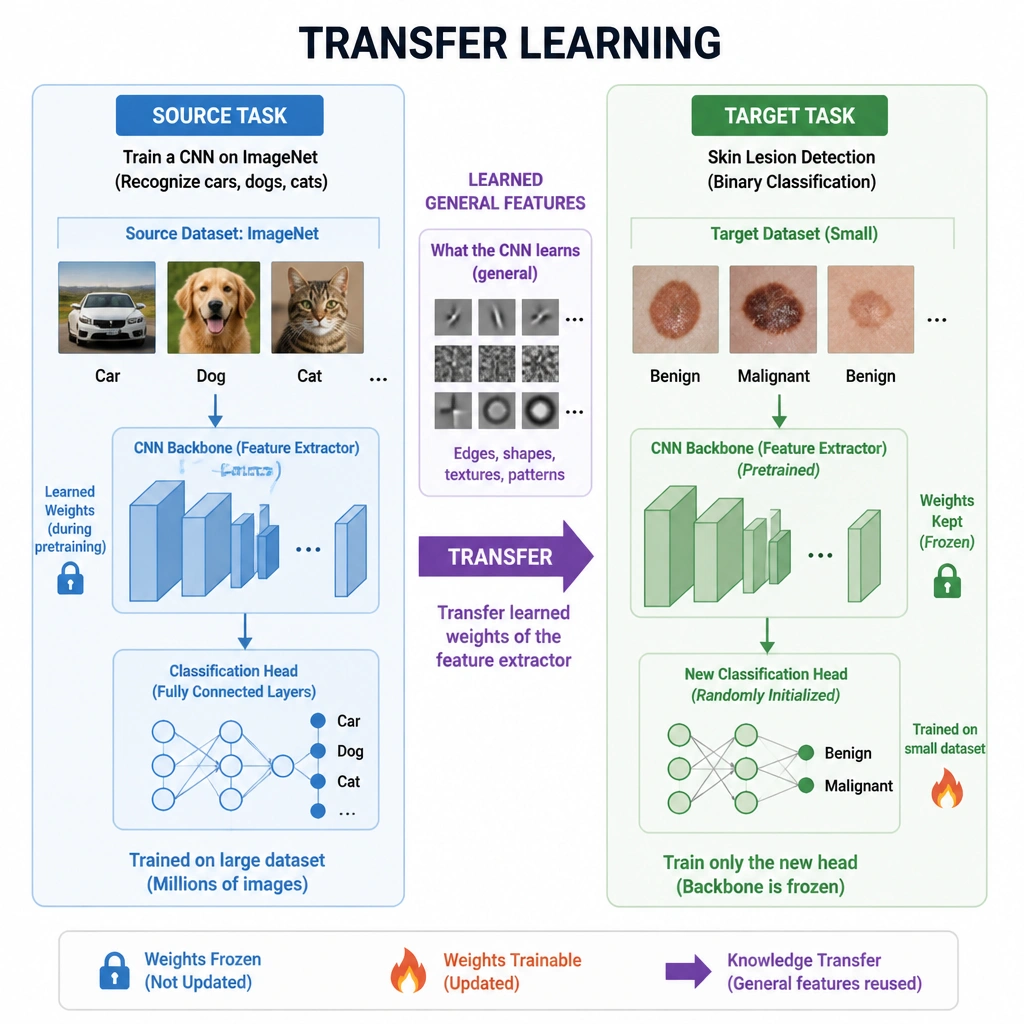
An AI startup needs to build a model that classifies rare medical skin lesions. Because they only have a few hundred labeled images, training a deep convolutional neural network from scratch would lead to severe overfitting. Instead, they choose to take a network pre-trained on the massive ImageNet dataset, freeze its early layers, and fine-tune the final layer on their skin lesion images. What is this machine learning practice called?
Select an answer to reveal the explanation.
Short Explanation and Infographic
Check this out: in the real world, you rarely have millions of labeled images lying around. If you tried to train a massive network from scratch with just a few hundred pictures of skin lesions, it would just memorize them and fail completely in production. So what do we do? We use transfer learning! Think of it like this: if you already know how to drive a car, learning to drive a truck is going to be way easier because you already understand steering, braking, and traffic laws. In AI, we take a model that already knows how to detect basic shapes, edges, and textures (like one trained on ImageNet) and apply that knowledge to a new, related task. It saves a massive amount of time and compute. Model distillation is about shrinking a big model into a smaller one, data transfer is just moving bytes, and zero-shot inference is making predictions without any fine-tuning. Transfer learning is the way to go here.
Full explanation below image
Full Explanation
The correct answer is Transfer Learning (Option C). Transfer learning is a machine learning technique where a model developed for a source task is reused as the starting point for a model on a second, related target task. This is highly beneficial in deep learning because the early layers of neural networks trained on large datasets (such as ImageNet for vision or Wikipedia corpora for NLP) learn general features like edges, textures, shapes, or basic grammar. By leveraging these pre-trained weights and fine-tuning only the later layers on a smaller, task-specific dataset, developers can achieve high accuracy with significantly less training data and computational time. Option A (Model Distillation) is incorrect because distillation (or knowledge distillation) is the process of transferring knowledge from a large, complex model (teacher) to a smaller, more efficient model (student) to reduce computational footprint. Option B (Data Transfer Protocol) is incorrect as it refers to networking protocols (like HTTP or FTP) used to transmit data across systems, not a machine learning training methodology. Option D (Zero-shot Inference) is incorrect because zero-shot learning or inference involves using a model to classify or predict on tasks it has never seen without any gradient updates or fine-tuning of its weights.