A company is developing a virtual assistant that can read customer support emails, extract the main customer complaints, and automatically route the tickets to the appropriate department. Which subfield of artificial intelligence is primarily concerned with enabling computers to understand, interpret, and manipulate human language in this manner?
Select an answer to reveal the explanation.
Short Explanation and Infographic
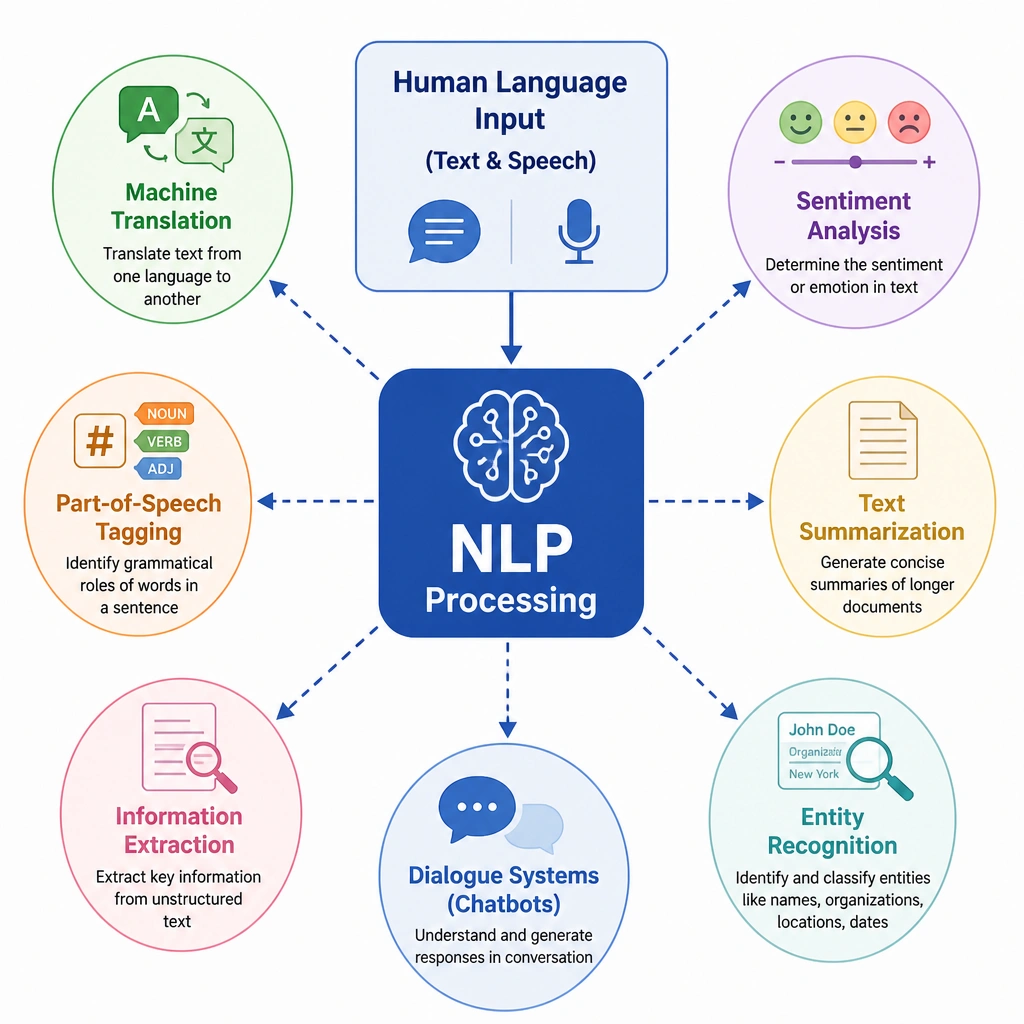
Okay, let's dive in. Computers are great with numbers, but human language is messy, full of slang, and highly contextual. If you want a computer to read an email, extract the sentiment, or translate a document, you can't just use standard coding rules. You need Natural Language Processing, or NLP. It's the branch of AI that bridges the gap between human communication and computer understanding. Think of it like teaching a computer how to read and speak our language. Computer vision is for images, reinforcement learning is for training agents via rewards (like games or robotics), and GANs are for generating realistic data like images. NLP is all about text and speech. Got it? Sweet.
Full explanation below image
Full Explanation
The correct answer is Natural Language Processing (Option B). Natural Language Processing (NLP) is a multidisciplinary subfield of artificial intelligence, computer science, and linguistics concerned with the interactions between computers and human (natural) languages. The ultimate objective of NLP is to program computers to process, analyze, and understand large amounts of natural language data, enabling tasks such as sentiment analysis, machine translation, named entity recognition, text summarization, and dialogue systems. Because human language is ambiguous and structurally complex, NLP combines computational linguistics with statistical, machine learning, and deep learning models to capture semantic meaning. Option A (Computer Vision) is incorrect because computer vision focuses on enabling computers to gain high-level understanding from digital images or videos, not text or speech. Option C (Reinforcement Learning) is incorrect because it is a machine learning paradigm focused on how software agents ought to take actions in an environment to maximize some notion of cumulative reward, commonly used in robotics and gaming. Option D (Generative Adversarial Networks) is incorrect because GANs are a generative model class used to synthesize realistic data (most commonly images or video) through a game-theoretic competition between a generator and a discriminator.