When building models for sequential data like text or time-series, why would a developer choose a Gated Recurrent Unit (GRU) over a traditional Recurrent Neural Network (RNN) or a Long Short-Term Memory (LSTM) network?
Select an answer to reveal the explanation.
Short Explanation and Infographic
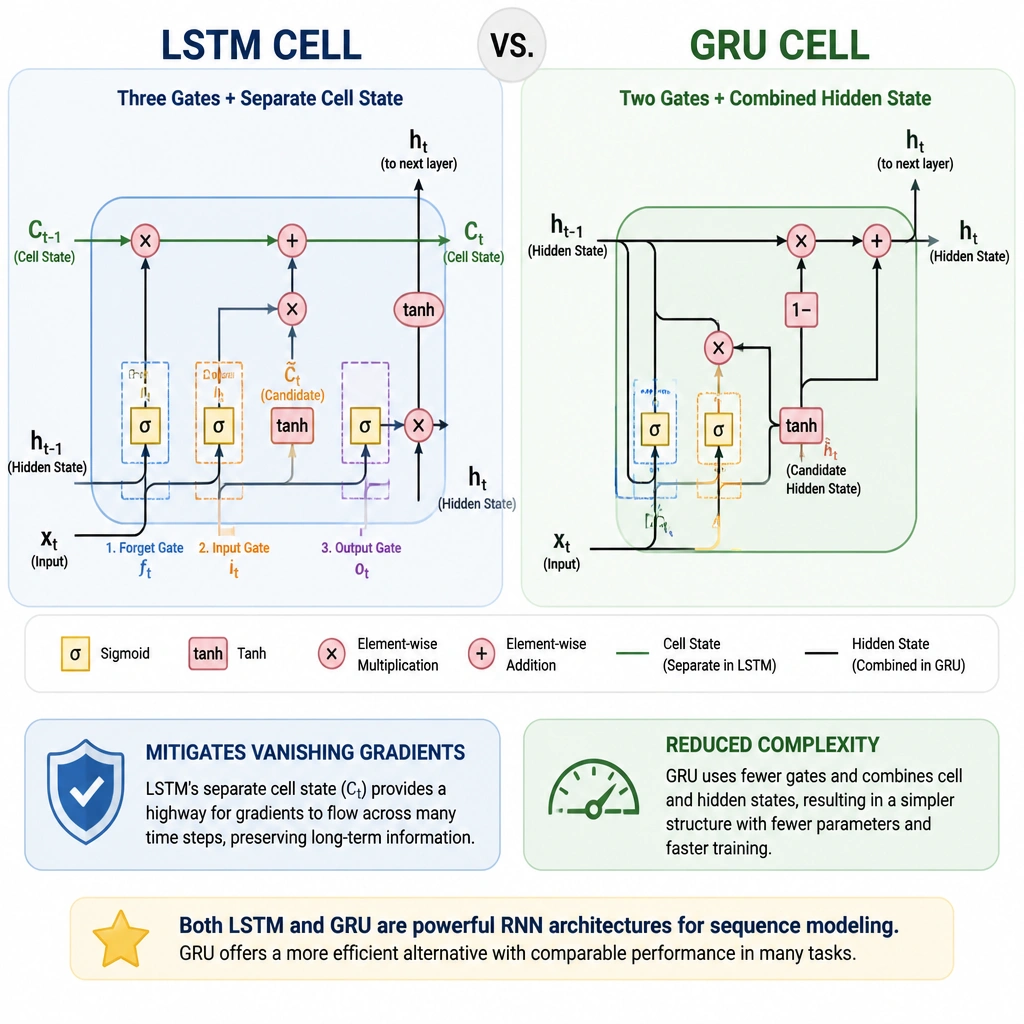
Okay, let's dive into sequential data. Standard RNNs have a short memory because they suffer from the vanishing gradient problem—the gradients shrink to zero during training, and the model forgets what happened at the start of a sentence. LSTMs fixed this by adding three gates to control information flow, but they are heavy and slow. Enter the GRU! Think of the GRU as a stripped-down, high-performance version of the LSTM. It uses just two gates (update and reset) to keep the memory flowing without the computational overhead of the LSTM. It's faster, simpler, and keeps the gradients alive. Got it? Sweet.
Full explanation below image
Full Explanation
Gated Recurrent Units (GRUs) are a type of recurrent neural network (RNN) architecture designed to process sequential data while addressing the vanishing gradient problem inherent in standard RNNs. Standard RNNs struggle to learn long-term dependencies because gradients can exponentially decay (vanish) as they are backpropagated through time, effectively preventing weight updates for earlier time steps. To solve this, architectures like Long Short-Term Memory (LSTM) and GRU introduce gating mechanisms. While an LSTM uses three gates (input, forget, and output gates) along with a separate cell state, a GRU merges the cell state and hidden state, and uses only two gates: an update gate and a reset gate. The update gate determines how much of the past information needs to be passed along to the future, and the reset gate decides how much of the past information to forget. This simplified architecture results in fewer parameters and faster training times compared to LSTMs, while still effectively combating vanishing gradients. The distractors are incorrect because GRUs still require a loss function, perform recurrent (not convolutional) operations, and do not function primarily as dimensionality reduction tools.