When training deep neural networks, engineers often implement a learning rate scheduler (sometimes called a learning rate planner). What is the primary purpose of using this tool during the training run?
Select an answer to reveal the explanation.
Short Explanation and Infographic
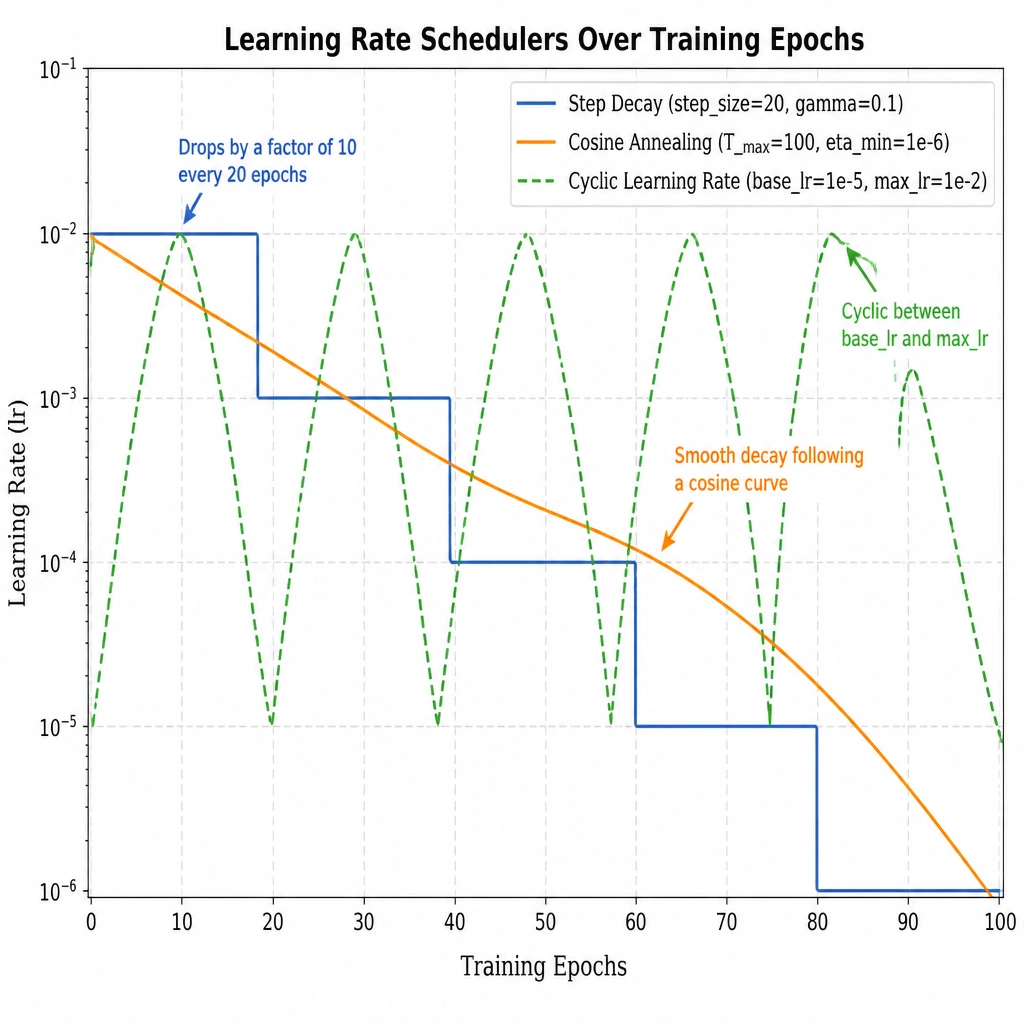
Think of a learning rate scheduler like the gear shift on a bicycle. When you start climbing a steep hill, you want a low, powerful gear. When you're cruising on flat ground, you shift to a higher gear. If you kept the same gear the whole time, you'd wear yourself out! A learning rate scheduler does the same thing for your model. It might start with a higher learning rate to make big, fast updates early on, and then gradually dial it down as the model gets closer to the minimum so it doesn't overshoot. It's all about getting your model to converge faster and perform better.
Full explanation below image
Full Explanation
A learning rate scheduler (or planner) is used to dynamically adjust the learning rate hyperparameter during the training process according to a predefined schedule or based on validation metrics. In the early stages of training, a larger learning rate is often desirable to make rapid progress toward the optimal weight space and potentially escape sub-optimal local minima. However, as training progresses and the model approaches the minimum of the loss surface, a large learning rate can cause the optimizer to overshoot and oscillate, preventing convergence. By decreasing (decaying) the learning rate over time—using techniques like step decay, exponential decay, or cosine annealing—the model can take smaller, more precise steps to settle cleanly into the global minimum. Some schedulers, such as cyclical learning rates or 'one-cycle' policies, even vary the learning rate up and down to help the model escape saddle points. The distractors are incorrect: Schedulers do not change the number of epochs (which is a fixed setting); Schedulers do not switch between optimizers (the optimizer remains the same); Schedulers do not apply L1/L2 regularization penalties, which are handled directly in the weight update step or the loss function calculation.