In a Convolutional Neural Network (CNN) architecture, what is the primary function of the fully connected (dense) layer located at the very end of the network?
Select an answer to reveal the explanation.
Short Explanation and Infographic
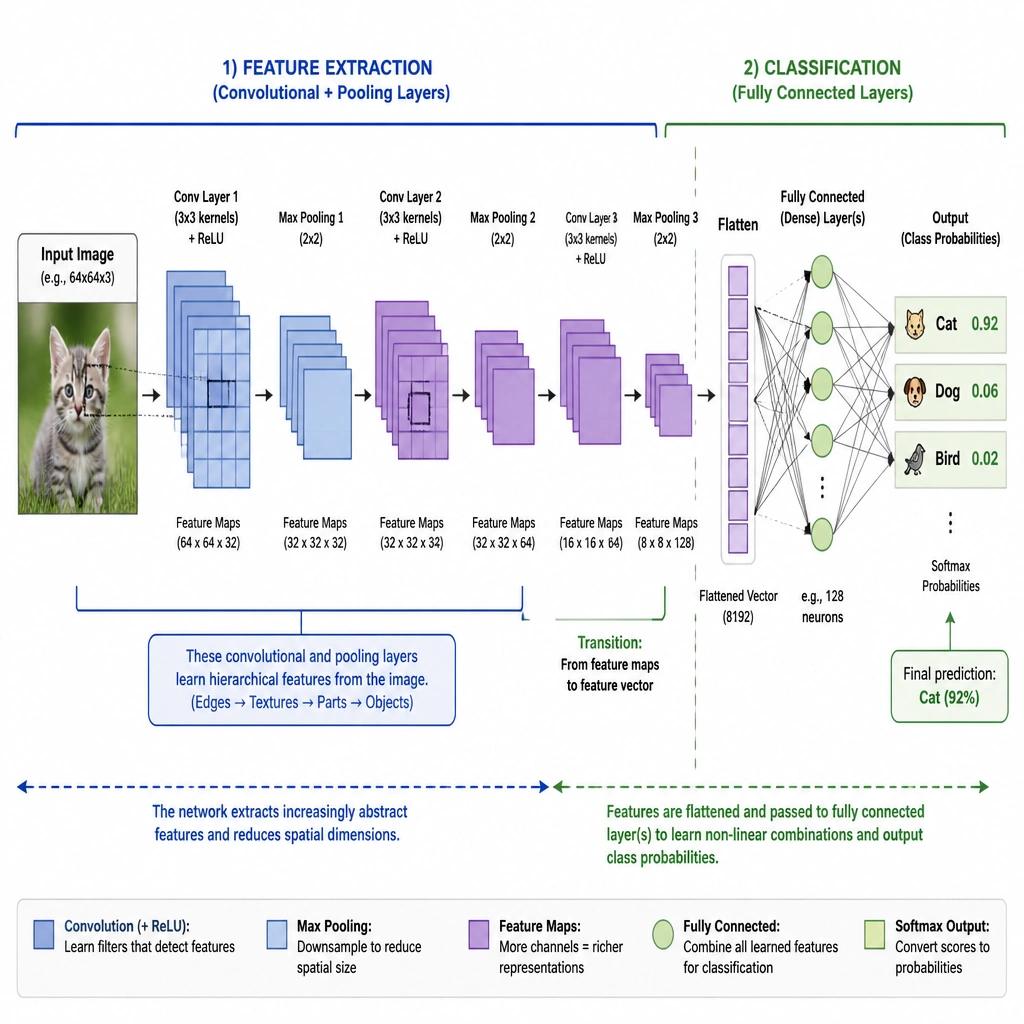
Alright, let's think about how a CNN works. The first few layers of the network—the convolutional and pooling layers—are like detectives. They look at the image and pull out features like edges, circles, and eyes. But those layers don't actually know what the image is. They just know the features are there. That's where the fully connected layer comes in at the end. It takes all those high-level features, flattens them, and maps them to the final categories we care about—like whether it's a cat, a dog, or a truck. It's the decision-maker of the whole operation. If you didn't have it, you'd have a bunch of features but no final answer. Got it? Sweet. Let's keep rolling.
Full explanation below image
Full Explanation
A Convolutional Neural Network (CNN) is structured into two main parts: feature extraction and classification. The early and middle layers—composed of convolutional and pooling layers—perform feature extraction. Convolutional layers apply filters to capture local patterns (such as edges, shapes, and complex textures), while pooling layers reduce spatial dimensions and introduce translation invariance.
Once the convolutional layers have processed the input, the final feature maps represent high-level, abstract features of the image. However, these features are still in a multi-dimensional grid format. To make a prediction, the network must flatten this output and pass it to one or more fully connected (dense) layers. The fully connected layer connects every input node to every output node, allowing it to learn non-linear combinations of these high-level features and map them to the target classes (e.g., using a Softmax activation function to output class probabilities).
Let's examine why the other choices are incorrect: - Option A is incorrect because reducing spatial dimensions is the function of pooling layers (such as max pooling or average pooling), not fully connected layers. - Option B is incorrect because extracting low-level features is the responsibility of the initial convolutional layers, which detect basic patterns like edges and curves. - Option D describes data augmentation. Data augmentation is a preprocessing technique performed on the input dataset before it enters the neural network to artificially expand the training set size and prevent overfitting, not something handled by the final fully connected layer.