What is a key advantage of using the Rectified Linear Unit (ReLU) activation function in the hidden layers of deep neural networks?
Select an answer to reveal the explanation.
Short Explanation and Infographic
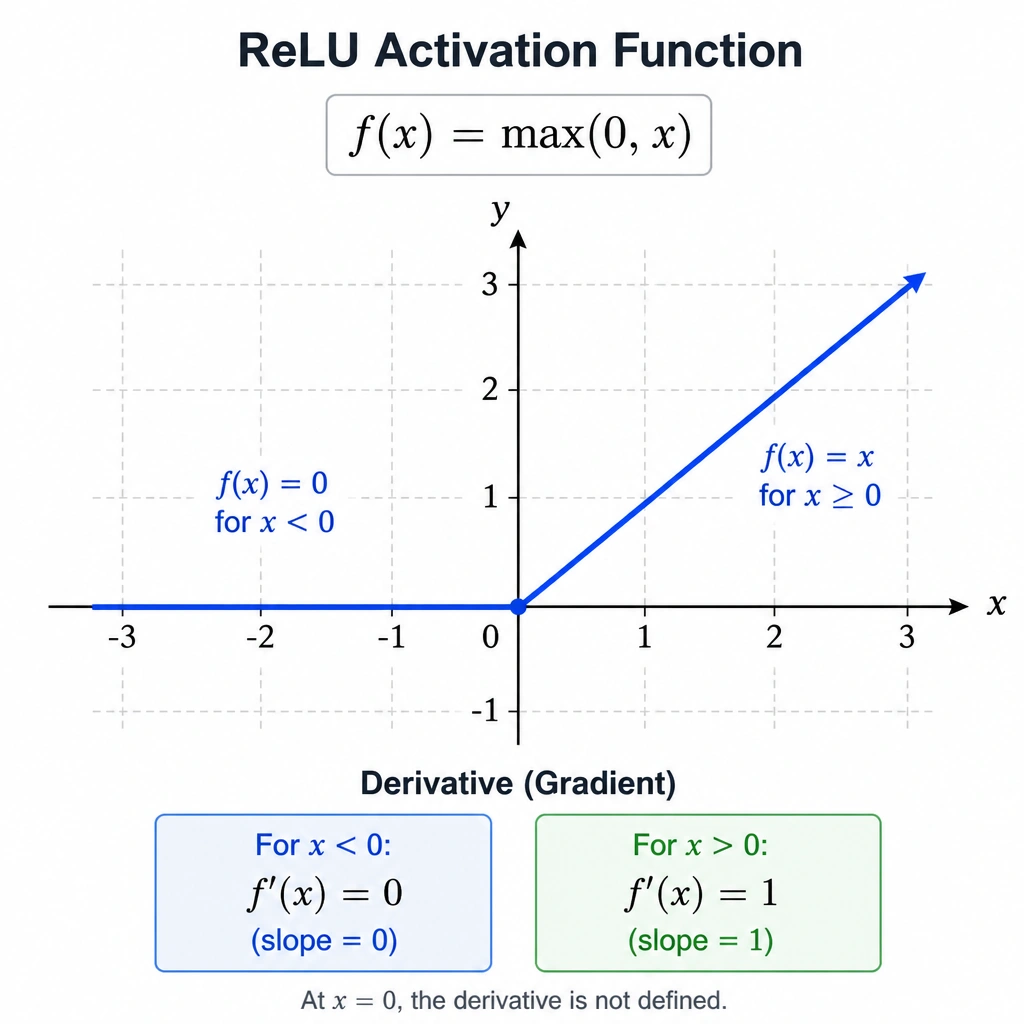
Check this out: ReLU is the undisputed champ of activation functions in hidden layers, and the reason is simple. It's incredibly fast to compute. The formula is literally just $f(x) = \max(0, x)$. If the input is negative, it outputs zero. If it's positive, it just passes the value straight through. Because the derivative of any positive input is exactly 1, the gradient doesn't shrink as it propagates backward through the network. This completely sidesteps the vanishing gradient problem for those positive inputs. Other functions like Sigmoid or Tanh squeeze their outputs into tight ranges, which leads to tiny gradients. ReLU keeps it simple, clean, and fast.
Full explanation below image
Full Explanation
The Rectified Linear Unit (ReLU) activation function, defined mathematically as $f(x) = \max(0, x)$, has become the standard activation function for the hidden layers of deep neural networks. Its widespread adoption is due to its computational efficiency and its ability to mitigate the vanishing gradient problem.
Unlike activation functions such as Sigmoid or Hyperbolic Tangent (Tanh), which require expensive exponential calculations, ReLU only requires a simple thresholding operation at zero. Furthermore, for any positive input ($x > 0$), the derivative of ReLU is constant and equal to 1. During backpropagation, this constant gradient of 1 propagates backward through the layers without being scaled down. This prevents the gradients from decaying exponentially (vanishing) as they travel to the initial layers of the network, enabling the training of much deeper architectures.
Let's break down the incorrect options: - Option A describes the Hyperbolic Tangent (Tanh) activation function, which outputs values between -1 and 1. Tanh suffers from vanishing gradients when saturated. - Option C describes the Leaky ReLU activation function, not the standard ReLU. Standard ReLU outputs a flat zero and a gradient of zero for all negative inputs, which can sometimes lead to 'dead neurons' (the dying ReLU problem) where neurons stop updating entirely. - Option D describes the Softmax function, which converts logits into a probability distribution. Softmax is used in output layers, not hidden layers, and operates differently than ReLU.