What is the main role of the loss function during the execution of the backpropagation algorithm?
Select an answer to reveal the explanation.
Short Explanation and Infographic
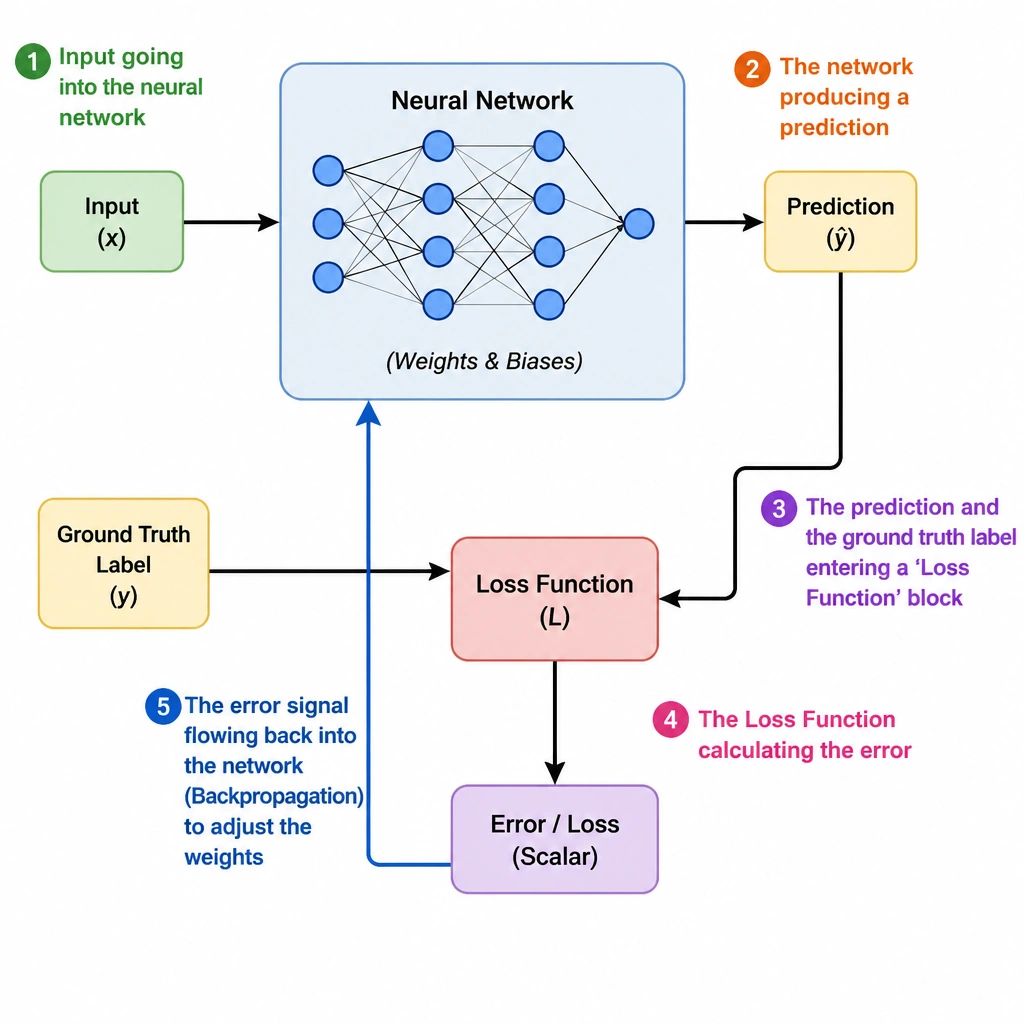
Think of a loss function like a strict flight instructor. If you're off course, you need to know exactly how off course you are. The loss function compares what the neural network predicted against the actual ground truth. It spits out a single number representing the error. Backpropagation then takes that error and works backward through the network, figuring out how much each weight contributed to the mistake so the optimizer can tweak them. Without the loss function, the network would have no feedback loop. It'd be flying blind with no way to improve. Let's keep rolling!
Full explanation below image
Full Explanation
The backpropagation algorithm is the core mechanism used to train artificial neural networks. It works by computing the gradient of a loss function with respect to the network's weights, allowing the optimizer to update those weights in a direction that minimizes error.
The loss function (also known as a cost or objective function) plays a critical role as the starting point of this process. During the forward pass, the network processes input data and outputs a prediction. The loss function compares this prediction to the actual target label (ground truth) and computes a scalar value representing the prediction error. Common examples include Mean Squared Error (MSE) for regression and Cross-Entropy Loss for classification. During the backward pass, backpropagation applies the chain rule of calculus starting with the derivative of this loss value. The resulting error signal propagates backward through the network layers to calculate the partial derivatives for every weight and bias, guiding the optimization step.
Let's address the incorrect options: - Option A is incorrect because adding non-linearity is the role of activation functions (such as ReLU, Sigmoid, or Tanh), not the loss function. - Option B is incorrect because dimensionality reduction is typically performed by specific layers (such as pooling layers or strides in CNNs) or techniques like Principal Component Analysis (PCA), not the loss function. - Option D is incorrect because adjusting the learning rate is handled by learning rate schedulers or optimization algorithms (like Adam or SGD with momentum), not the loss function.