You are tasked with designing a deep learning model to analyze a sequential time-series of financial market data to forecast stock price movements. Which neural network type is most appropriate for this task?
Select an answer to reveal the explanation.
Short Explanation and Infographic
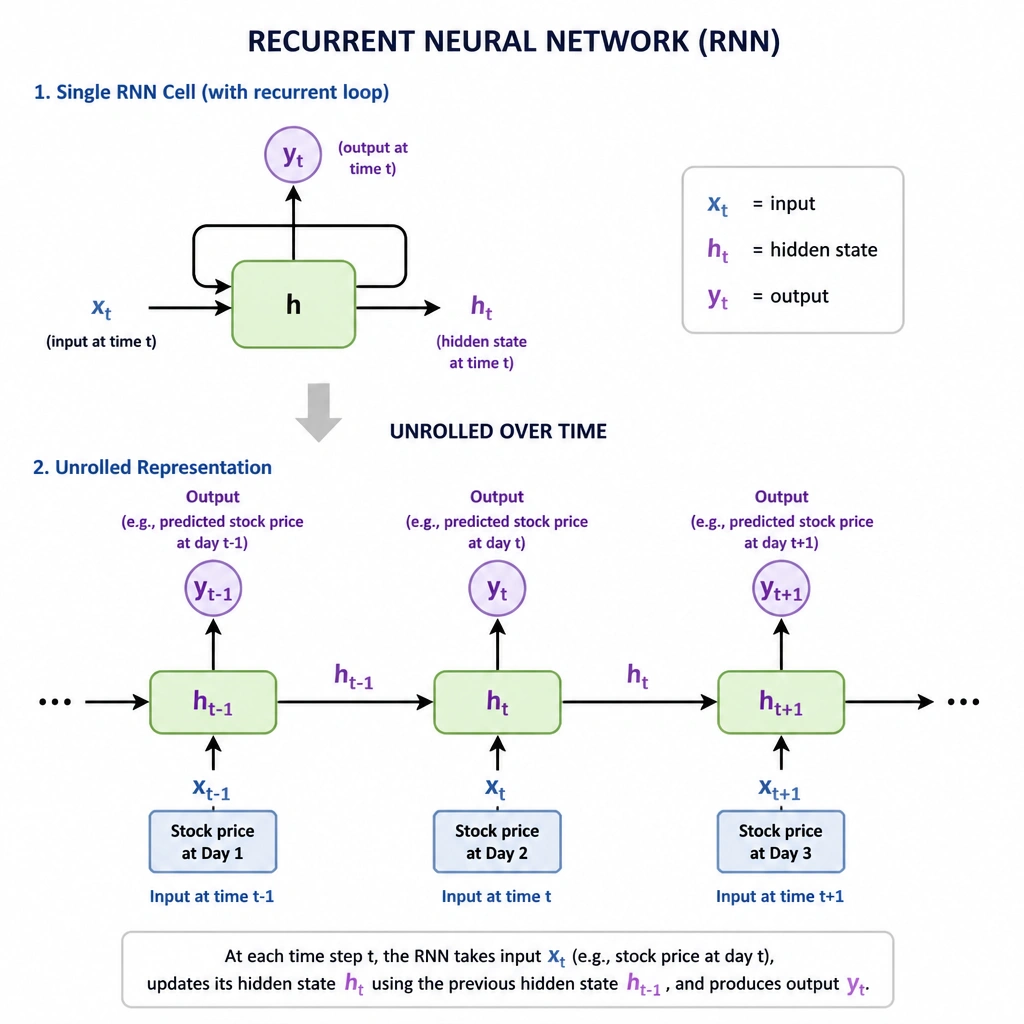
Here's the deal: stock prices aren't random, isolated events. Today's price depends on yesterday's price, which depended on the day before that. That means we're dealing with sequential data—a time series. Standard feedforward networks look at each input as completely independent. They don't have a concept of time. Recurrent Neural Networks (RNNs), on the other hand, have loops that allow information to persist. They pass a hidden state from one step to the next, giving them a memory of past events. For time-series, text, or audio, RNNs (especially LSTMs) are your go-to tool. Always remember: sequence equals recurrence!
Full explanation below image
Full Explanation
To choose the correct neural network architecture, it is essential to analyze the nature of the input data. Financial market data, such as stock price history, is sequential and chronological (time-series data). The order of the data points carries critical information, and predictions depend heavily on past context.
Recurrent Neural Networks (RNNs) are designed specifically for processing sequential data. Unlike feedforward architectures, RNNs contain recurrent connections (loops) that allow them to maintain an internal memory (hidden state). As the network processes each element in the sequence, it combines the current input with the hidden state from the previous step. This structure allows the model to learn temporal dependencies and patterns over time, making it ideal for forecasting stock prices, natural language processing, and speech recognition.
Let's examine why other architectures are less suitable: - Option A (CNN) is designed for grid-like data with spatial relationships, such as images. While 1D CNNs can sometimes be adapted for sequence data, they do not natively maintain sequential state like RNNs. - Option C (GAN) consists of two networks (a generator and a discriminator) trained in competition to generate realistic synthetic data (e.g., creating fake images). They are not designed for predictive sequential analysis. - Option D (Standard Feedforward Neural Network) assumes that all inputs and outputs are independent of each other. It lacks the recurrent memory loops required to process sequences where order matters.