In a deep neural network, what is the primary role of a Dense (fully connected) layer?
Select an answer to reveal the explanation.
Short Explanation and Infographic
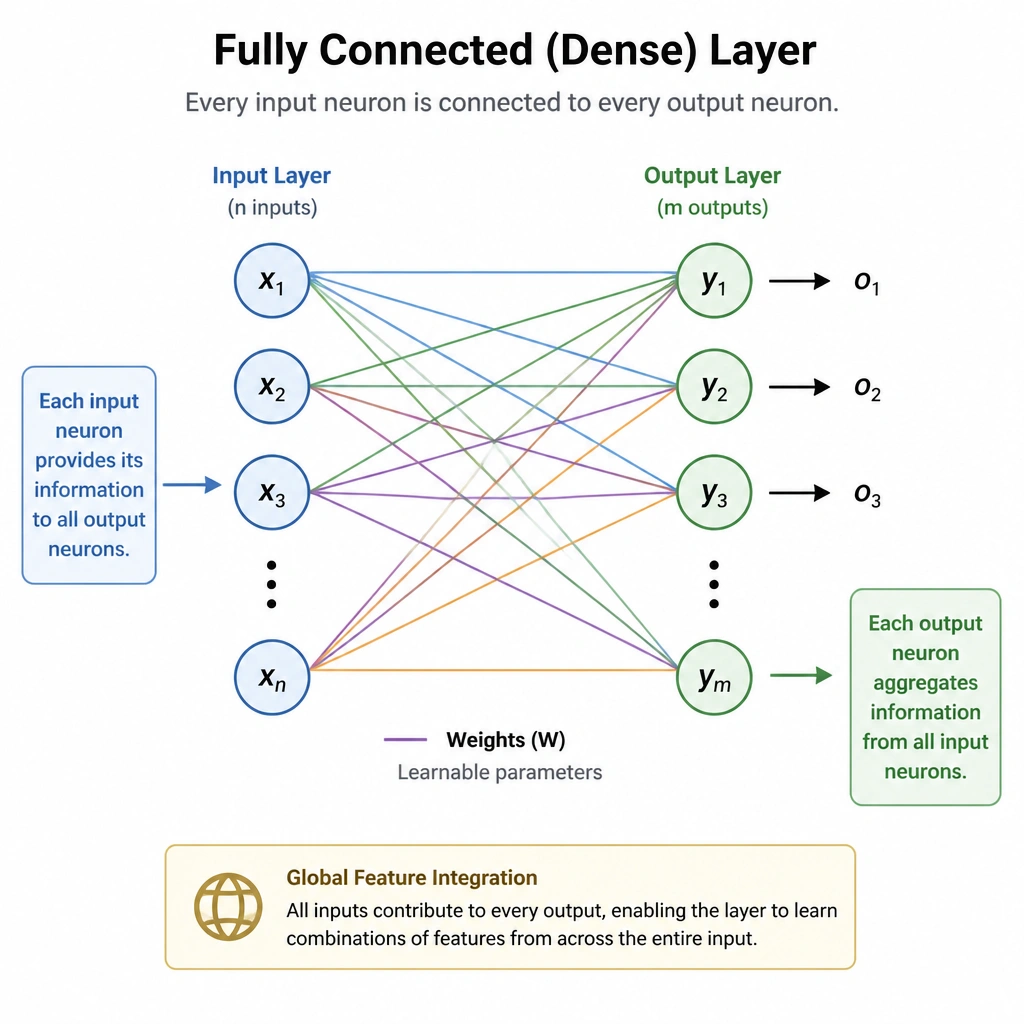
Let's look at how neural networks are built. In a Dense layer—which we also call a fully connected layer—every single neuron in the previous layer is connected to every single neuron in the current layer. Think of it as a huge meeting room where everyone is talking to everyone else. The purpose here is to take all the localized features we've extracted (like from a CNN's convolutional layers) and combine them globally. This allows the network to learn complex, high-level relationships and make a final prediction. Extracting local features? That's what convolutional layers do. Reducing dimensionality? That's pooling or stride. And while dense layers use activations, they aren't just activation gates—they are packed with weights that the network learns during training. Got it? Sweet!
Full explanation below image
Full Explanation
A Dense (or fully connected) layer is a layer where each neuron receives input from all neurons in the previous layer. Its primary mathematical operation is a matrix-vector multiplication of inputs and weight parameters, plus a bias term, followed by an activation function. This dense connectivity allows the network to perform global feature integration. While convolutional layers focus on extracting local features (such as edges or textures), dense layers combine these features globally to perform classification or regression. - Distractor A is incorrect because extracting local features is the role of convolutional layers, which use shared weights and local receptive fields. - Distractor B is incorrect because reducing dimensionality (specifically spatial dimensions) is primarily the function of pooling layers. - Distractor D is incorrect because dense layers contain learnable weights and biases; they are not merely mathematical activation functions.