What is the structural and functional difference between a basic Feedforward Neural Network (Multi-Layer Perceptron) and a Convolutional Neural Network (CNN)?
Select an answer to reveal the explanation.
Short Explanation and Infographic
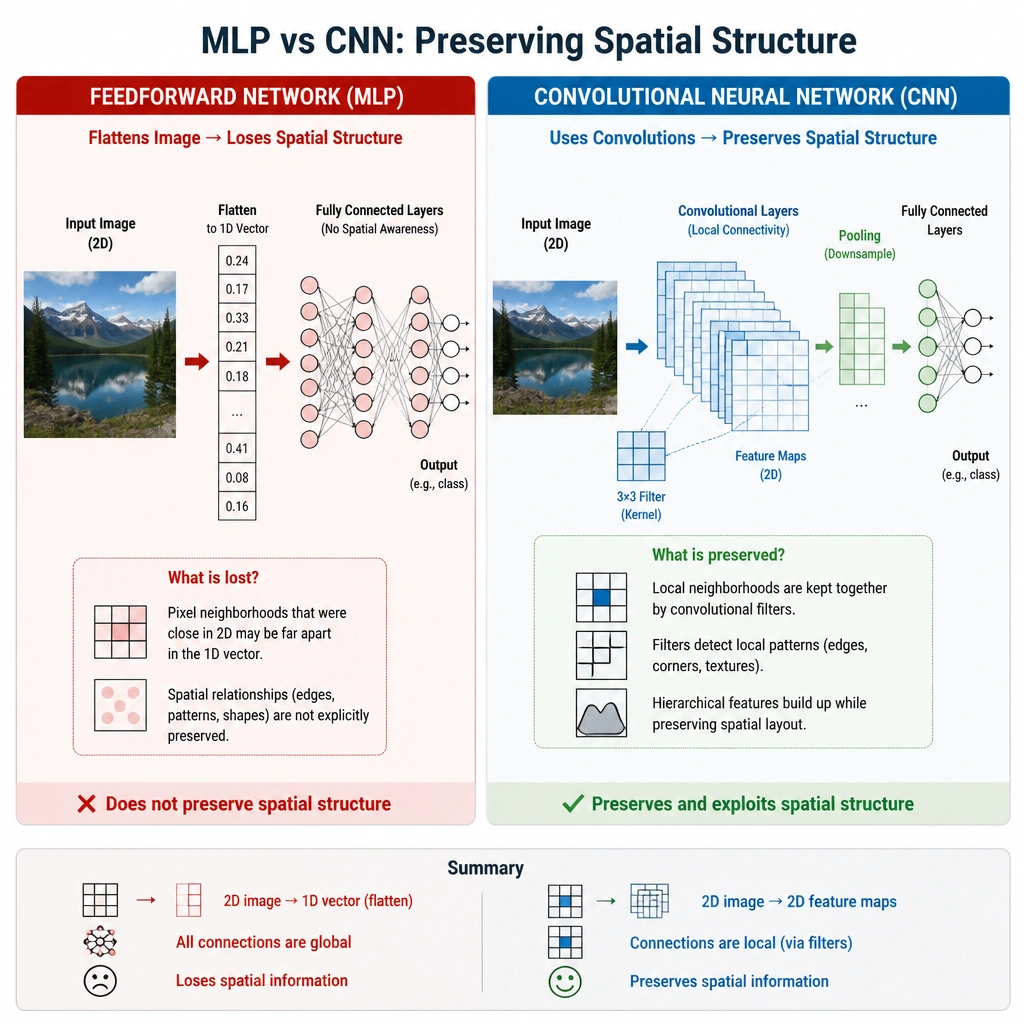
Let's get this straight: a CNN is actually a type of feedforward neural network, but it's got some cool superpowers. In a basic feedforward network (like a Multi-Layer Perceptron), you flatten your data and feed it into fully connected layers. But if you do that with an image, you throw away all the spatial information—like how pixels next to each other form a line or an eye. A CNN solves this by using convolutional and pooling layers first. These layers preserve the grid structure of the image, scanning it to extract features before sending it to the classification layer. Neither of these networks has a 'memory'—that's what Recurrent Neural Networks (RNNs) do. So, remember: CNNs are feedforward networks optimized for grid-like data like images. Got it? Sweet!
Full explanation below image
Full Explanation
A Convolutional Neural Network (CNN) is a specialized class of feedforward neural networks. While a standard Feedforward Neural Network (such as a Multi-Layer Perceptron, or MLP) consists of fully connected layers where input spatial structure is flattened and lost, a CNN uses convolutional layers and pooling layers. These layers apply mathematical convolutions to preserve the spatial and temporal relationships of the input, making them highly effective for processing grid-structured data like 2D images or 3D video. - Distractor A is incorrect because both MLPs and CNNs can perform both classification and regression tasks. - Distractor C is incorrect because CNNs are primarily known for image processing, though they can be applied to 1D data like text; they are not restricted to text. - Distractor D is incorrect because standard feedforward networks do not have memory (recurrent loops); Recurrent Neural Networks (RNNs) are the architectures that utilize memory states to process sequential data.