The Adam optimizer is widely used for training deep neural networks due to its fast convergence and robust performance. What are the two core mechanisms that Adam combines to achieve this efficiency?
Select an answer to reveal the explanation.
Short Explanation and Infographic
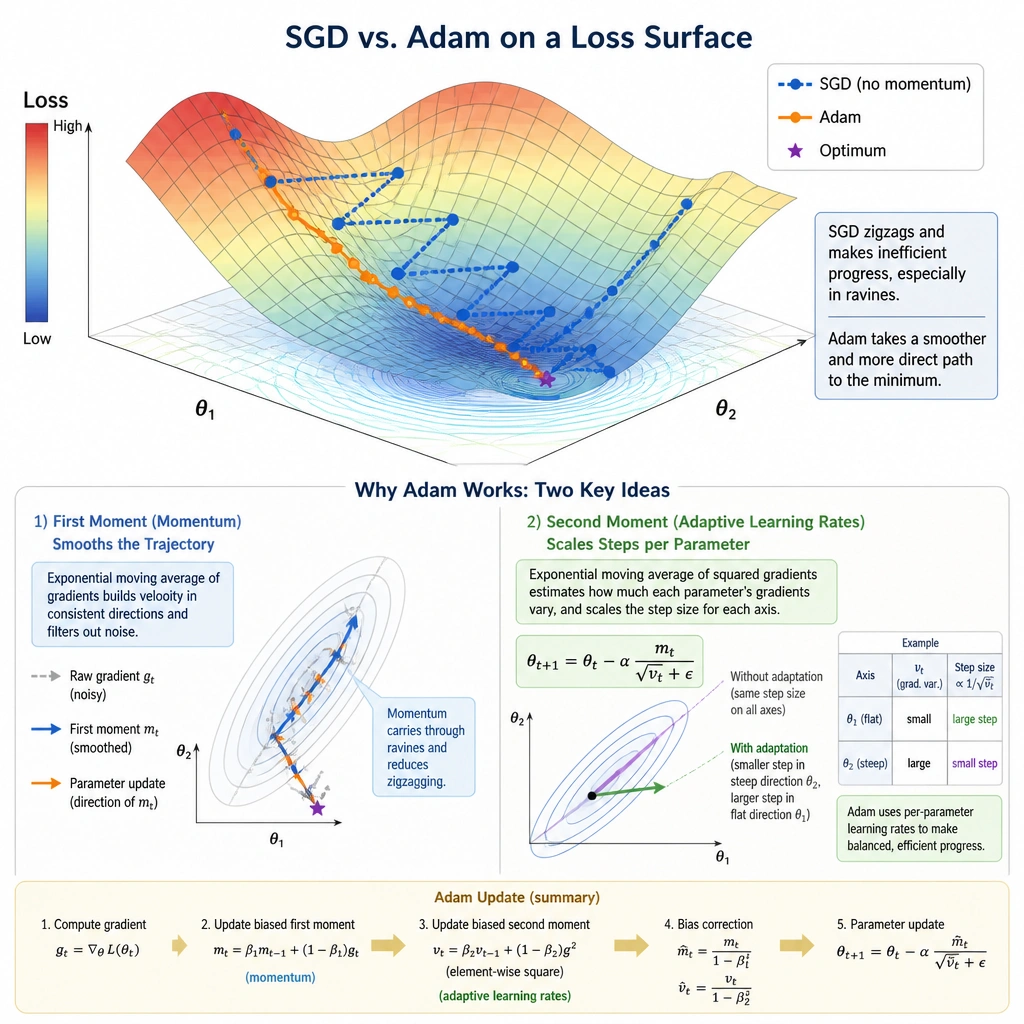
Here's the deal with the Adam optimizer—it's the absolute gold standard for most deep learning tasks, and for good reason! Instead of using a single, rigid learning rate for every single weight in your network, Adam is way smarter. It combines two powerhouses: momentum (which helps the optimizer roll past local minima by remembering past gradients) and RMSprop (which adapts the learning rate for each parameter individually based on how active it is). Think of it like driving down a bumpy road—you want to maintain speed in the right direction but slow down when the bumps get wild. Adam handles both, making your training incredibly fast and stable. Got it? Sweet.
Full explanation below image
Full Explanation
The Adam (Adaptive Moment Estimation) optimization algorithm is designed to improve training speeds and stability compared to standard Stochastic Gradient Descent (SGD). Its effectiveness stems from combining two key concepts: momentum and adaptive learning rates.
1. Momentum (First Moment Vector): Adam maintains an exponentially decaying average of past gradients (similar to SGD with momentum). This helps accelerate the optimizer in directions of consistent gradients, reducing oscillation and helping the optimization path navigate out of shallow local minima or flat regions. 2. Adaptive Learning Rates (Second Moment Vector): Adam computes individual learning rates for different parameters by tracking the exponentially decaying average of the squared gradients. If a parameter's gradient is highly volatile or very large, its learning rate is scaled down; conversely, parameters with small, sparse updates receive larger steps. Furthermore, Adam introduces default hyperparameters (such as $\beta_1 = 0.9$ for momentum, $\beta_2 = 0.999$ for scaling, and $\epsilon = 10^{-8}$ to prevent division by zero) which work remarkably well out-of-the-box for most architectures.
Let's examine why the other choices are incorrect: - Option A is incorrect because a loss function is separate from the optimization algorithm itself, and a static learning rate is a hyperparameter rather than the adaptive mechanism inside Adam. - Option B is incorrect because gradient clipping is an external technique used to prevent exploding gradients, and dropout is a regularization method applied to layer activations, not a component of the optimizer. - Option D is incorrect because L1 regularization is a penalty added to the loss function, and batch normalization is a layer-level technique used to stabilize inputs to subsequent layers, not part of the optimizer's math.