What is the fundamental structural and functional difference between a Feedforward Neural Network (FNN) and a Recurrent Neural Network (RNN)?
Select an answer to reveal the explanation.
Short Explanation and Infographic
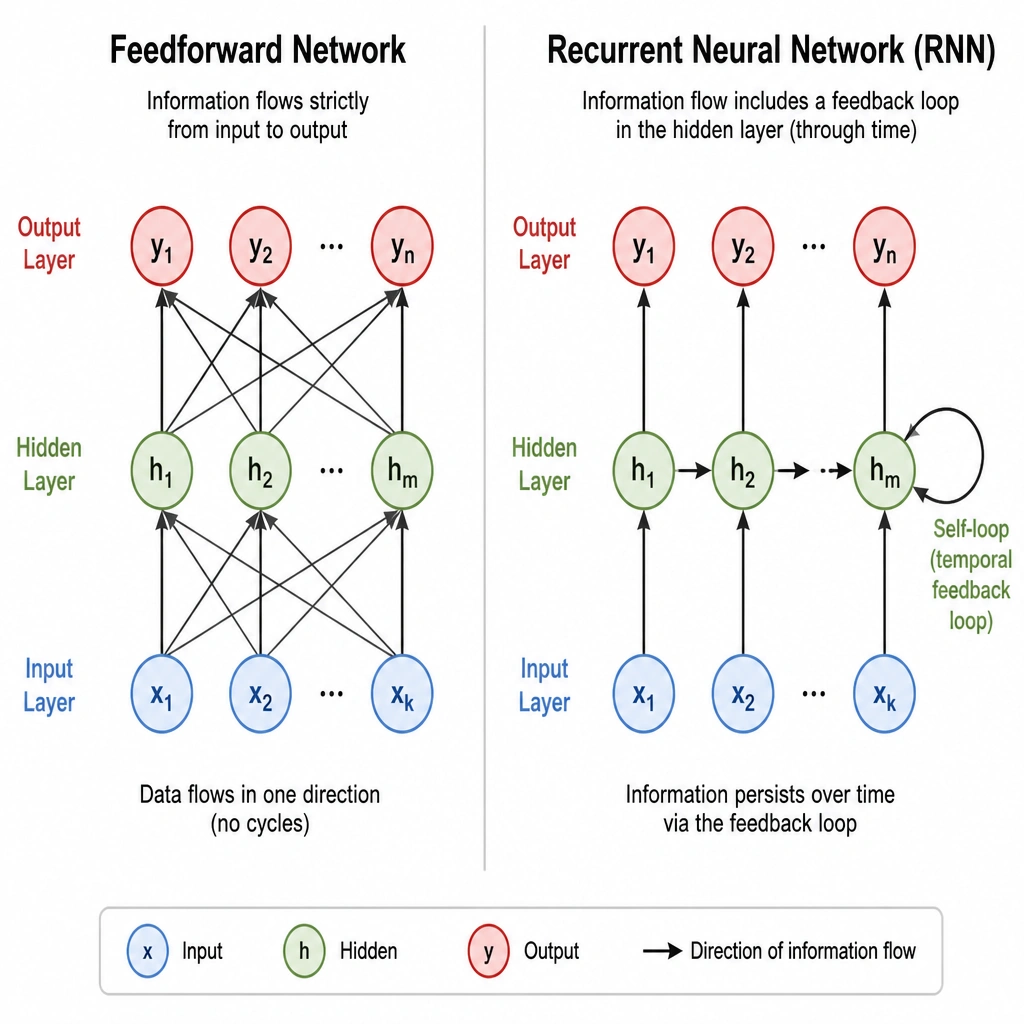
Let's dive in. A standard feedforward network is a one-way street. You feed it data, it does the math, spits out an answer, and immediately forgets what it just did. It treats every single input as completely independent. But what if you're dealing with sequential data like text or time-series? You need memory! That's where Recurrent Neural Networks (RNNs) come in. RNNs have a feedback loop, which means the output of a hidden layer at one step is fed right back in as an input for the next step. This gives the network a memory, allowing it to keep track of sequence context. That makes Option A the absolute winner.
Full explanation below image
Full Explanation
The fundamental difference between Feedforward Neural Networks (FNNs) and Recurrent Neural Networks (RNNs) lies in their architectural topology and how they handle data over time. In a Feedforward Neural Network, the flow of information is strictly unidirectional: from the input layer, through any hidden layers, to the output layer. There are no loops or cycles. Consequently, FNNs assume that all inputs are independent of one another. They have no temporal memory, making them suitable for static data points (like predicting a house price from features) but poorly suited for sequence modeling. In contrast, a Recurrent Neural Network introduces feedback loops (recurrent connections) within its hidden layers. At each step in a sequence, the network processes both the current input and its own hidden state (output) from the previous step. This cyclic structure allows the network to maintain an internal state, or memory, of previous inputs in the sequence. This makes RNNs highly effective for sequential and time-series data, such as natural language processing (NLP), speech recognition, and stock price forecasting. Let's evaluate the distractors: Option B is incorrect because FNNs can be extremely deep (e.g., deep multi-layer perceptrons or ResNets). Option C is incorrect because FNNs and CNNs are used for images, and RNNs are not typically used for static tabular data. Option D is the exact opposite of reality; FNNs have no cycles, while RNNs do. For the exam, remember that FNNs are unidirectional and memoryless, while RNNs feature feedback loops for processing sequential data.