You are training a deep neural network on a GPU and want to find a balance between the speed of Stochastic Gradient Descent (SGD) and the stability of Batch Gradient Descent. You decide to use Mini-Batch Gradient Descent. Which statement accurately describes how Mini-Batch Gradient Descent operates?
Select an answer to reveal the explanation.
Short Explanation and Infographic
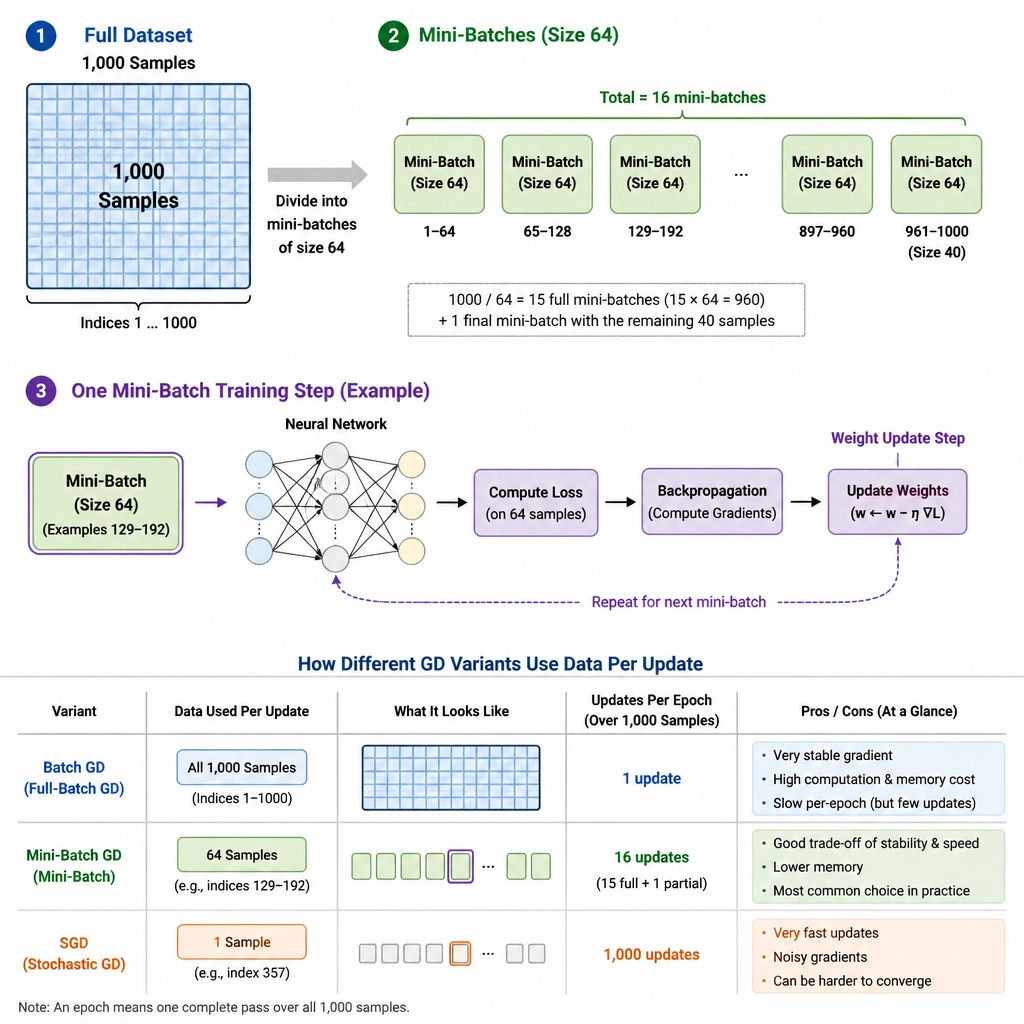
Here's the deal: pure Batch Gradient Descent makes you wait for the whole dataset, which is a total drag on speed. Pure Stochastic Gradient Descent (SGD) updates after every single sample, which is fast but makes your weight updates bounce around like a pinball machine. Plus, updating one sample at a time doesn't let your GPU flex its parallel-processing muscles. So, what do we do in the real world? We split the difference! Mini-Batch Gradient Descent is the gold standard. Think of it like this: instead of evaluating one toy at a time or the entire yard, you pick up a basket of 32 or 64 toys. You process that mini-batch, update your weights, and repeat. This gives you the best of both worlds. You get the speed of frequent updates, but because you're averaging the gradient over a small batch, the path is much smoother than pure SGD. And because modern GPUs love matrix math, processing a batch of 64 values is just as fast as processing one. Pay close attention here, because on the exam, they love to test how this hybrid approach bridges the gap between Batch GD and SGD!
Full explanation below image
Full Explanation
Mini-Batch Gradient Descent is the standard optimization workflow used in modern deep learning. It functions as a hybrid approach that combines the best characteristics of both Batch Gradient Descent and Stochastic Gradient Descent (SGD).
Instead of updating the weights after processing the entire dataset (Batch GD) or after processing a single training example (SGD), Mini-Batch Gradient Descent splits the training dataset into small, manageable subsets called 'mini-batches.' Common batch sizes range from 32 to 512 samples, depending on hardware constraints.
Here is how it operates: 1. Batching: During each training iteration, the optimizer selects a mini-batch of size $N$ from the shuffled dataset. 2. Forward and Backward Pass: The model computes the loss and gradients across these $N$ samples. 3. Weight Update: The gradients are averaged over the mini-batch, and the model's weights are updated once. This process repeats until all mini-batches have been processed, completing one epoch.
Benefits of this approach: - Computational Efficiency: By processing data in batches, it leverages vectorized operations on parallel computing hardware (GPUs and TPUs). This is far more efficient than the sequential updates of pure SGD. - Stable Convergence: Averaging the gradient over multiple samples reduces the noise of individual updates, leading to a more stable convergence path than pure SGD while avoiding the memory bottlenecks of Batch GD.
Let's review the incorrect options: - It processes the entire dataset before updating... This describes Batch Gradient Descent, which is computationally prohibitive for large datasets. - It is only used for classification... Mini-Batch GD is an optimization algorithm and is entirely independent of the task type; it is used for regression, classification, generative tasks, and more. - It updates weights after each individual sample... This describes pure Stochastic Gradient Descent (SGD), which does not process data in batches.