A development team wants to deploy a state-of-the-art text generation model in their application. Why would they choose to use the Hugging Face Transformers library for this project?
Select an answer to reveal the explanation.
Short Explanation and Infographic
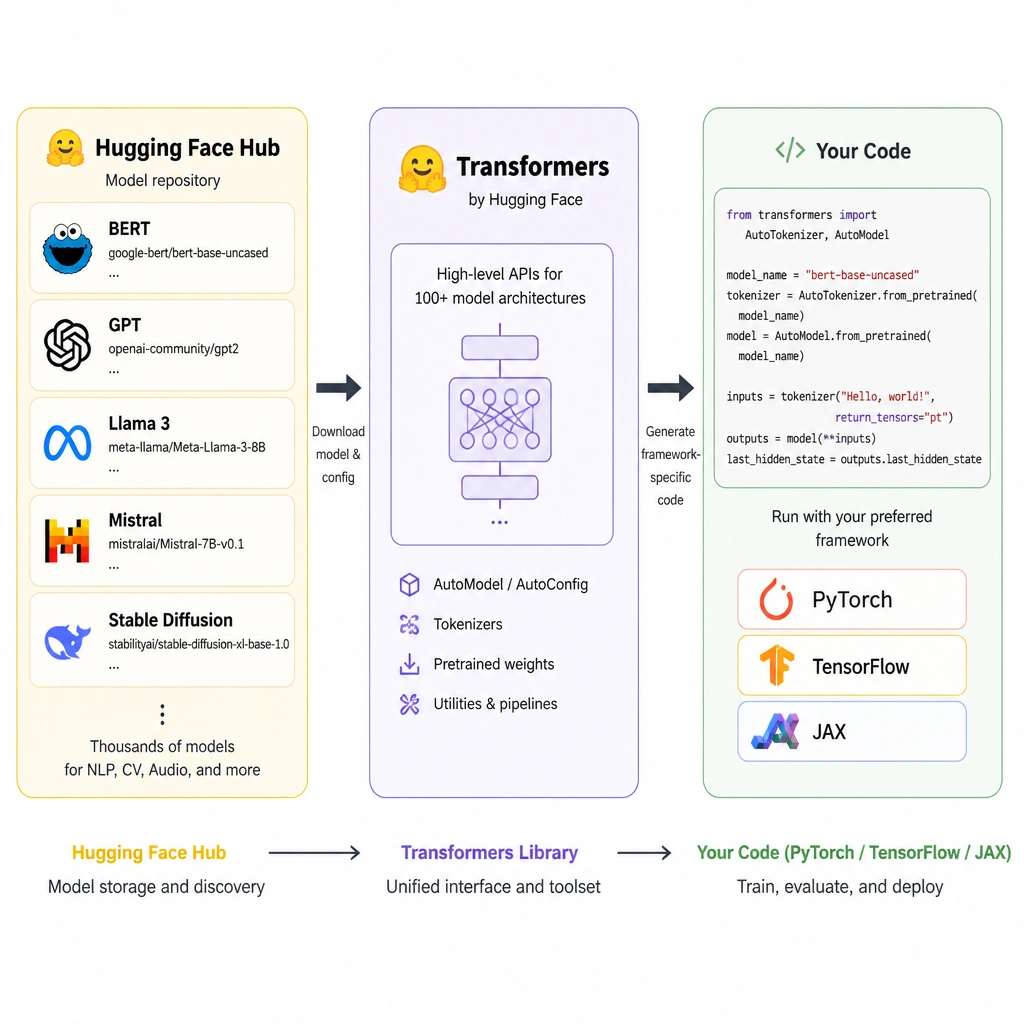
Let me show you how this works in the real world: if you wanted to build a custom language model ten years ago, you had to write pages and pages of complex code, set up massive servers, and spend weeks training it. Now, with the Hugging Face Transformers library, you can download a state-of-the-art model with just a couple of lines of Python code! Think of it like a giant app store for pre-trained AI models. Whether you need a model for translation, text classification, or even image recognition, Hugging Face has it ready to go. The cool thing is that it works seamlessly with both PyTorch and TensorFlow, so you aren't locked into one tool. It saves you an absolute mountain of work. Trust me on this—it is the go-to library for modern AI developers. Got it? Sweet. Let's keep rolling.
Full explanation below image
Full Explanation
The Hugging Face Transformers library is a highly popular open-source library that provides APIs and tools to easily download and train state-of-the-art pre-trained models. - Option B is correct. Its main advantage is that it simplifies the adoption of complex transformer architectures by offering a centralized model hub and a unified programming interface. This interface abstractly handles tokenization, modeling, and pipeline execution for NLP, vision, and audio tasks. - Option A is incorrect. Hugging Face Transformers is not a legacy library; it is a modern, actively maintained framework at the cutting edge of deep learning. - Option C is incorrect. Hugging Face is not a single model, but a library and repository that hosts thousands of different model architectures from various research teams. - Option D is incorrect. The library is famously framework-agnostic, supporting PyTorch, TensorFlow, and JAX, which allows developers to use their preferred ecosystem.