A developer has selected a pre-trained BERT model for a project. Which set of tasks is this model specifically designed to handle effectively through fine-tuning?
Select an answer to reveal the explanation.
Short Explanation and Infographic
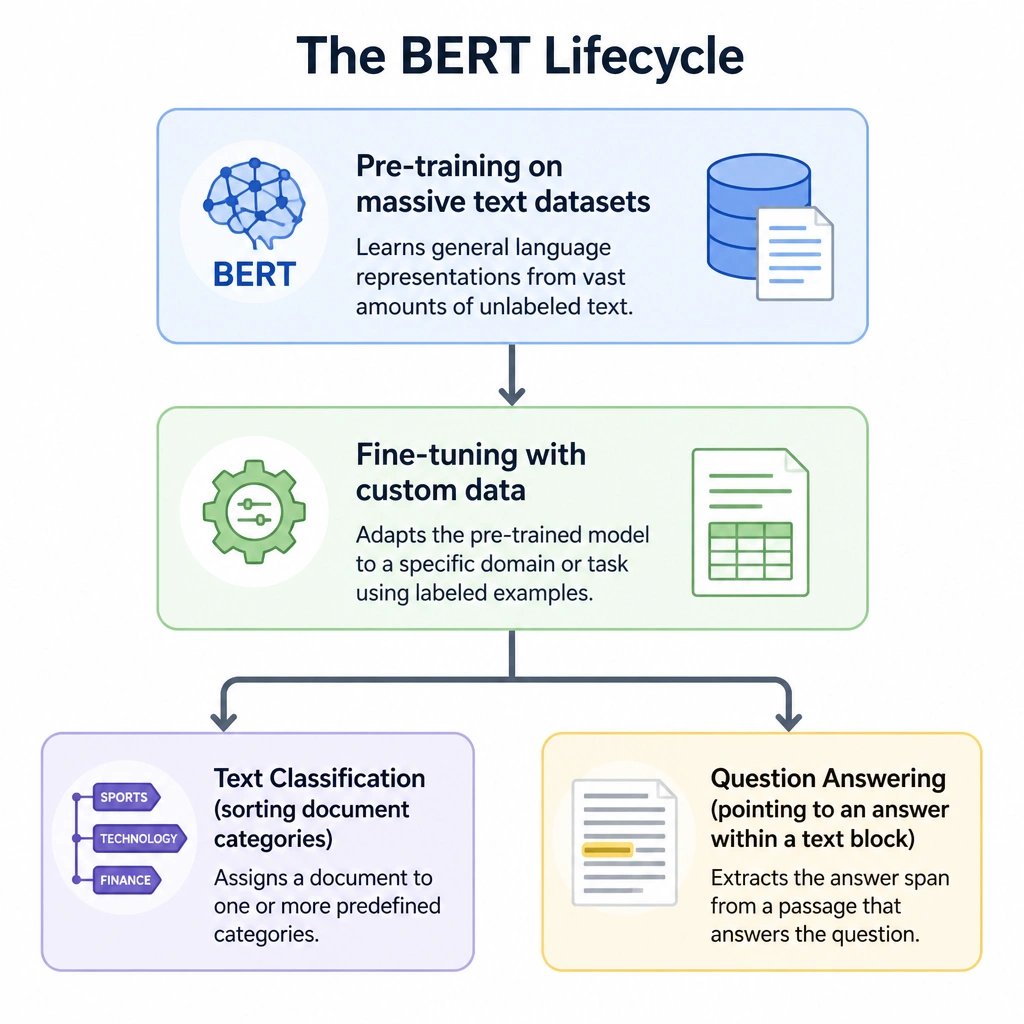
BERT is an absolute beast when it comes to understanding natural language, but you need to know what it's built for. It's a text model, period. You can take a pre-trained BERT model—which already knows a ton about how language works—and fine-tune it with a little bit of your own data to solve specific problems. The classic use cases here are text classification (like sorting emails) and question answering (like building a support bot). You're not going to use it for forecasting stock prices, clustering customer purchasing habits, or finding cats in pictures. Keep BERT in the NLP lane!
Full explanation below image
Full Explanation
BERT (Bidirectional Encoder Representations from Transformers) is a pre-trained language model developed by Google. It is pre-trained on massive text datasets (specifically Wikipedia and BookCorpus) using unsupervised tasks like Masked Language Modeling (MLM) and Next Sentence Prediction (NSP). This pre-training enables the model to acquire a rich, context-aware understanding of human language syntax, grammar, and semantics.
To solve specific real-world problems, developers perform fine-tuning. This involves taking the pre-trained BERT model, adding a relatively simple, task-specific output layer (such as a classification head), and training the entire network on a labeled dataset for a few epochs. Fine-tuning allows the model to adapt its broad linguistic knowledge to targeted tasks with minimal training data and computation. BERT is highly effective for tasks that require deep text comprehension, including text classification (e.g., sentiment analysis, spam detection, topic categorization), question answering (determining where an answer lies within a text passage), named entity recognition (NER), and sentence similarity tasks.
Let's review the incorrect options: - Option A is incorrect because image classification and object detection are Computer Vision tasks. While Vision Transformers (ViTs) exist, BERT is strictly designed for textual input and cannot process raw images. - Option B is incorrect because time series forecasting (such as stock prediction or weather forecasting) involves predicting continuous numerical sequences, typically handled by LSTMs, GRUs, or autoregressive statistical models. - Option D is incorrect because customer segmentation is an unsupervised tabular data clustering task (typically solved using algorithms like K-Means or hierarchical clustering), which is completely unrelated to natural language understanding.