A developer is using the Hugging Face Transformers library to build an email spam classifier. Instead of designing a neural network architecture and training it from scratch, they load a pre-trained model. What is the primary advantage of utilizing a pre-trained model for this classification task?
Select an answer to reveal the explanation.
Short Explanation and Infographic
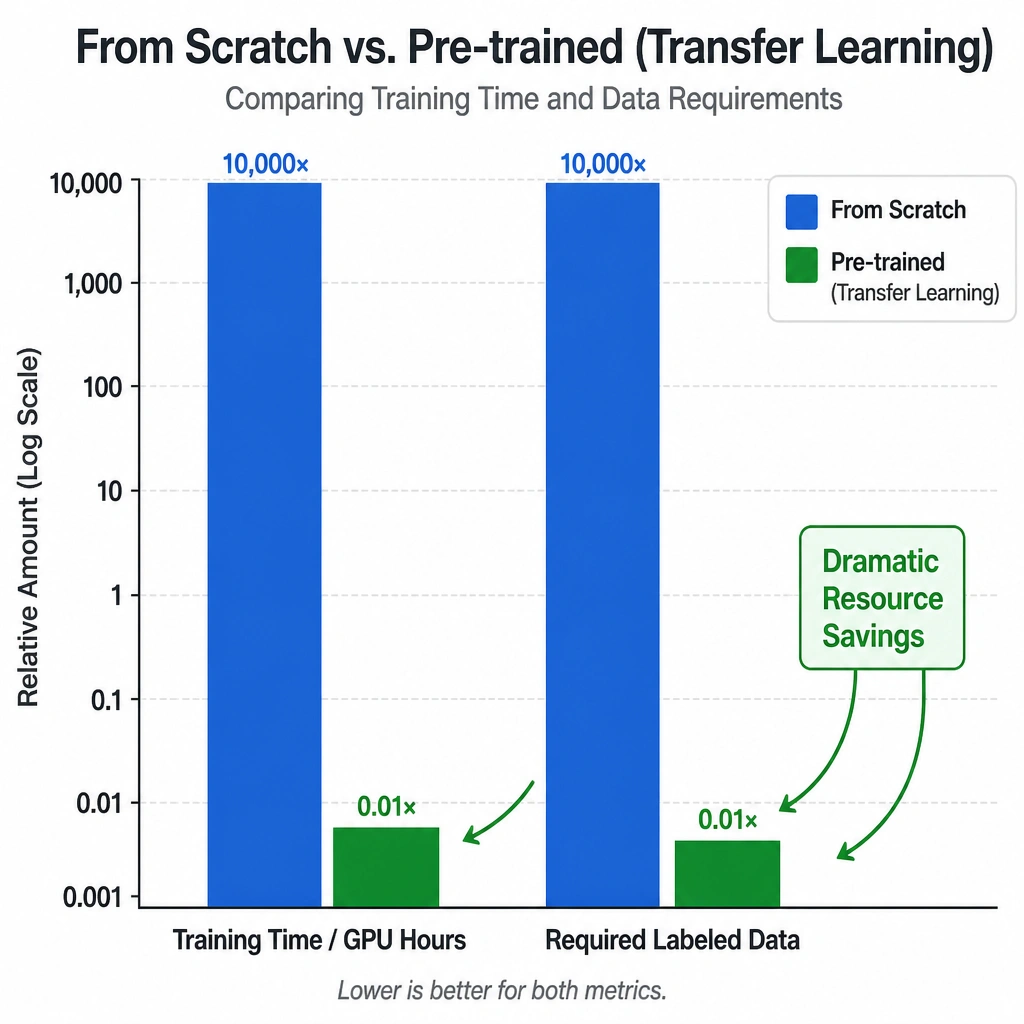
Check this out: if you were to train a text classifier completely from scratch, you would need to feed it hundreds of thousands of labeled examples just so it could figure out what basic words and sentences mean. Plus, you'd be burning through GPU hours (and your budget) like crazy. In the real world, we don't have time for that! By grabbing a pre-trained model off Hugging Face, you're starting with a model that already knows the English language inside and out. All you have to do is show it a small handful of spam and non-spam emails to get it dialed in. It saves you tons of time, tons of data, and a massive amount of computing power. Hopefully you answered A, because leveraging pre-trained models is the ultimate cheat code for developers who want to ship AI features fast.
Full explanation below image
Full Explanation
Using pre-trained models is the cornerstone of transfer learning in modern machine learning. In natural language processing, pre-trained models (such as BERT, RoBERTa, or DistilBERT) are trained on massive, multi-gigabyte corpora of unlabeled text. During this pre-training, the model learns the foundational syntax, semantics, and context of language.
When a developer uses a pre-trained model for a specific task like classification, they only need to perform a process called "fine-tuning." The advantages include: 1. Data Efficiency: Training a deep learning model from scratch requires vast amounts of labeled data (often millions of samples) to avoid overfitting. A pre-trained model already possesses general language features, so it can achieve state-of-the-art performance with only a few hundred or thousand labeled examples. 2. Computational Savings: Pre-training requires weeks of computation on large-scale GPU clusters. Fine-tuning a pre-trained model takes a fraction of that time (minutes to a few hours on a single GPU), which dramatically lowers cloud compute costs and carbon footprints.
Let's break down the incorrect options: - Option B is incorrect because deep learning models, especially large pre-trained transformers, are "black boxes" with millions or billions of parameters. They are notoriously difficult to interpret compared to simpler models like decision trees or logistic regression. - Option C is incorrect because pre-trained models are not guaranteed to be perfect or 100% accurate; performance depends heavily on the quality and representation of the fine-tuning data. - Option D is incorrect because pre-trained models can run on both CPUs and GPUs. In fact, training/fine-tuning them on a CPU is extremely slow and inefficient, making GPU acceleration highly recommended.