When selecting a model for natural language processing tasks like sentiment analysis or named entity recognition, what is the primary architectural advantage of using Google's BERT model?
Select an answer to reveal the explanation.
Short Explanation and Infographic
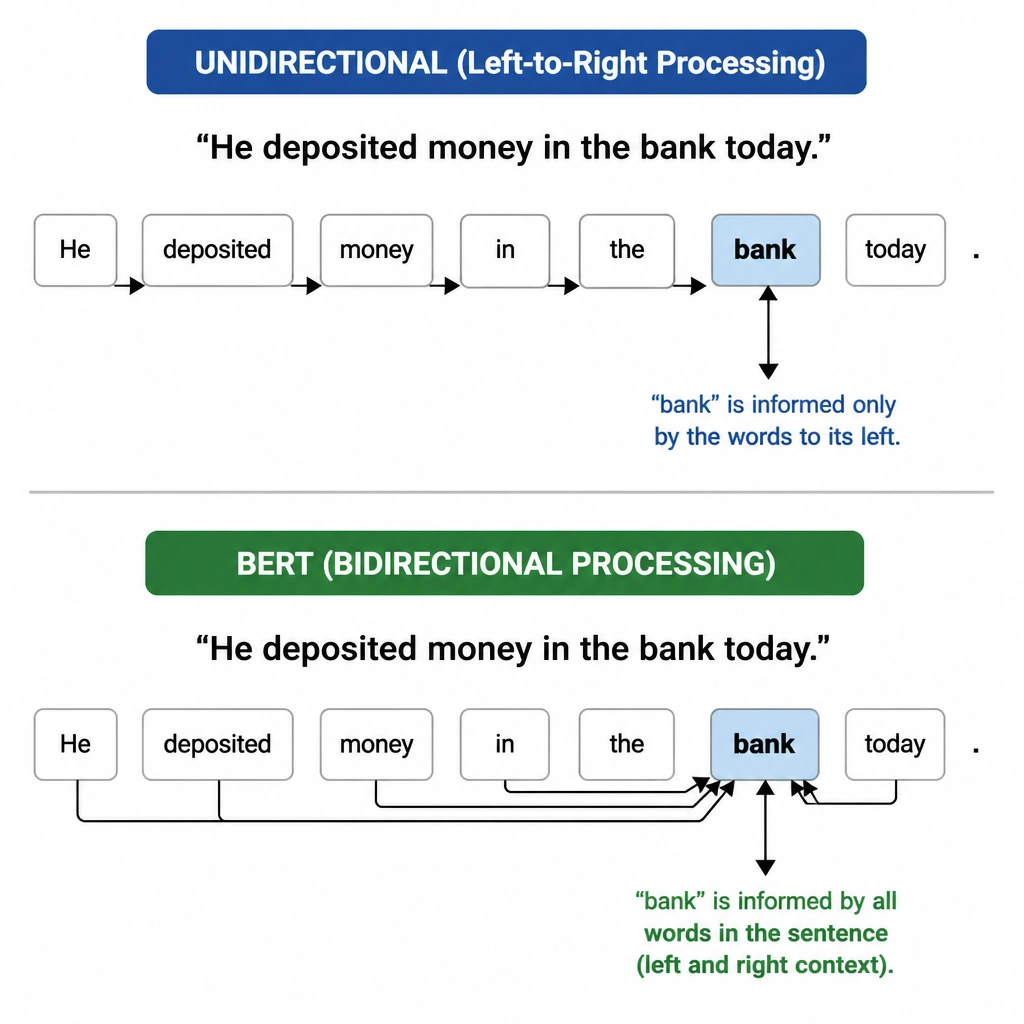
Check this out: before BERT came along, language models were pretty much reading sentences like a person with tunnel vision. They would read from left to right, or from right to left, but they couldn't do both at the same time. Think of the sentence: "The bank of the river." If you only read left to right, when you hit "bank," you don't know if it's a financial bank or the side of a river until you read further. BERT is different. Because it's based on the Transformer encoder, it looks at the words on the left and the words on the right of the target word all at once. That bidirectional context is what makes BERT so incredibly good at understanding the actual meaning of words in a sentence. Hopefully you chose D, because this bidirectional superpower is what set a new standard for NLP.
Full explanation below image
Full Explanation
BERT (Bidirectional Encoder Representations from Transformers), introduced by Google in 2018, is a milestone architecture in natural language processing. The key innovation of BERT lies in its bidirectional training approach.
Traditional language models, such as unidirectional LSTMs or autoregressive models (like the GPT series), are trained to predict the next word in a sequence given the previous words (left-to-right). This prevents them from looking ahead, which is a major limitation for tasks that require a complete understanding of a sentence's context.
BERT solves this by using a Masked Language Model (MLM) pre-training objective: 1. Masked Language Modeling: The model randomly masks (hides) a percentage of the input tokens (typically 15%) and then tries to predict the masked words based on the surrounding context. 2. Bidirectional Context: Because the training objective is prediction of masked tokens rather than next-token prediction, the self-attention mechanism in the Transformer encoder can aggregate context from both the left and right sides of the target token simultaneously across all layers.
This yields contextual representations that are highly effective for downstream tasks like question answering, named entity recognition, and sentence classification.
Let's review the incorrect options: - Option A is incorrect because training BERT from scratch requires immense computational resources (hundreds of GPU/TPU hours) and massive datasets; it is not easily trained from scratch on standard consumer hardware. - Option B is incorrect because BERT is an encoder-only model, not a decoder-only model. It is optimized for understanding/representation tasks rather than generative text tasks (like GPT). - Option C is incorrect because BERT models (BERT-Base has 110 million parameters, BERT-Large has 340 million) are significantly larger and more computationally expensive than traditional RNNs or LSTMs.