Which of the following best describes the primary objective of fine-tuning a pre-trained Large Language Model (LLM)?
Select an answer to reveal the explanation.
Short Explanation and Infographic
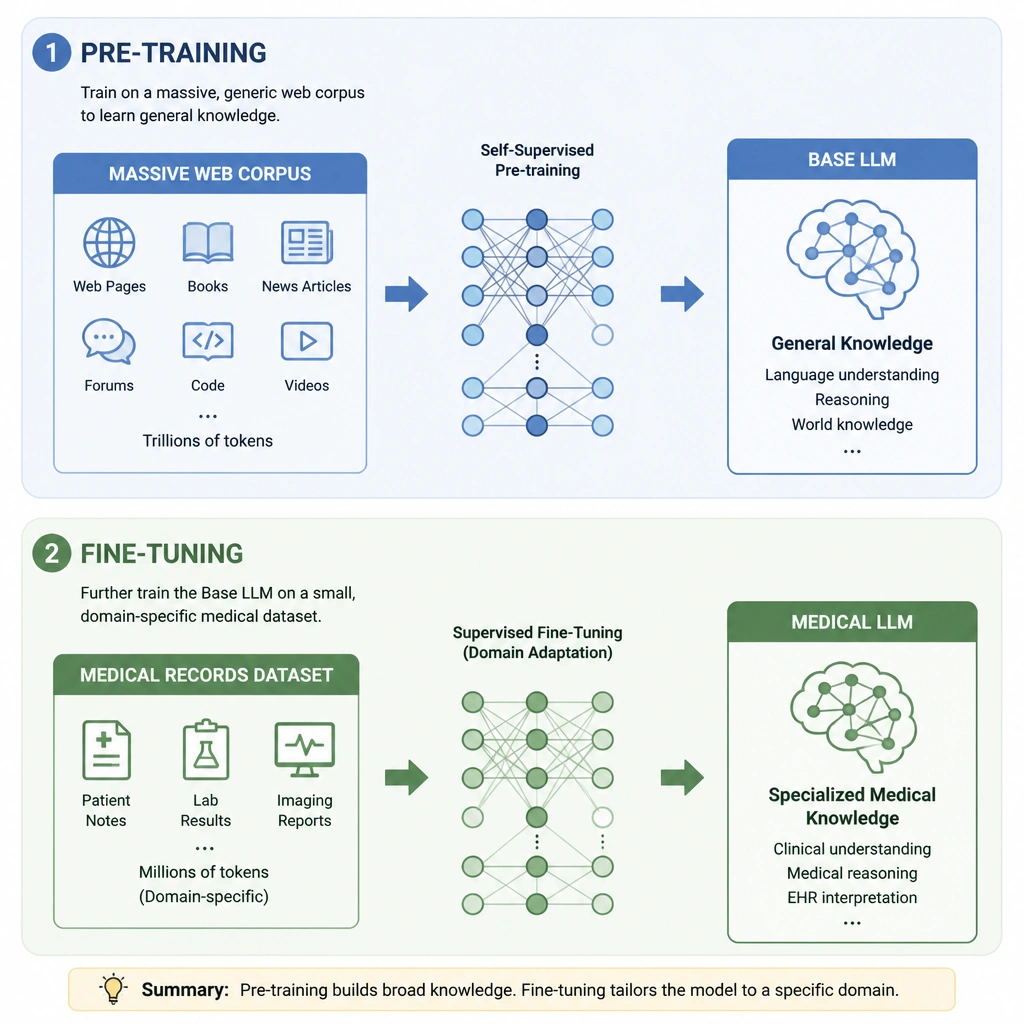
Here's the deal: when a model is pre-trained, it reads the whole internet and learns how to write general sentences. But what if you need it to read medical files or draft legal contracts? It doesn't know the specific jargon or style you want yet. That's where fine-tuning comes in. You take that smart, pre-trained model and do a little extra training on your small, specialized dataset. It's like sending a college graduate to a specialized trade school. You aren't rebuilding the brain from scratch—you're just tuning it for a specific job. Option D is the correct answer.
Full explanation below image
Full Explanation
Fine-tuning is a transfer learning technique where a pre-trained language model is trained further on a target dataset. During initial pre-training, the model learns general language features, grammar, syntax, and broad factual knowledge from massive datasets (like Wikipedia and web crawls) at a very high computational cost.
However, this general model may not perform optimally on highly specialized tasks, such as diagnosing medical symptoms from clinical notes or writing code in a proprietary language. In fine-tuning, the developer takes the pre-trained model and continues training it (performing gradient descent and weight updates) on a much smaller, task-specific dataset. This process adjusts the model's weights to adapt to the specific vocabulary, tone, structure, and objectives of the target domain without losing the general linguistic knowledge acquired during pre-training.
Let's look at why the other options are distractors: - Option A describes model compression or pruning, which is used to reduce model size and accelerate inference, not to adapt it to new tasks. - Option B is incorrect because randomizing weights would destroy the model's learned language capabilities, rendering it useless. - Option C is incorrect because fine-tuning typically preserves the existing model architecture and parameter count rather than increasing complexity or adding new layers.
For the exam, remember that fine-tuning is about adapting a pre-trained model's general capabilities to a specific downstream task using specialized data.