When interacting with a Large Language Model (LLM) to solve a task, what is the meaning of 'zero-shot learning' or 'zero-shot prompt design'?
Select an answer to reveal the explanation.
Short Explanation and Infographic
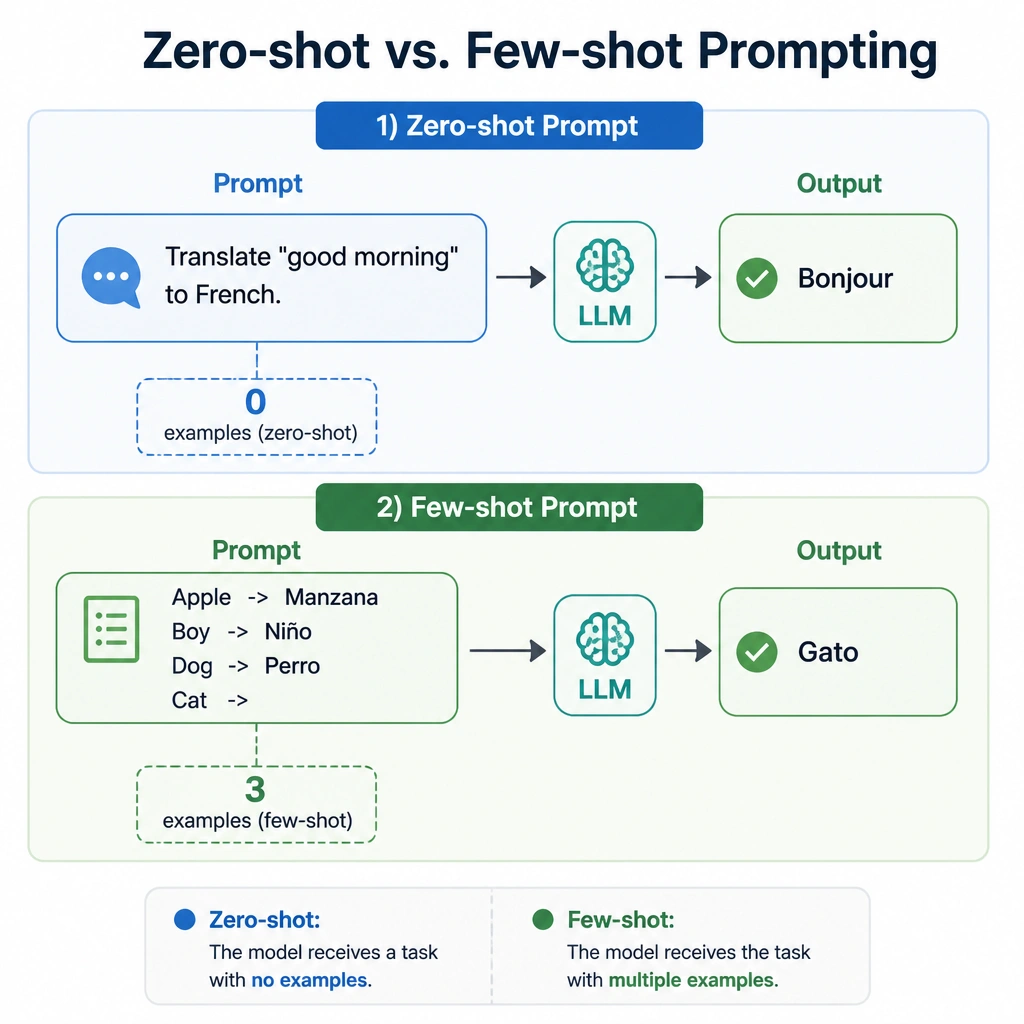
Here's the deal: when you ask an LLM to do something, say, translate a sentence from English to Spanish, you have a few ways to structure your prompt. If you just give it the instruction: 'Translate: Hello, how are you? ->' and it spits out the correct Spanish translation immediately, that is 'zero-shot'. You gave it zero examples of the task! It's relying entirely on the massive general knowledge it picked up during its initial pre-training. If you had given it three translation examples first, that would be 'few-shot'. So Option A is the absolute correct definition here.
Full explanation below image
Full Explanation
Zero-shot learning in the context of Large Language Models (LLMs) refers to the model's ability to perform a task without having received any specific training examples for that task. This capability arises from the model's extensive pre-training on diverse, multi-domain text corpora, which allows it to develop a generalized understanding of grammar, semantics, logic, and instructions.
During inference, the user provides a prompt containing a description of the task (e.g., 'Extract the names of companies from this press release:') followed by the input text. The model processes the instruction and generates the correct output without any gradient updates or weight modifications. This is contrasted with: - Few-shot learning, where a small number of demonstration examples (input-output pairs) are included in the prompt to guide the model's output formatting or style. - Fine-tuning, which involves training the model on thousands of examples to modify its weights.
Let's look at why the other options are wrong: - Option B is incorrect because training a model on 'zero data' is impossible; models require data to learn weights and structure. - Option C is incorrect because a model with zero parameters cannot function or hold any mathematical representations. - Option D is incorrect because setting a model's temperature to zero makes its outputs deterministic (always picking the highest probability token), but does not define zero-shot learning.
For your exam, associate zero-shot learning with executing a task based solely on instruction in the prompt, with no examples provided.