A software engineering team is building an enterprise-grade document processing service that must extract named entities from millions of customer support emails daily. Why would the team choose the spaCy library for this production pipeline instead of other educational NLP toolkits?
Select an answer to reveal the explanation.
Short Explanation and Infographic
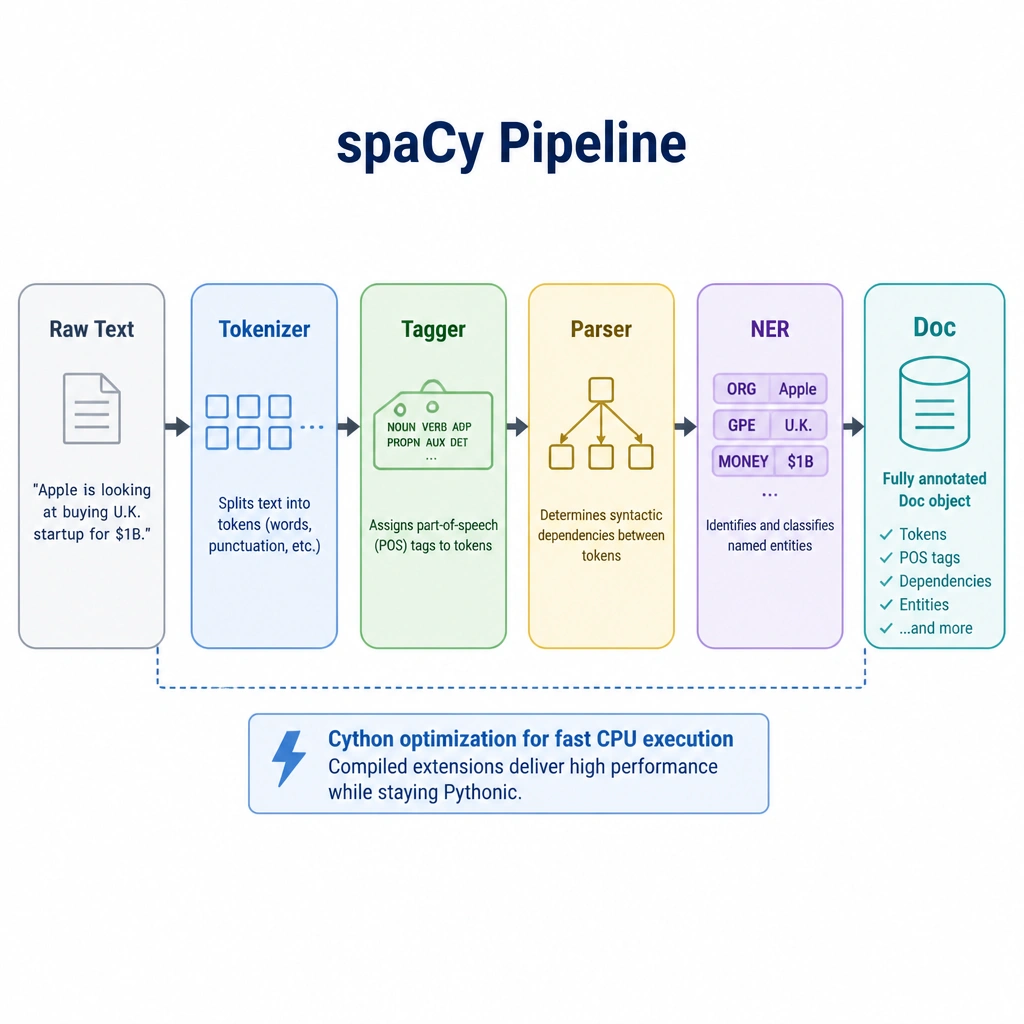
Here's the deal—when you're in school or playing around with simple text processing, you might use a library like NLTK. It's great for learning because it has tons of academic algorithms you can tweak. But imagine your boss walks in on a Monday morning and says, "We need to parse ten million customer emails by Friday to categorize support tickets." If you try to use an academic, unoptimized library for that, your servers are going to melt. That's where spaCy comes in. spaCy was built from day one for the real world—what we call "industrial-strength" NLP. It's written in Cython, which is basically Python compiled down to run at C-speed. It doesn't give you fifty different ways to do sentence splitting; it gives you the single fastest, most accurate way, and wraps it into a clean, ready-to-go pipeline. When you need speed, efficiency, and a system that won't fall over in production, spaCy is your go-to. Keep that in mind: spaCy equals high-speed, production-ready pipelines.
Full explanation below image
Full Explanation
In NLP development, choosing the right tool depends heavily on the production environment's requirements. Academic libraries, such as the Natural Language Toolkit (NLTK), are designed for education and research, providing a wide array of experimental algorithms but often lacking optimization for speed and scale.
spaCy, on the other hand, is specifically designed as an "industrial-strength" library for production environments. Its core features include: 1. High-speed execution: Much of spaCy’s underlying code is written in Cython, which compiles directly to C, making operations like tokenization, part-of-speech tagging, and named entity recognition (NER) significantly faster than pure Python alternatives. 2. Direct pipeline integration: spaCy uses a standardized Doc object and a pipeline architecture (nlp(text)), which processes raw text and passes it through tokenizers, taggers, parsers, and entity recognizers sequentially and efficiently. 3. Opinionated design: Instead of offering multiple alternative implementations for a single task, spaCy provides a single, state-of-the-art implementation, reducing design decisions for developers and ensuring consistency.
Let's evaluate the incorrect options: - Option A is incorrect because spaCy is a Python library typically run on the server side, not a client-side JavaScript library. - Option C is incorrect because spaCy relies on downloadable, pre-trained statistical and transformer-based models which require significant memory and disk space to load. - Option D is incorrect because modern versions of spaCy are compatible with Python 3 and have dropped support for Python 2.