When converting raw text into numerical features for machine learning models, what is the primary technical distinction between a Bag-of-Words (BoW) model and Word Embeddings?
Select an answer to reveal the explanation.
Short Explanation and Infographic
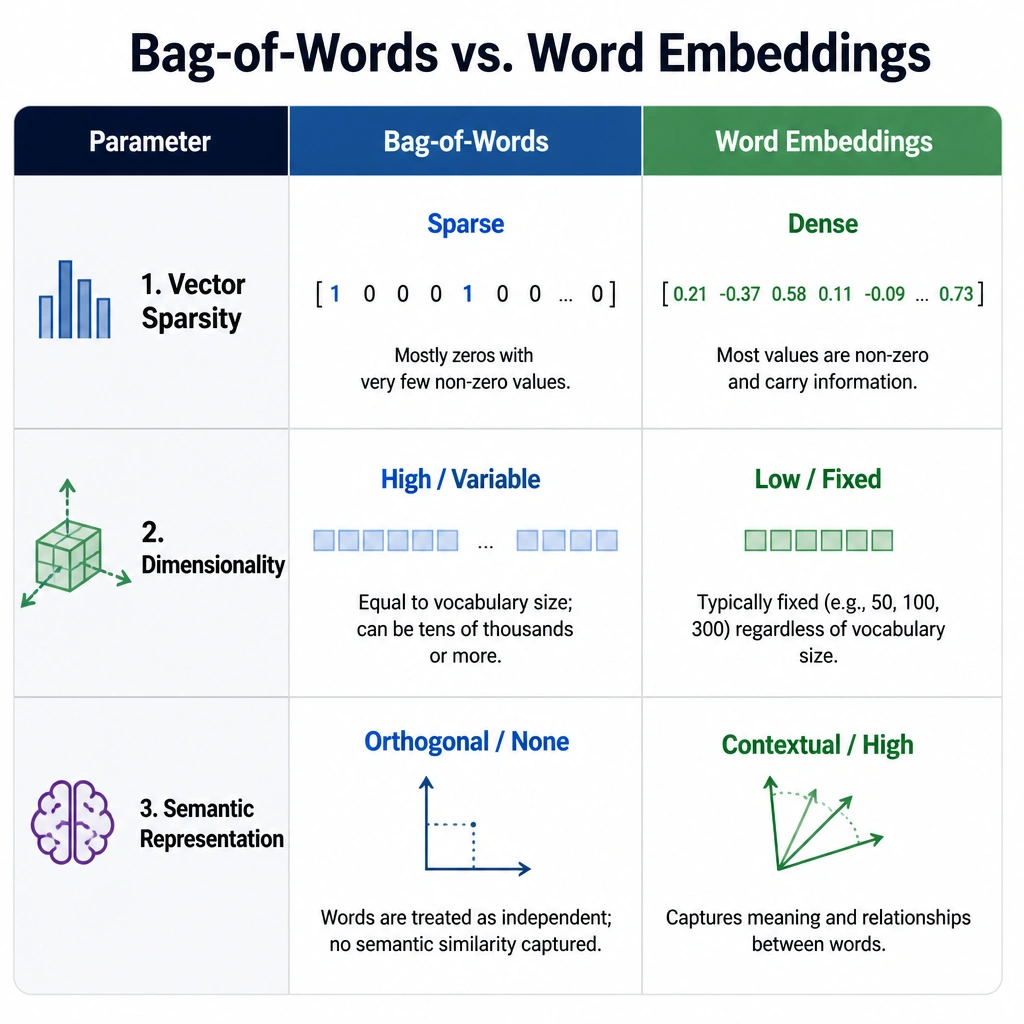
Here's the deal: Bag-of-Words is like a simple inventory check. It looks at a document, counts how many times each word shows up, and writes those counts down in a massive, mostly empty vector. It's high-dimensional, it's sparse (mostly zeros), and it doesn't care about word relationships or grammar. If you have "happy" and "glad" in your document, BoW treats them as completely independent. Word Embeddings are a completely different animal. They map each word to a compact, dense vector of real numbers (usually 100 to 300 dimensions). In this vector space, the mathematical distance between words represents their semantic similarity. That's why Option B is the correct answer.
Full explanation below image
Full Explanation
The choice between Bag-of-Words (BoW) and Word Embeddings represents a shift from sparse, high-dimensional text representations to dense, low-dimensional semantic representations. 1. Bag-of-Words (BoW): - Dimensionality: Equal to the size of the vocabulary ($V$), which can range from thousands to millions. - Sparsity: High. Since a single document contains only a small fraction of the total vocabulary, most vector entries are zero. - Semantic Capture: None. BoW treats each word as an independent dimension. The relationship between "run" and "running" or "giant" and "huge" is lost. - Word Order: Ignored. The sentence "not good, very bad" and "not bad, very good" have the exact same representation. 2. Word Embeddings: - Dimensionality: Low and fixed (typically 50 to 300 dimensions). - Sparsity: Dense. Every entry in the vector is a real-valued number representing a projection in a latent semantic space. - Semantic Capture: High. The vectors capture semantic and syntactic relationships based on context, meaning synonyms are close in the vector space.
Let's review the other options: - Option A is incorrect because standard BoW does not preserve word order, whereas Word Embeddings capture local context during training (though standard embeddings are also combined via averaging/pooling for document-level tasks). - Option C is incorrect because BoW requires no neural training (it is a count), whereas Word Embeddings are learned via neural models (like Word2Vec) or matrix factorization (like GloVe). - Option D is incorrect because both representations can be used across various machine learning tasks, including classification, clustering, and regression.