A machine learning engineer decides to package a newly trained computer vision model inside a Docker container before deploying it to production. What is the primary benefit of using containerization in this deployment strategy?
Select an answer to reveal the explanation.
Short Explanation and Infographic
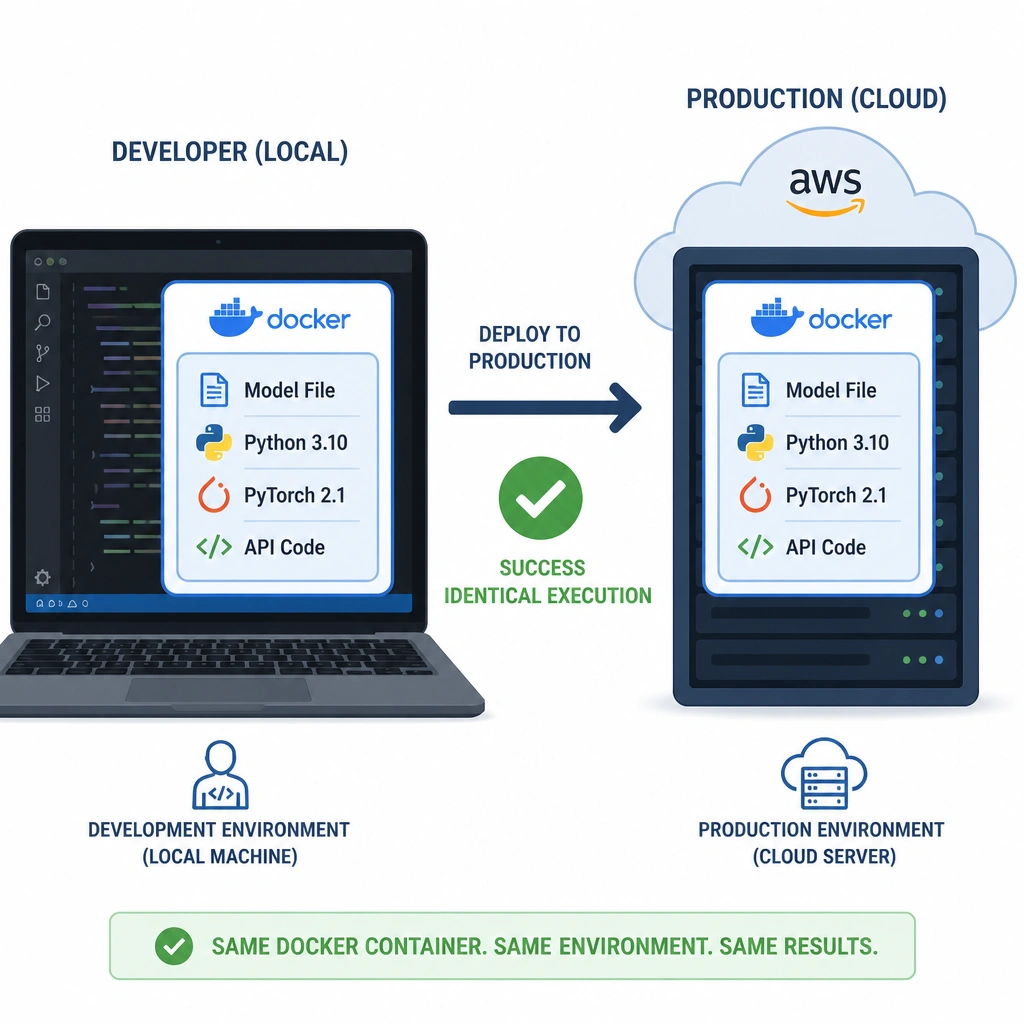
Check this out: I remember when we used to deploy software and someone would inevitably scream, 'But it worked on my machine!' That's a production nightmare. In the machine learning world, you have complex python libraries, specific CUDA versions, and helper files. If your prod server has a slightly different library version than your test machine, the model might crash or give weird results. Docker solves this by wrapping the model, the code, and every single dependency into a single, neat container. Whether it runs on your laptop, a local server, or in the cloud, it runs exactly the same. It doesn't make the model smarter or train faster, but it makes your life a whole lot easier. Trust me on this!
Full explanation below image
Full Explanation
The primary advantage of containerizing machine learning models using Docker is the guarantee of environment consistency and reproducibility, often referred to as solving the dependency hell or 'works on my machine' issue.
In modern machine learning, models rely on a deep stack of software dependencies, including specific versions of programming languages (e.g., Python 3.10), machine learning frameworks (e.g., PyTorch, TensorFlow), utility libraries (e.g., NumPy, Pandas), and system-level libraries (e.g., CUDA drivers for GPU acceleration). Differences in any of these components between the development environment and the production server can lead to runtime crashes, silent performance degradation, or subtle bugs.
Docker addresses this by creating a lightweight, standalone, executable package called a container. The container includes everything needed to run the application: the model weights, application code, runtime environment, system tools, and libraries. This ensures that the container behaves identically whether it is running on a local development laptop, an on-premises test server, or a cloud provider's managed Kubernetes cluster. This consistency simplifies the CI/CD pipeline, reduces deployment risk, and facilitates horizontal scaling.
Let's evaluate the incorrect options: - Option A is incorrect because containerization is a deployment and packaging tool. It does not alter the model's math, weights, or architecture, and therefore has no impact on model accuracy. - Option C is incorrect because Docker is typically used for packaging and serving models, and while containers can be used in training pipelines, they do not inherently speed up the training process or parallelize mathematical operations; that is managed by the training framework and hardware. - Option D is incorrect because containers still run on top of a shared host operating system kernel and require physical hardware resources; they do not eliminate the need for them.