You are building a classification model to categorize incoming support tickets as either "Urgent" or "Routine" based on the text description. Which supervised learning algorithm is a classic, highly effective baseline choice for this type of text classification task?
Select an answer to reveal the explanation.
Short Explanation and Infographic
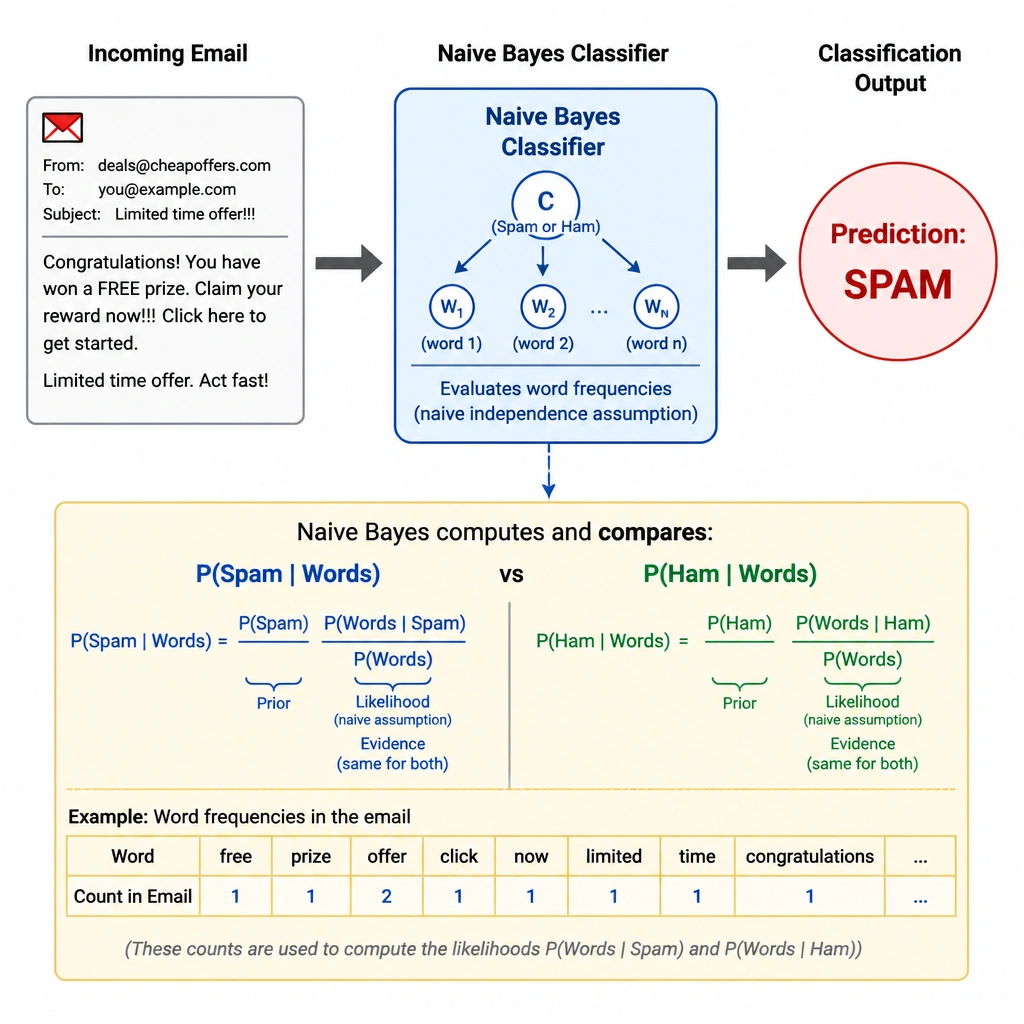
Here's the deal: when you're classifying text—like separating spam from ham, or urgent emails from routine ones—you're looking at word probabilities. If an email contains words like 'win', 'free', and 'millions', there's a high probability it's spam. The Naive Bayes classifier is a classic supervised algorithm that excels at this. It's fast, simple, and works incredibly well with text data because it uses probability theory (Bayes' theorem) under the hood. Algorithms like K-Means and DBSCAN are unsupervised clustering algorithms—they don't use labels at all. And PCA is just for shrinking your data dimensions. So for this classification job, Naive Bayes is your go-to. Trust me on this!
Full explanation below image
Full Explanation
For text classification tasks such as spam filtering or sentiment categorization, the Naive Bayes classifier is a highly effective and computationally efficient supervised learning algorithm.
Naive Bayes is based on Bayes' Theorem, which calculates the probability of a hypothesis (in this case, a class label like 'Urgent' or 'Routine') given prior knowledge (the words present in the document). The algorithm is called 'naive' because it operates under the assumption of conditional independence: it assumes that the presence of a particular feature (word) in a class is completely unrelated to the presence of any other feature, given the class label. Although this assumption rarely holds true in natural language (where word order and context matter), Naive Bayes performs surprisingly well in practice. It requires relatively little training data to estimate the necessary parameters and is highly scalable to large vocabularies.
Let's break down why the other options are incorrect: - Option A (Principal Component Analysis or PCA) is an unsupervised dimensionality reduction technique. It is used to project high-dimensional data into a lower-dimensional space to simplify analysis or speed up other models, not to perform classification. - Option C (K-Means) is an unsupervised clustering algorithm. It groups data points into $K$ clusters based on distance metrics without using labels, meaning it cannot be trained to predict predefined categories like 'Urgent' or 'Routine'. - Option D (DBSCAN - Density-Based Spatial Clustering of Applications with Noise) is also an unsupervised clustering algorithm. It groups data points based on density (spatial proximity) and is used to discover clusters of arbitrary shapes and identify outliers, not for supervised classification.