A developer is using a pre-trained BERT (Bidirectional Encoder Representations from Transformers) model for a text classification task. What is the defining architectural characteristic of the BERT model?
Select an answer to reveal the explanation.
Short Explanation and Infographic
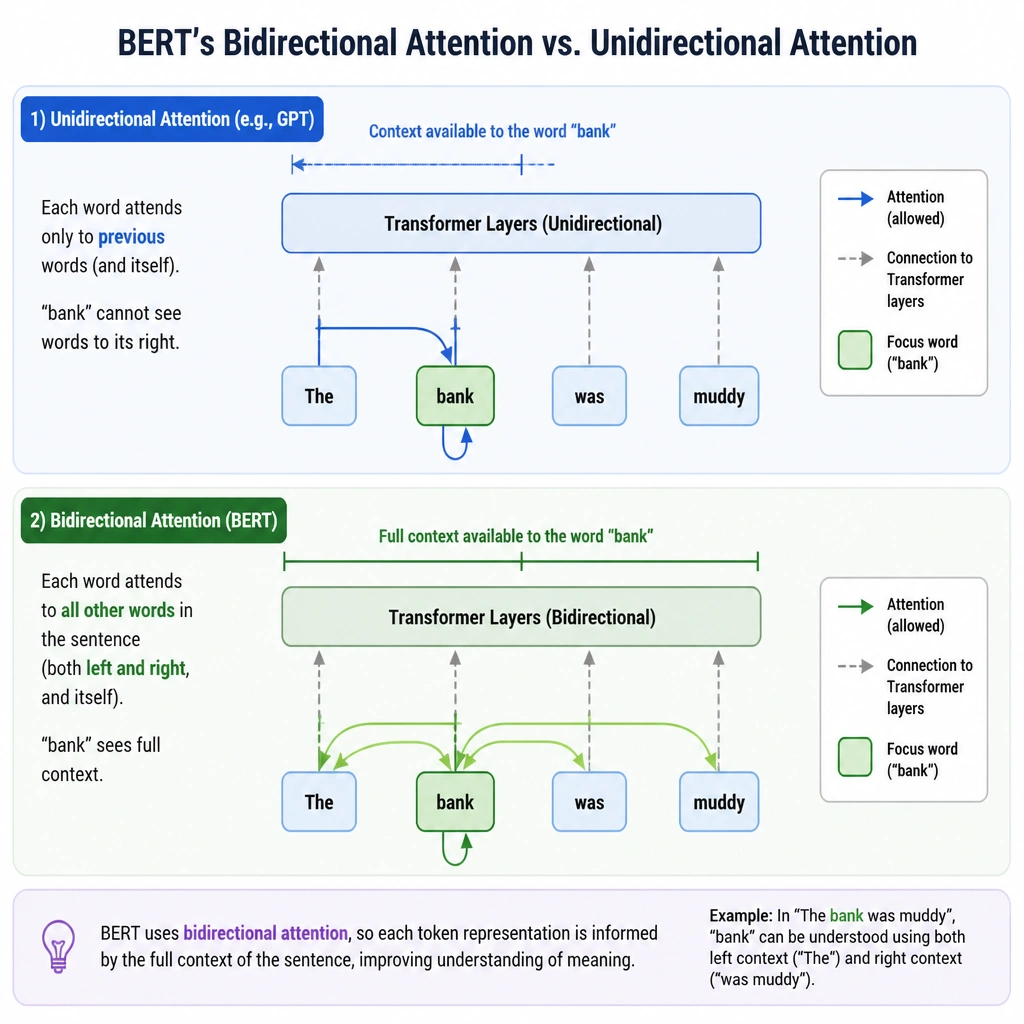
Okay, let's look at BERT. Before Transformers took over the natural language processing world, we had to process text one word at a time, sequentially—usually from left to right. But language doesn't work that way! The word "bank" can mean the side of a river or a financial institution, and you need to look at both the words before and after it to know which is which. BERT stands for Bidirectional Encoder Representations from Transformers. That "bidirectional" part is the secret sauce. By using the Transformer's encoder architecture, it looks at the entire sentence at the exact same time, capturing context from both directions simultaneously. That's why Option A is the absolute winner.
Full explanation below image
Full Explanation
BERT (Bidirectional Encoder Representations from Transformers) is a landmark language model developed by Google. Its primary architectural characteristic is its use of the Transformer encoder, which utilizes self-attention to model bidirectional context. Unlike traditional sequential models like LSTMs or unidirectional models (like GPT, which are autoregressive decoders that process text left-to-right), BERT reads the entire sequence of words at once. This non-directional approach allows the model to learn the context of a word based on all of its surroundings (both left and right of the word) across all layers.
Let's check the distractors: - Option B is incorrect because BERT is a Transformer-based model, not a recurrent model (RNN/LSTM). Transformers replaced recurrence with self-attention to allow parallel processing. - Option C is incorrect because BERT is a language model designed for Natural Language Processing (NLP), not spatial image classification. - Option D is incorrect because it describes autoregressive decoder models (like the GPT series), which are unidirectional (left-to-right) and designed for text generation rather than bidirectional context representation.
For the exam, remember that BERT uses the Transformer encoder, making it inherently bidirectional in its attention mechanism.