A DevOps engineer recommends using Kubeflow to support the machine learning team's operations. What is the primary benefit of deploying Kubeflow for machine learning workflows?
Select an answer to reveal the explanation.
Short Explanation and Infographic
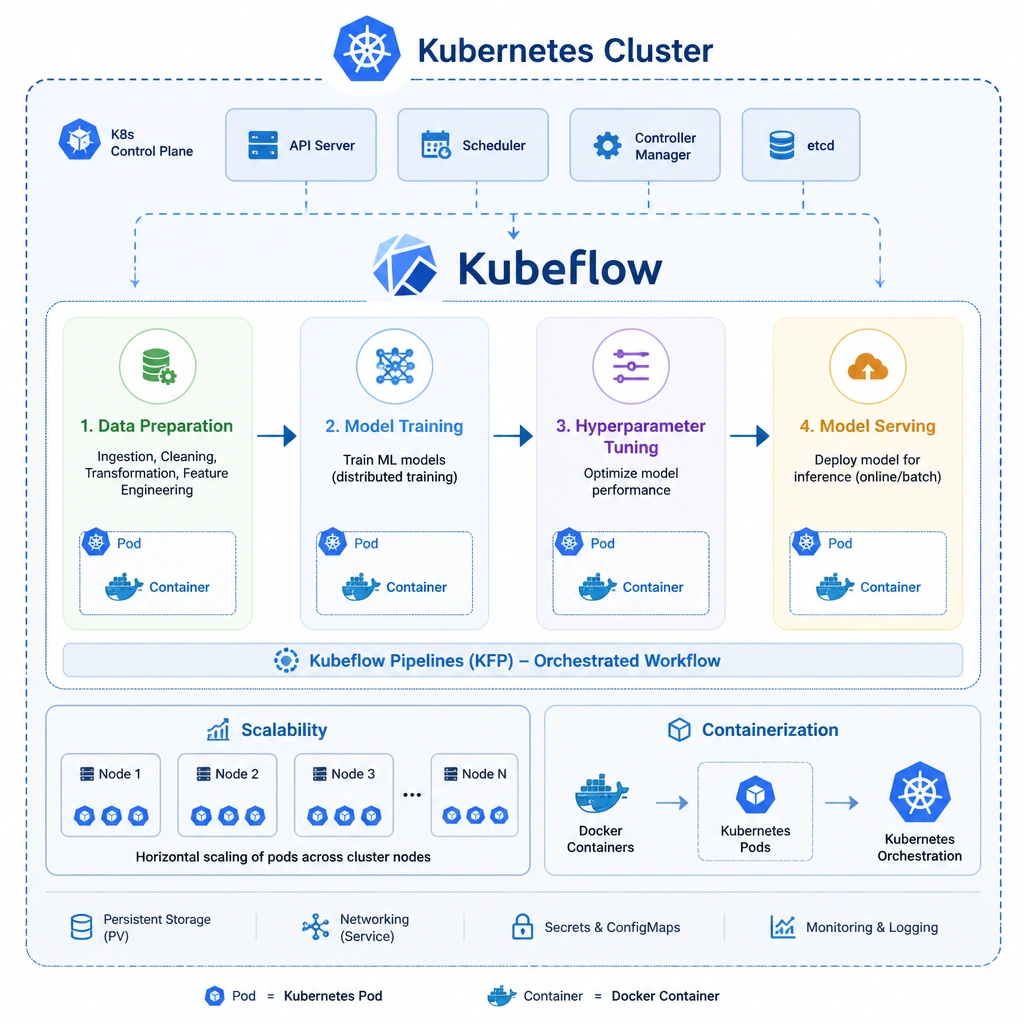
Okay, let's dive in. Training a model on your laptop is easy, but what happens when you need to scale up, run automated pipelines, tune hyperparameters on a massive cluster, and then deploy the model to production? Doing all of that manually is a nightmare. That's where Kubeflow comes to the rescue. It's a platform built specifically on top of Kubernetes. Because it runs on Kubernetes, it can orchestrate your entire ML pipeline—from cleaning data to training and serving—while making sure it's portable and can scale up to handle massive workloads across clusters. Option D is exactly what makes Kubeflow a heavy hitter in the MLOps space.
Full explanation below image
Full Explanation
Kubeflow is an open-source project dedicated to making machine learning workflows on Kubernetes simple, portable, and scalable. It provides a cloud-native platform for orchestrating and managing the complete ML lifecycle. Kubeflow includes components such as Kubeflow Pipelines (for orchestrating multi-step ML workflows), Katib (for automated hyperparameter tuning), and integrations with training operators (like TFJob and PyTorchJob) and serving frameworks (like KFServing/KServe). By running natively on Kubernetes, Kubeflow ensures that ML workloads can be scale-tested, reproduced, and easily moved between local development environments, on-premises clusters, and public clouds.
Let's check the distractors to see why they are incorrect: - Option A is incorrect because code versioning is managed by tools like Git, not Kubeflow. - Option B is incorrect because while Kubeflow includes UI components for pipeline tracking and runs, it is not a dedicated business intelligence or data visualization dashboarding tool. - Option C is incorrect because Kubeflow is an enterprise-grade orchestration platform, not a simple local text editor or script runner.
For the exam, remember that Kubeflow leverages Kubernetes to orchestrate and scale end-to-end machine learning pipelines.