Once a machine learning model is trained and validated, it is often deployed behind a RESTful API. What is the primary purpose of this approach during the model serving phase?
Select an answer to reveal the explanation.
Short Explanation and Infographic
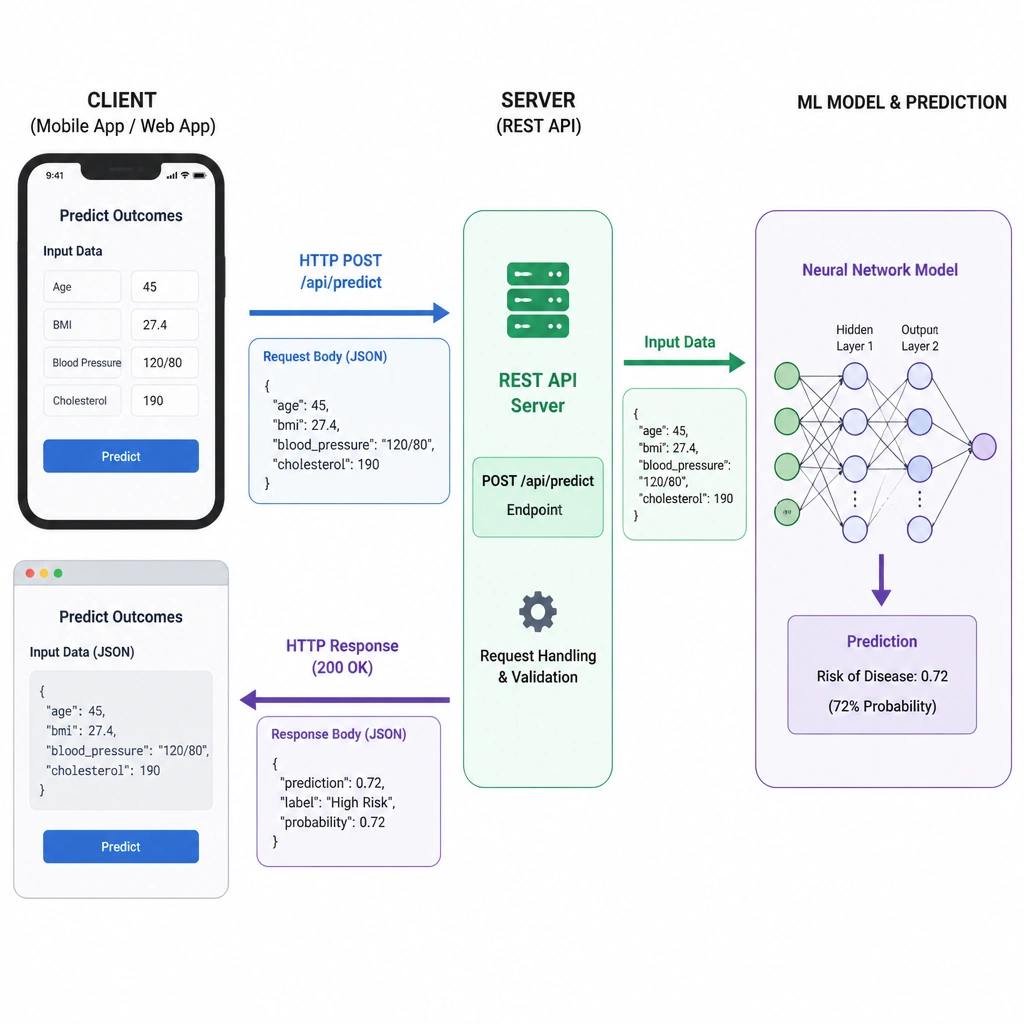
Imagine your boss walks in and says, 'Our data science team built a killer recommendation model, and now our web developers need to use it in our mobile app.' How do you connect the two? You don't want to bundle the entire model and its dependencies inside the mobile app—that would make the app download massive! Instead, you deploy the model on a server and expose it through a RESTful API. Now, whenever the mobile app needs a recommendation, it simply sends a standard HTTP request containing the user's data to the server, the server runs the model, and it sends the predictions back to the app in a split second. Nice and clean. Option A is the right answer.
Full explanation below image
Full Explanation
Deploying a machine learning model behind a RESTful (Representational State Transfer) API is a standard practice for model serving and inference. The RESTful API acts as an interface between the deployed model and client applications (such as web browsers, mobile apps, or other microservices).
When a client needs a prediction, it sends an HTTP/HTTPS request (typically a POST request carrying a JSON payload of features) to the API endpoint. The model serving framework receives the request, parses the input data, passes it through the model to perform forward-pass inference, and returns the output predictions back to the client in the HTTP response. This decouples the model's complex runtime environment (e.g., Python, TensorFlow, PyTorch) from the client applications, which can be written in any programming language that supports standard HTTP communication.
Let's look at why the other options are incorrect: - Option B is incorrect because data preprocessing (like normalization or feature engineering) is part of data preparation, not the primary purpose of the RESTful API itself, although lightweight preprocessing is often performed as a step inside the serving container before inference. - Option C is incorrect because model version control is handled by model registries or Git, not the serving API. - Option D is incorrect because model training is a resource-intensive process executed during development, whereas a serving API is strictly for running inference (predictions) on already-trained models.
For the exam, associate RESTful APIs with model serving and facilitating real-time inference over HTTP.