A marketing analytics team wants to group their active customers into distinct segments based on historical purchasing frequency, average order value, and product categories. The database has no pre-existing segment tags or labels for these customers. Which branch of machine learning should the team use to discover these natural groupings?
Select an answer to reveal the explanation.
Short Explanation and Infographic
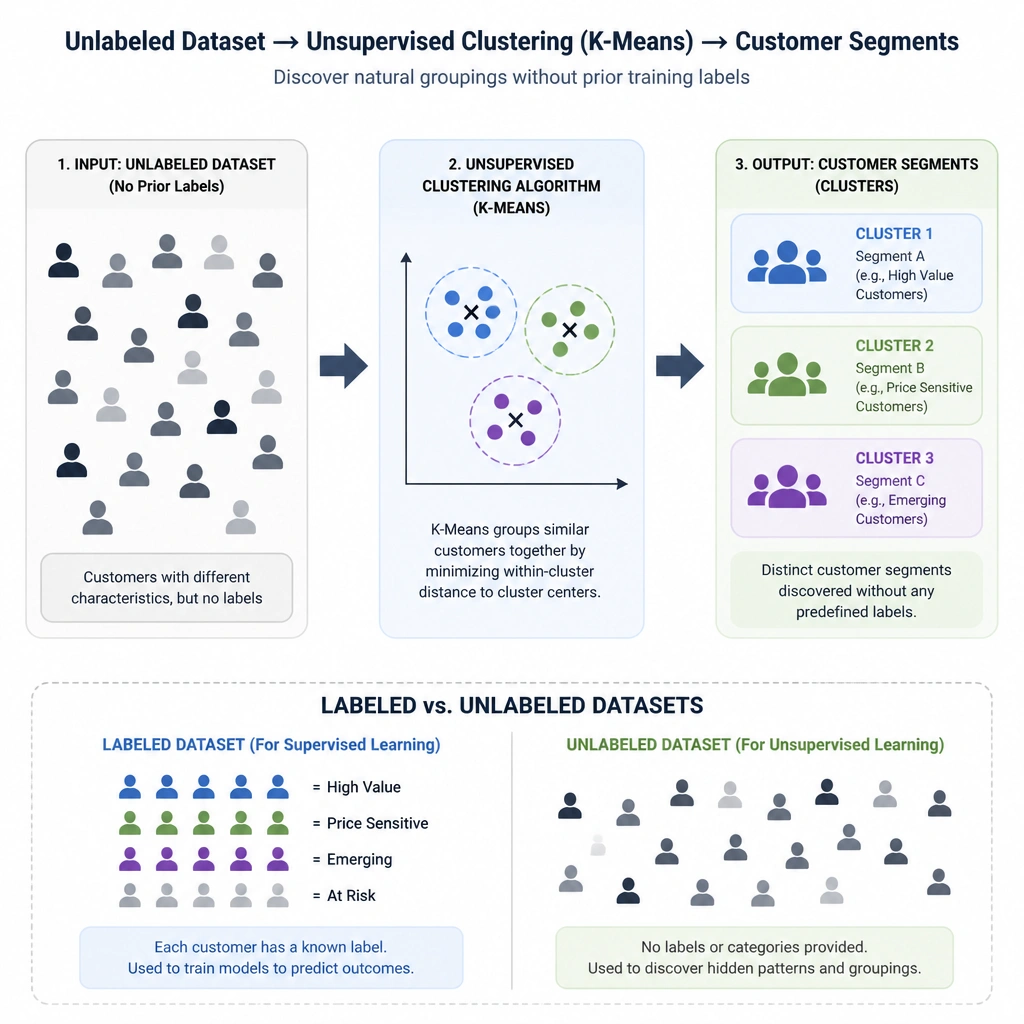
Here's the deal: you've got a pile of customer data but zero labels or categories telling you who is who. If you don't have predefined labels or a "ground truth" to train your model on, supervised learning is out of the question. You need the model to do the heavy lifting and find hidden patterns or groupings all by itself. Think of it like dumping a massive bucket of unsorted Lego blocks on the floor and telling someone to group them by similarity without giving them any instructions. That's classic unsupervised learning! We use clustering algorithms like K-Means or hierarchical clustering to get this done in the real world. Got it? Let's keep rolling!
Full explanation below image
Full Explanation
Unsupervised learning is a category of machine learning where models are trained on unlabeled data. The primary objective is to identify underlying patterns, structures, or groupings within the dataset without human intervention or predefined categories. In this customer segmentation scenario, the model analyzes input features—such as purchase history, spending habits, and frequency—and groups similar data points together using clustering techniques like K-Means clustering, DBSCAN, or hierarchical clustering. Because there is no target label (or "ground truth") to guide the training, the system relies entirely on mathematical distances or statistical distributions to determine similarity.
Let's look at why the other options do not fit: - Supervised learning requires labeled training data, meaning each customer record would already need a known segment label. The model would learn the relationship between features and these labels to predict categories for new customers, which is not the case here since no labels exist. - Reinforcement learning involves an agent learning to make decisions by performing actions in an environment to maximize a cumulative reward. It operates on a feedback loop of trial and error (actions, states, and rewards) rather than analyzing static historical datasets for grouping. - Semi-supervised learning uses a small amount of labeled data combined with a large amount of unlabeled data. While it could theoretically be applied if some customer profiles were pre-labeled, the scenario explicitly states there are no predefined labels at all, making unsupervised learning the correct and most direct choice.