An MLOps engineer packages a trained machine learning model and its dependencies into a Docker container. What is the primary advantage of containerizing the model for deployment?
Select an answer to reveal the explanation.
Short Explanation and Infographic
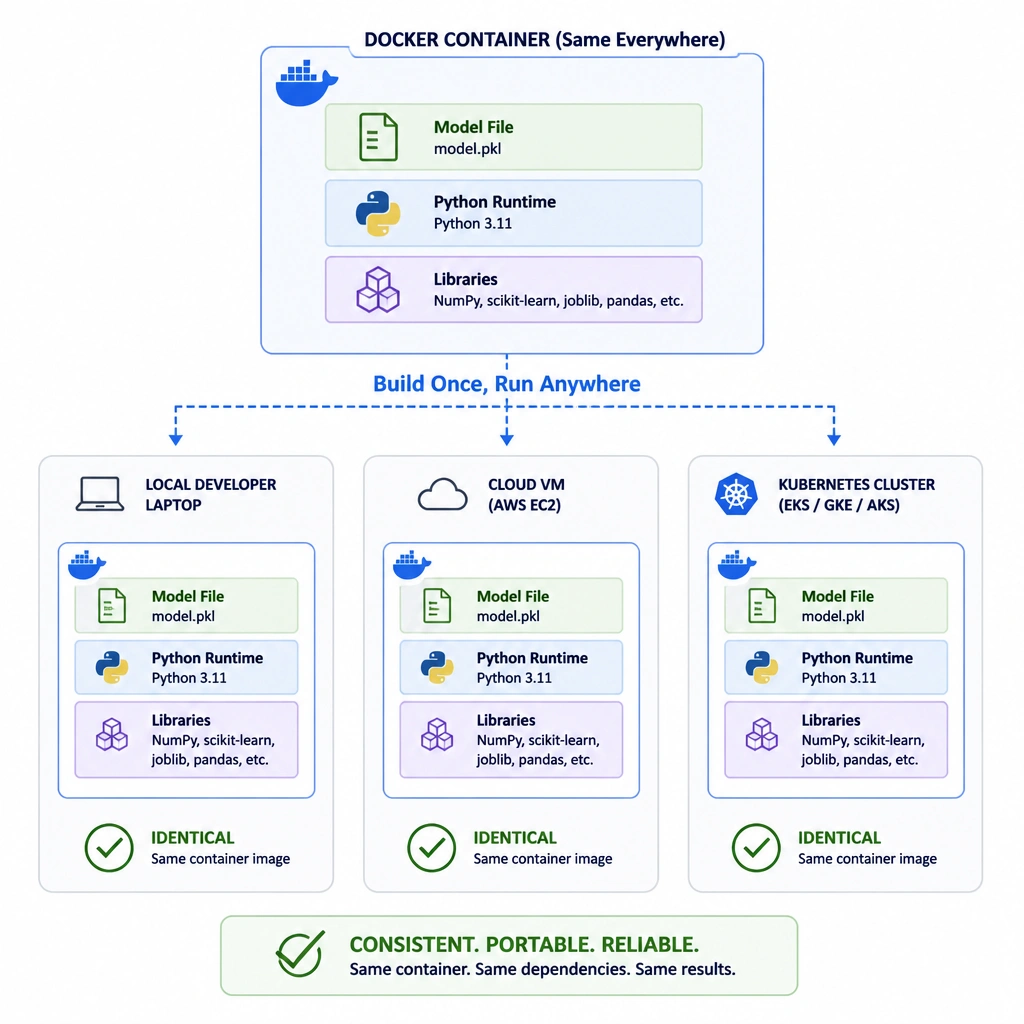
I remember when we used to deploy software and someone would say, "Well, it worked on my machine!" That's a total nightmare in production. With machine learning, you have specific versions of Python, library dependencies like PyTorch or TensorFlow, and system files. If any of those are different on the production server, your model will break. Docker solves this by wrapping your model, dependencies, and environment configuration into a neat little package called a container. It runs the exact same way on your laptop, the testing server, or in the cloud. It isolates everything so you don't get version conflicts. That consistency is why containerization is a cornerstone of MLOps!
Full explanation below image
Full Explanation
Containerization using tools like Docker involves packaging an application, its dependencies, libraries, binaries, and environment configurations into a single container image. In MLOps (Machine Learning Operations), containerizing models ensures environment reproducibility and isolation. This guarantees that the model will behave identically regardless of whether it is running on a developer's local machine, a staging server, or a highly scaled Kubernetes cluster in production. It prevents the "dependency hell" scenario where libraries (such as specific versions of CUDA, TensorFlow, or NumPy) conflict with other applications hosted on the same server.
Let's look at why the other options are incorrect: - Automating manual tasks (Option B) is handled by workflow orchestrators (like Airflow, Prefect, or Kubeflow) and CI/CD pipelines, not the containerization layer itself. - Reducing training duration (Option C) is not a benefit of Docker. Docker introduces a tiny virtualization overhead; speed improvements come from optimized hardware (GPUs/TPUs) or distributed training frameworks. - Compressing model weight files (Option D) is accomplished via techniques like quantization, pruning, or model distillation, not by wrapping the application in a Docker container.