An autonomous vehicle manufacturer is designing the emergency collision avoidance module for its self-driving system. What represents the primary ethical consideration that developers and policy makers must address for this critical AI application?
Select an answer to reveal the explanation.
Short Explanation and Infographic
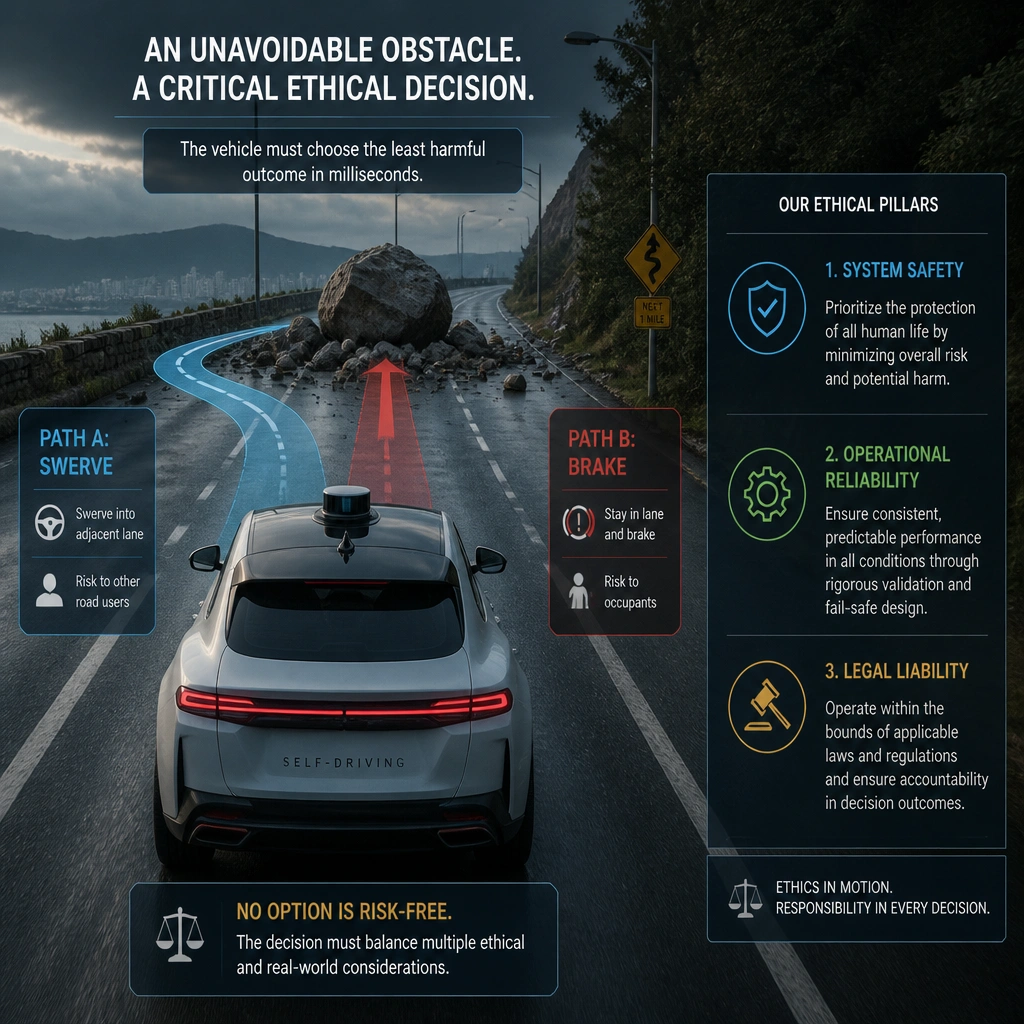
Imagine you're building the software for an autonomous vehicle. Your boss walks in and says, 'We need this car on the road by Friday.' But here's the catch: what happens if the car has to choose between hitting a pedestrian or swerving into a wall and hurting the passenger? That's a classic ethical dilemma. It's not about how fast the model trains, and it's definitely not about how much we spent on GPUs. It's about safety, reliability, and liability. Who gets sued when something goes wrong? The programmer? The driver? The manufacturer? Pay close attention here, because critical systems like self-driving cars demand bulletproof safety standards and clear legal accountability before they ever hit the asphalt.
Full explanation below image
Full Explanation
When developing AI for safety-critical systems like autonomous vehicles, the primary ethical considerations center on safety, reliability, and liability. Because these systems make decisions in physical environments where human lives are at risk, they must be engineered to minimize harm and operate reliably under unpredictable conditions. - Option C is correct because developers must address moral decision-making frameworks (e.g., how the vehicle prioritizes human lives during an unavoidable collision) and establish clear lines of legal and ethical liability among the software engineers, manufacturers, and owners. - Option A (computational latency) and Option B (dataset size) are technical engineering constraints, not ethical considerations. - Option D (financial cost) is a business constraint, which is secondary to the primary ethical duty of protecting human life.