Your customer support team is overwhelmed by the volume of daily product reviews and emails. To help them prioritize response efforts, you want to build an NLP system that reads the incoming text and automatically labels each message as positive, negative, or neutral. Which NLP task is designed to solve this problem?
Select an answer to reveal the explanation.
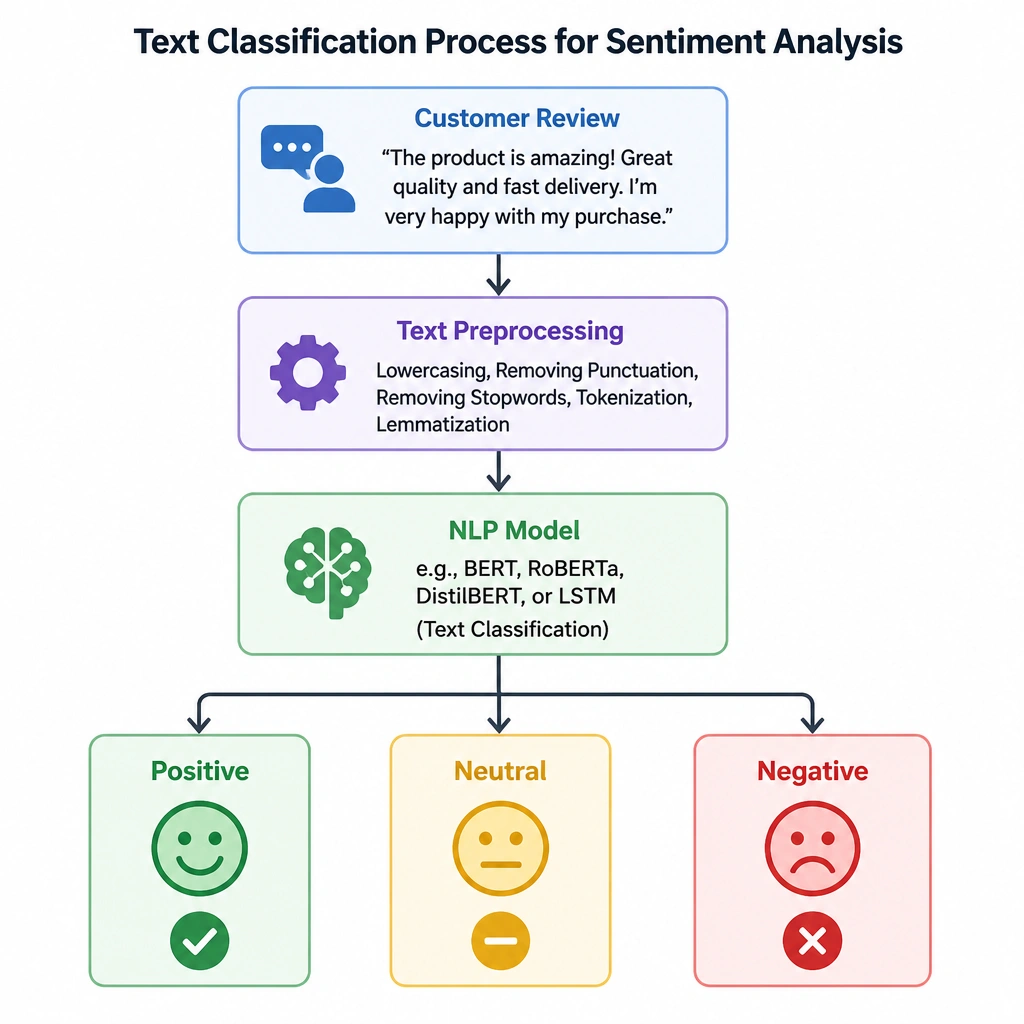
Short Explanation and Infographic
Think of it like this: if your inbox is flooded with thousands of customer reviews, you want to know immediately who is thrilled and who is ready to cancel their subscription. Sentiment analysis is the NLP tool that does exactly this. It reads the text, looks at the tone, and classifies it as positive, negative, or neutral. It's like having a virtual assistant who pre-screens every email and flags the angry customers so you can handle them first. Let's make sure you don't confuse this with other NLP tasks on the exam, because they do very different jobs.
Full explanation below image
Full Explanation
Sentiment analysis (sometimes called opinion mining) is a subfield of Natural Language Processing (NLP) that involves identifying and extracting subjective information from text. The primary goal is to determine the writer's attitude, emotional state, or tone toward a particular topic, product, or service. In business applications, this is commonly implemented as a classification task that labels text into discrete categories, such as positive, negative, or neutral.
By automating sentiment analysis, businesses can monitor brand reputation, analyze customer reviews at scale, and route high-priority negative feedback to customer support representatives in real time. Modern approaches utilize deep learning models, such as transformers, that capture contextual nuances, sarcasm, and complex sentence structures to classify sentiment accurately.
Let's review the other NLP tasks listed in the distractors: - Text summarization involves condensing a long document into a shorter version while retaining its core information. - Named Entity Recognition (NER) identifies and classifies specific entities in text, such as names of people, organizations, locations, and dates. - Machine translation translates text from one natural language to another. None of these tasks focus on detecting the emotional polarity of a text, which makes sentiment analysis the correct and only applicable answer.