When designing and implementing a complex artificial intelligence solution, which approach represents the most effective software engineering strategy for solving the problem?
Select an answer to reveal the explanation.
Short Explanation and Infographic
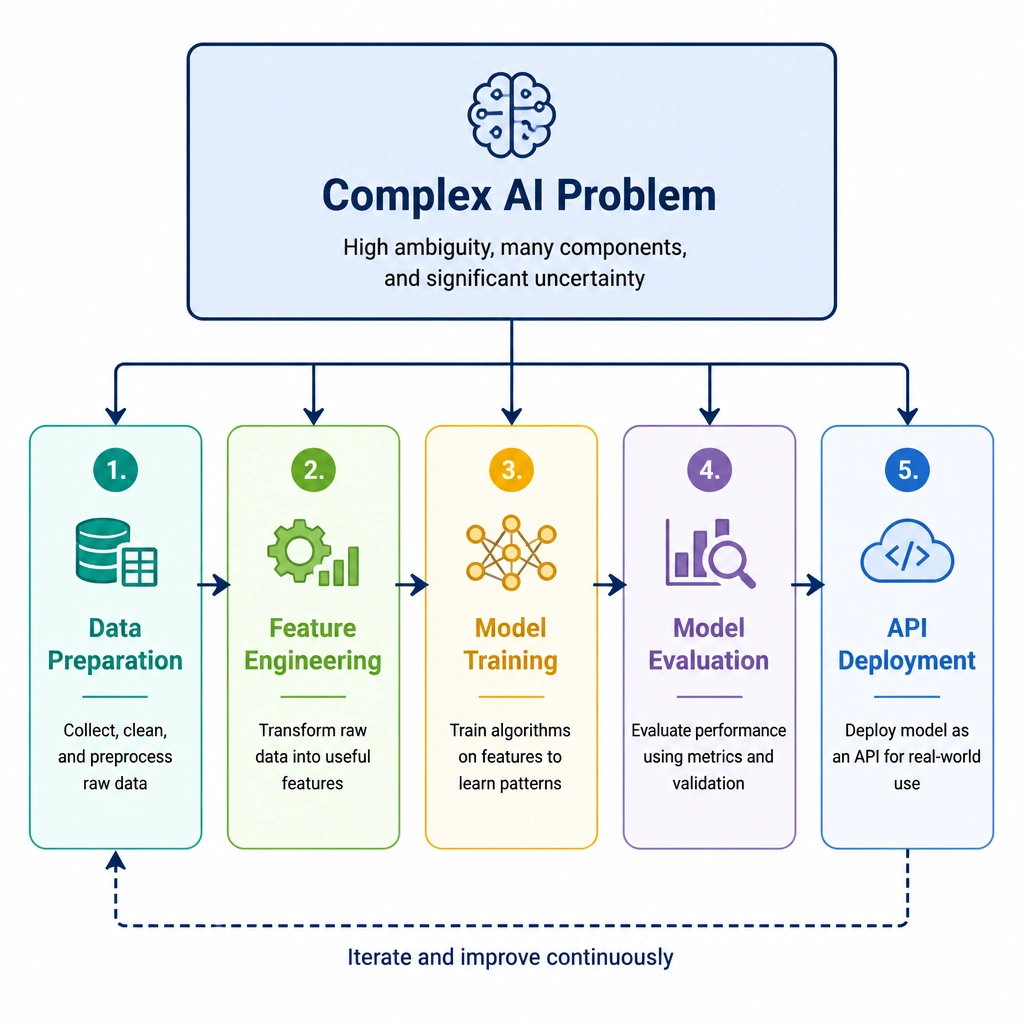
Here's the deal: if your boss walks in and says, 'Build me an AI system that predicts customer churn and integrates with our website by Friday,' you might feel like panicking. That's a massive project! If you try to tackle the whole thing at once, you're going to fail. The secret is modular engineering. Think of it like building a house—you don't just wave a magic wand and have a house. You lay the foundation first, frame the walls, run the plumbing, and then paint. In AI, you break it down into clean, manageable chunks. First, you handle data preparation. Once that's solid, you build the model. After that's tested, you focus on deployment. By separating these steps, you can troubleshoot each piece individually and keep your sanity. Trust me, trying to write one giant system in one go is a recipe for absolute chaos. Break it down, test each step, and you'll get it done! Let's keep rolling.
Full explanation below image
Full Explanation
In systems engineering and software development, particularly within complex domains like artificial intelligence, tackling a large-scale project requires a structured, iterative methodology. The most effective strategy is decomposition—breaking a complex problem down into smaller, well-defined, and manageable sub-problems or modules. For a machine learning project, this modular approach typically splits the workflow into distinct phases: data collection and cleaning, feature engineering, model selection and training, evaluation, and finally, deployment and monitoring. Each sub-problem has its own inputs, outputs, and success criteria. This modularity provides several key engineering benefits: it allows different team members to work on separate components in parallel, simplifies debugging and testing since issues can be isolated to specific phases, and makes the overall codebase much more maintainable and scalable. Let's analyze why other strategies are ineffective: focusing only on the easiest parts neglects the core functional requirements and critical integrations, leading to incomplete solutions; attempting to build the entire system at once increases complexity exponentially, making it extremely difficult to identify the root cause of failures when they occur; referencing an unrelated project without adapting it fails to account for the unique constraints, schemas, and objectives of the current problem. Therefore, breaking a complex project into logical, sequential modules is the standard best practice for delivering reliable AI solutions.