A candidate preparing for a professional AI certification exam wants to maximize their information retention and practical understanding of machine learning concepts. Which study method is most effective?
Select an answer to reveal the explanation.
Short Explanation and Infographic
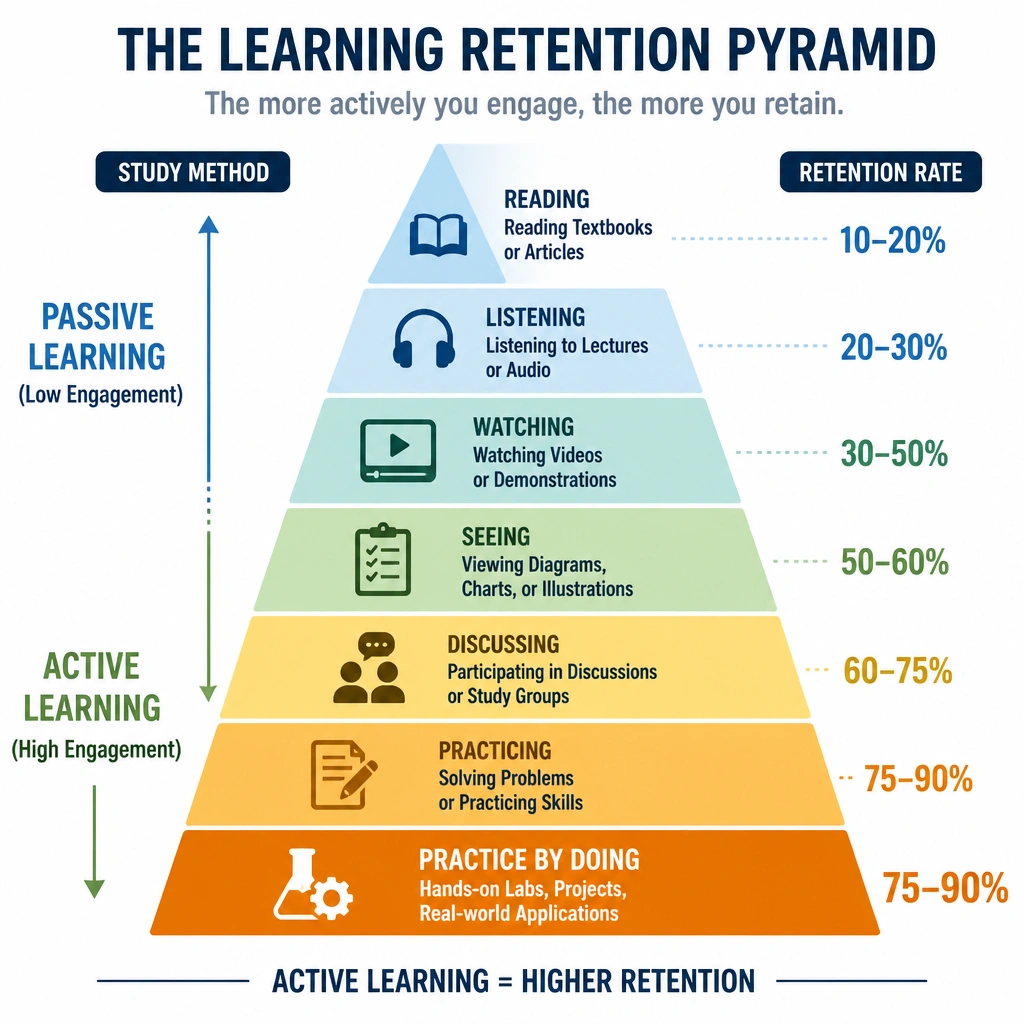
Okay, let's dive in. I've been training engineers for over forty years, and I will tell you the absolute truth: you cannot learn networking or machine learning just by staring at a textbook or falling asleep to videos. Think of it like learning to ride a bike—you can read ten books about balance, but until you get on the seat and pedal, you don't know how to ride. The only way to make this stuff stick is active learning. You've got to get your hands dirty. Write the code, spin up the models, configure the pipelines, and troubleshoot when they break. When a model fails and you have to dig into the logs to fix a syntax error or a bad shape, that's when you actually learn. Trust me on this: build the labs, complete the coding exercises, and you'll crush this exam. Got it? Sweet, let's keep rolling!
Full explanation below image
Full Explanation
Educational research indicates that learning efficiency and retention vary dramatically depending on the cognitive engagement required by the study method. Passive learning methods—such as rereading textbooks, highlighting text, or watching lectures without taking notes—involve low cognitive effort. While these methods can create an 'illusion of competence' where the learner feels familiar with the material, they rarely lead to long-term memory retention or the ability to apply concepts in novel situations. In contrast, active learning involves active recall, problem-solving, and practical application. For technical domains like artificial intelligence, this translates to writing code, configuring pipelines, building projects from scratch, and debugging errors. When a learner actively writes code (e.g., defining a neural network architecture in PyTorch or implementing data validation in a pipeline), they are forced to confront syntax details, shape dimensions, and operational constraints. Troubleshooting errors forces the brain to retrieve and apply theoretical concepts (such as understanding why a learning rate is too high when gradients explode). This strengthens neural pathways and builds a deep, conceptual model of the technology. Let's address the incorrect options: passive reading, passive video watching, and rote memorization are all passive learning techniques. While memorizing definitions may help with simple recall questions, it fails to prepare candidates for scenario-based exam questions or real-world engineering tasks. Therefore, active practice through hands-on coding and labs is the most effective preparation strategy.