As part of an enterprise machine learning initiative, a financial organization establishes a data governance framework. What is the primary objective of data governance within the machine learning lifecycle?
Select an answer to reveal the explanation.
Short Explanation and Infographic
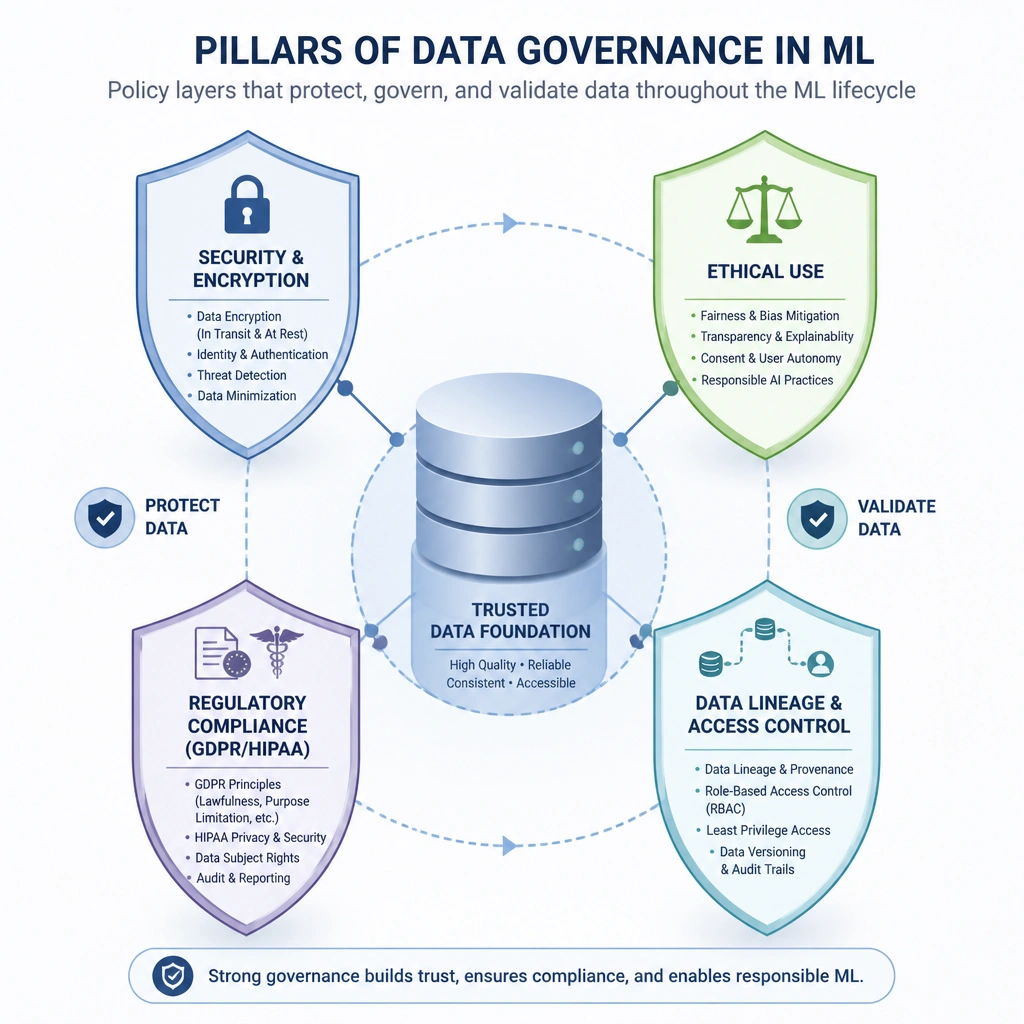
Here's the deal: 'garbage in, garbage out' is the golden rule of machine learning. If you feed your model bad, corrupt, or inconsistent data during training, your model's predictions are going to be useless. That's why data governance is so critical. Think of it as the rulebook for your data. It defines who owns the data, who can access it, how it's stored securely, and whether it's ethical to use it for training. It's not about training algorithms or setting up servers. It's about making sure your data is clean, compliant, and handled with integrity throughout the entire lifecycle. Trust me on this, strong data governance is what keeps you out of court!
Full explanation below image
Full Explanation
Data governance refers to the overall management of the availability, usability, integrity, and security of data used in an enterprise. Within the machine learning lifecycle, data governance plays a critical role in ensuring that the data used to train and evaluate models is collected, stored, and processed in a compliant and ethical manner. A proper data governance framework establishes clear policies regarding data ownership, access controls (ensuring only authorized personnel can view sensitive data), privacy compliance (e.g., GDPR or HIPAA), and data lineage (tracking where data originated and how it was modified). This prevents legal, regulatory, and ethical issues, such as bias amplification or unauthorized data usage. Model deployment involves packaging and serving the model, which is handled by MLOps and DevOps tools, not data governance. Model training is the phase where mathematical optimization occurs, which uses data but does not establish governance rules. Model monitoring tracks post-deployment metrics like drift and latency, which is an operational task rather than a compliance and data management policy framework. Therefore, the core purpose of data governance is ensuring the ethical, secure, and compliant usage of data.