During your preparation for a professional AI certification exam, you take a diagnostic quiz and discover you have a fundamental misunderstanding of a core concept. What is the most effective study strategy to resolve this learning bottleneck?
Select an answer to reveal the explanation.
Short Explanation and Infographic
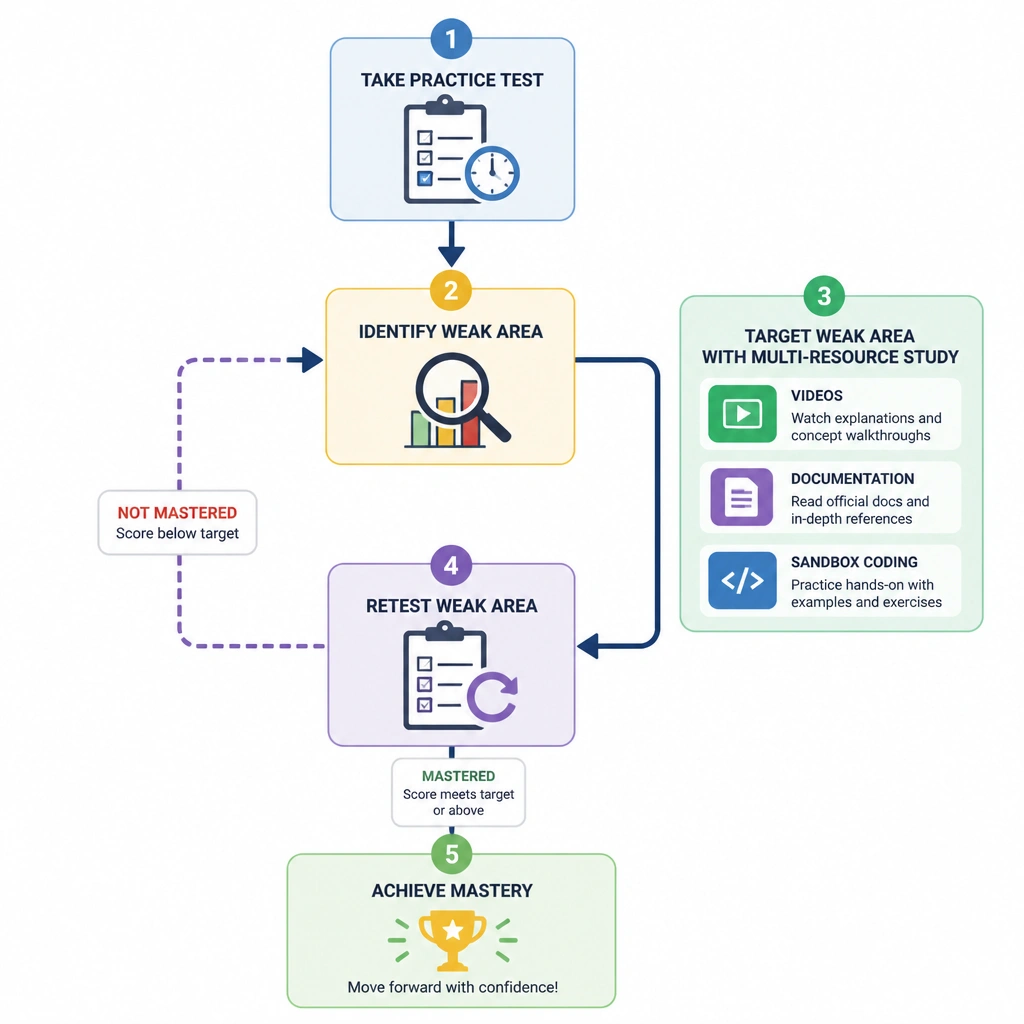
Okay, let's dive in. We've all been there—you're studying hard, taking practice tests, and suddenly you hit a topic that makes absolutely no sense. Maybe it's backpropagation or bias-variance tradeoff. Your first reaction might be to panic or just cross your fingers and hope it doesn't show up on the exam. Don't do that! The best way to beat this is to run straight toward the fire. Stop, isolate that specific concept, and attack it from a different angle. If the textbook explanation didn't work, find a video, read a blog post, or write some quick scratch code to see how it works in action. Working through targeted practice problems is the absolute best way to turn a weakness into a strength. Trust me, once you master the tough stuff, you'll walk into that testing center with total confidence. Let's keep rolling!
Full explanation below image
Full Explanation
Effective exam preparation and adult learning methodologies rely heavily on diagnostic feedback and targeted remediation. When a candidate identifies a fundamental misunderstanding or knowledge gap during practice, the optimal strategy is to systematically isolate that topic and engage in active recall and focused learning. This process involves several key steps: 1) Multi-Channel Learning: If one source (e.g., a specific textbook) fails to clarify a concept, the candidate should seek alternative explanations, such as video lectures, technical blogs, or interactive visualizations. 2) Active Learning and Application: Working through practice problems specifically focused on the weak area forces the brain to retrieve and apply the corrected information, reinforcing the neural pathways. 3) Feedback Loops: Re-testing the specific concept after study ensures that the misunderstanding has been successfully resolved. Ignoring the concept (Option D) or bypassing it to focus only on strengths (Option A) leaves critical weaknesses exposed, which can easily lead to failure if those topics are heavily weighted on the exam. Canceling the exam (Option C) is a defeatist approach that halts professional growth.