When preparing for a high-stakes artificial intelligence certification exam, what is the most effective approach for identifying your specific knowledge gaps before test day?
Select an answer to reveal the explanation.
Short Explanation and Infographic
Here's the deal: you can read a book cover-to-cover ten times, but that doesn't mean you're ready to pass the exam. It's easy to look at a page and think, 'Oh yeah, I know that.' That's called the illusion of competence. In the real world, the only way to prove you actually know the material is to test yourself. Taking practice exams is like putting your car on a dyno—it exposes exactly where the engine is losing power. When you get a question wrong, don't just get annoyed and move on. That wrong answer is pure gold. It's telling you exactly where your knowledge gap is. Write it down, research it, understand why you missed it, and fix it. Trust me on this, this feedback loop is the single fastest way to guarantee a passing score!
Full explanation below image
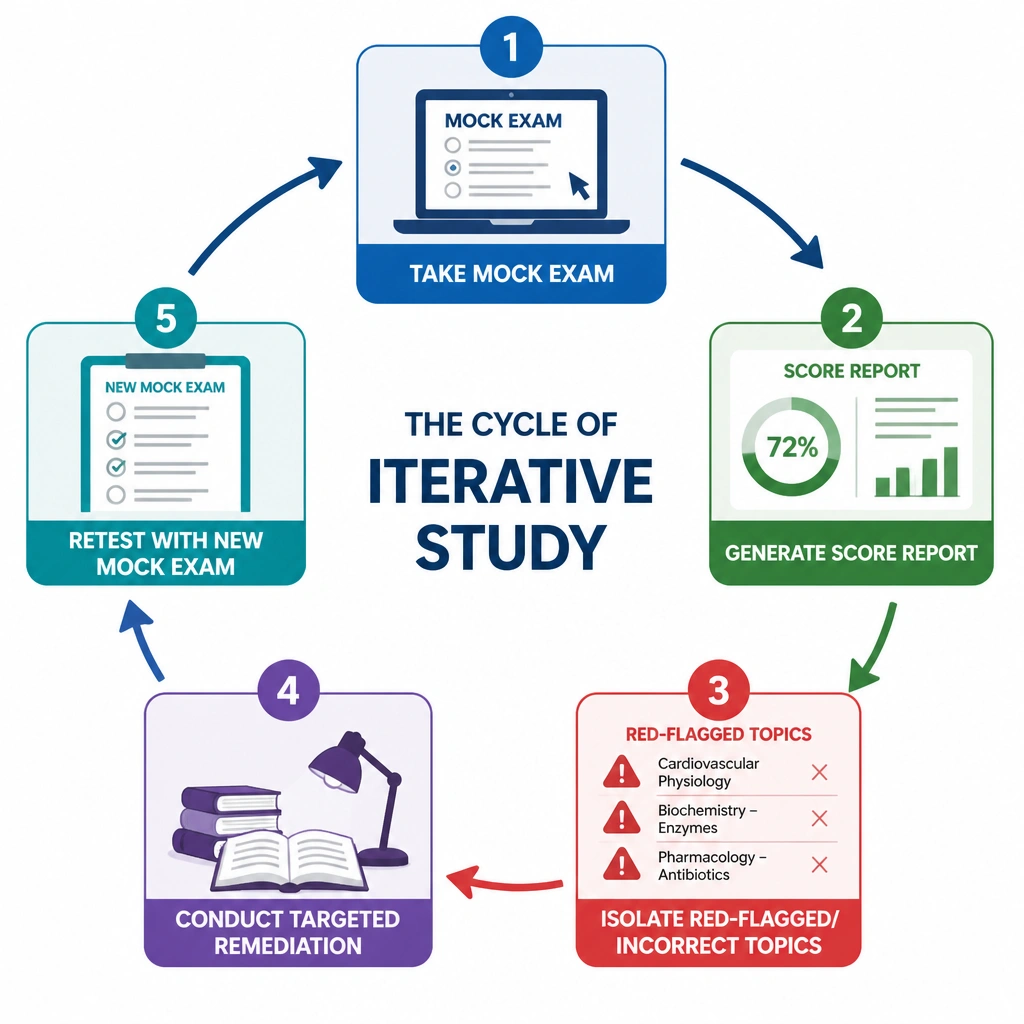
Full Explanation
Active recall and spaced repetition are highly effective strategies in cognitive science for long-term information retention and test preparation. A critical phase of this process is identifying knowledge gaps—areas where the learner's understanding is incomplete, outdated, or incorrect. The most structured and empirically supported strategy for identifying these gaps is taking mock or practice examinations under simulated testing conditions, followed by a detailed post-exam analysis: 1) Diagnostic Evaluation: Practice tests reveal not just what a student knows, but how well they can apply that knowledge under pressure and time constraints. 2) Error Analysis (Remediation): Reviewing incorrect answers allows candidates to classify their mistakes (e.g., misreading the question, lack of factual knowledge, or conceptual misunderstanding). This highlights specific sub-topics that require additional study. 3) Calibrating Confidence: It prevents the 'illusion of competence'—a cognitive bias where passive reading makes material feel familiar, leading the candidate to overestimate their readiness. Alternative study habits are highly inefficient: reading sequentially without self-assessment (Option A) provides no objective measure of retention; focusing only on strengths (Option B) leaves critical weaknesses unaddressed; and restricting the study scope (Option D) exposes the candidate to failing grades on the remaining untested domains.