A network administrator is configuring a firewall for a new subnet. After adding several specific allow and deny rules, the administrator wants to ensure that any traffic not matching an explicit rule is blocked. Which firewall concept accomplishes this?
Select an answer to reveal the explanation.
Short Explanation and Infographic
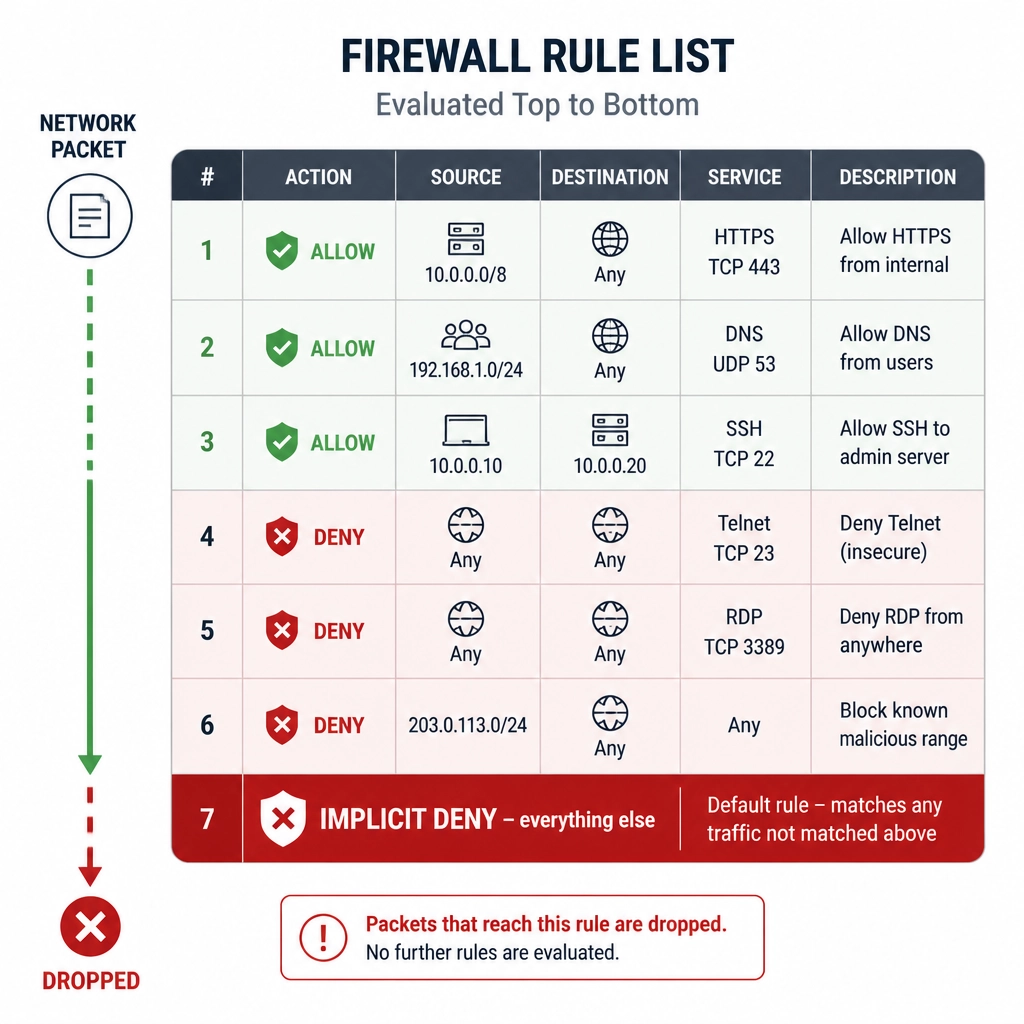
Think about how a firewall reads its rules: top to bottom, first match wins. If nothing matches, what happens? It drops the packet. That's the implicit deny sitting at the bottom of every good rule set. You don't write a rule for every bad thing — you allow what you need and let the implicit deny catch everything else. That's your default-deny posture in one line.
Full explanation below image
Full Explanation
Firewall rule sets are evaluated top to bottom, and most firewalls apply an implicit deny at the end: any packet that does not match an explicit allow rule is dropped. This is the foundation of a default-deny security posture, so the administrator does not need to write a rule for every possible unwanted flow. An explicit allow-any rule would do the opposite (permit everything), which is the least secure configuration. Stateful packet inspection tracks the state of connections (and is valuable) but does not by itself decide the default action for unmatched traffic. A DMZ is a network-segmentation concept — a zone for public-facing services — rather than a rule-evaluation behavior. The correct mechanism for blocking anything not explicitly permitted is the implicit deny.