You're setting up a distributed deep learning cluster where you've got multiple GPU servers (nodes) that need to train a massive language model together. Because the model is split across these nodes, they have to constantly exchange weights and gradients at lightning speed. If the network lags, your expensive GPUs will sit idle, waiting for data. Which networking technology should you run to get the high bandwidth and low latency required to keep this multi-node cluster scaling efficiently?
Select an answer to reveal the explanation.
Short Explanation and Infographic
Here's the deal—when you scale deep learning across multiple nodes, standard networking is going to choke. I've seen engineers try to use standard Gigabit Ethernet because it's cheap and familiar, but it creates a massive bottleneck. The latency is too high, and the bandwidth is way too low for the massive amounts of data GPUs need to swap. Wi-Fi 6 is great for your laptop, and Fibre Channel is for storage networks, but for high-performance GPU-to-GPU node clustering, InfiniBand is the gold standard. It gives you the ultra-low latency and extreme throughput required to keep those GPUs fed and working together as one giant machine.
Full explanation below image
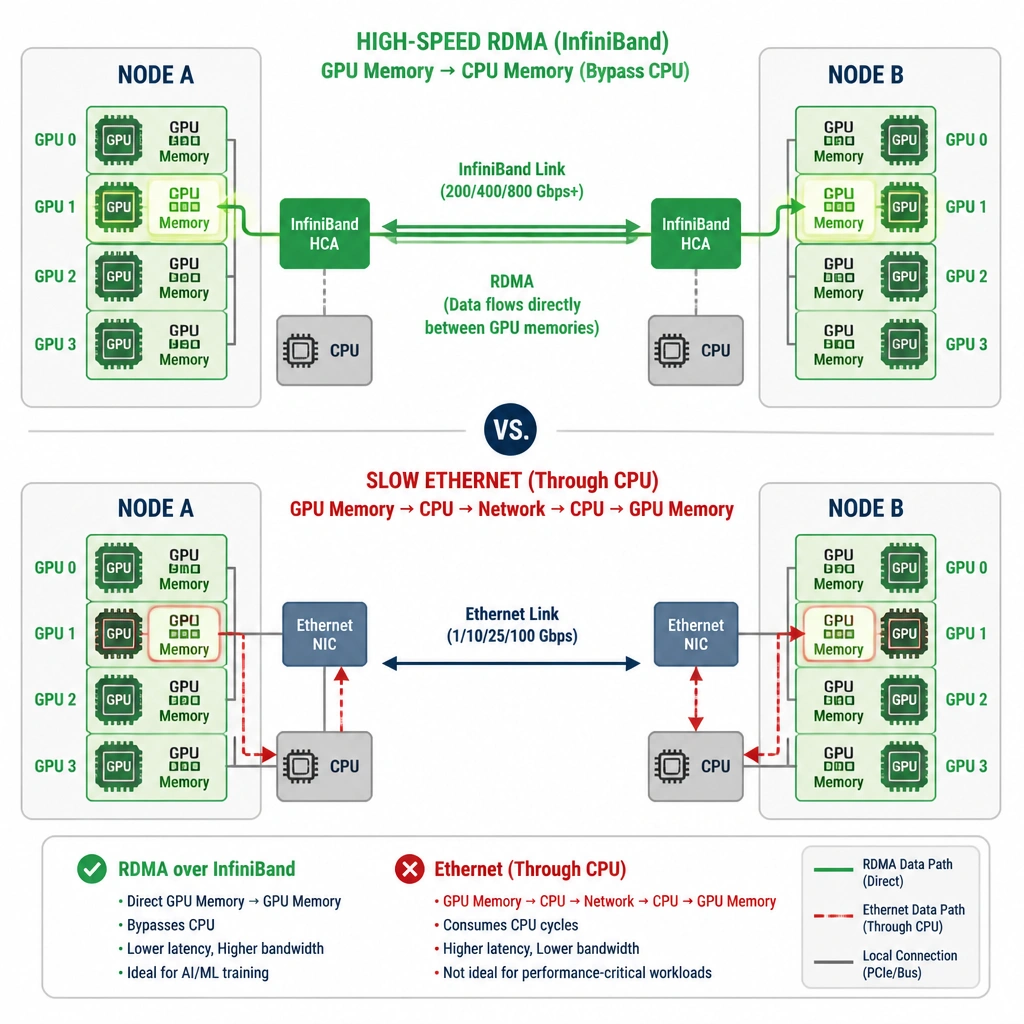
Full Explanation
Distributed deep learning training involves partitioning a neural network or dataset across multiple physical servers. As the training progresses, the nodes must continuously synchronize model weights and gradients during the backward pass of backpropagation. This synchronization phase is highly sensitive to network latency and throughput; if the network cannot keep up, the GPUs enter an idle state, degrading training efficiency.
InfiniBand is the preferred interconnect technology for high-performance computing (HPC) and large-scale AI clusters due to its architectural advantages: - Extreme Bandwidth & Ultra-Low Latency: InfiniBand links (such as HDR 200 Gbps or NDR 400 Gbps) provide massive throughput and sub-microsecond latency, which are critical for exchanging large parameter matrices. - Remote Direct Memory Access (RDMA): InfiniBand supports RDMA, allowing a GPU on one node to read or write directly to the memory of a GPU on another node without involving either server's CPU or operating system kernel. This bypasses OS TCP/IP stack overhead and reduces latency significantly.
Analyzing the alternatives: - 1 Gbps Ethernet (Option B) is far too slow, creating a severe bottleneck that results in poor scaling efficiency. - Wi-Fi 6 (Option D) is a wireless local area network standard intended for client devices and lacks the bandwidth, reliability, and low latency required for server clustering. - Fibre Channel (Option C) is a protocol designed for block-level storage access in storage area networks (SANs) and is not optimized for node-to-node inter-process communication in AI clusters.
Thus, InfiniBand is the most suitable networking technology for scaling multi-node deep learning workloads.