You're deploying a machine learning model to spot credit card fraud in real time. Fraudsters are smart—they constantly change their tactics, meaning a model that works great today might be completely useless next month due to data drift. To make sure your fraud detection system stays sharp and adapts to these changing tricks on the fly, how should you structure your training pipeline?
Select an answer to reveal the explanation.
Short Explanation and Infographic
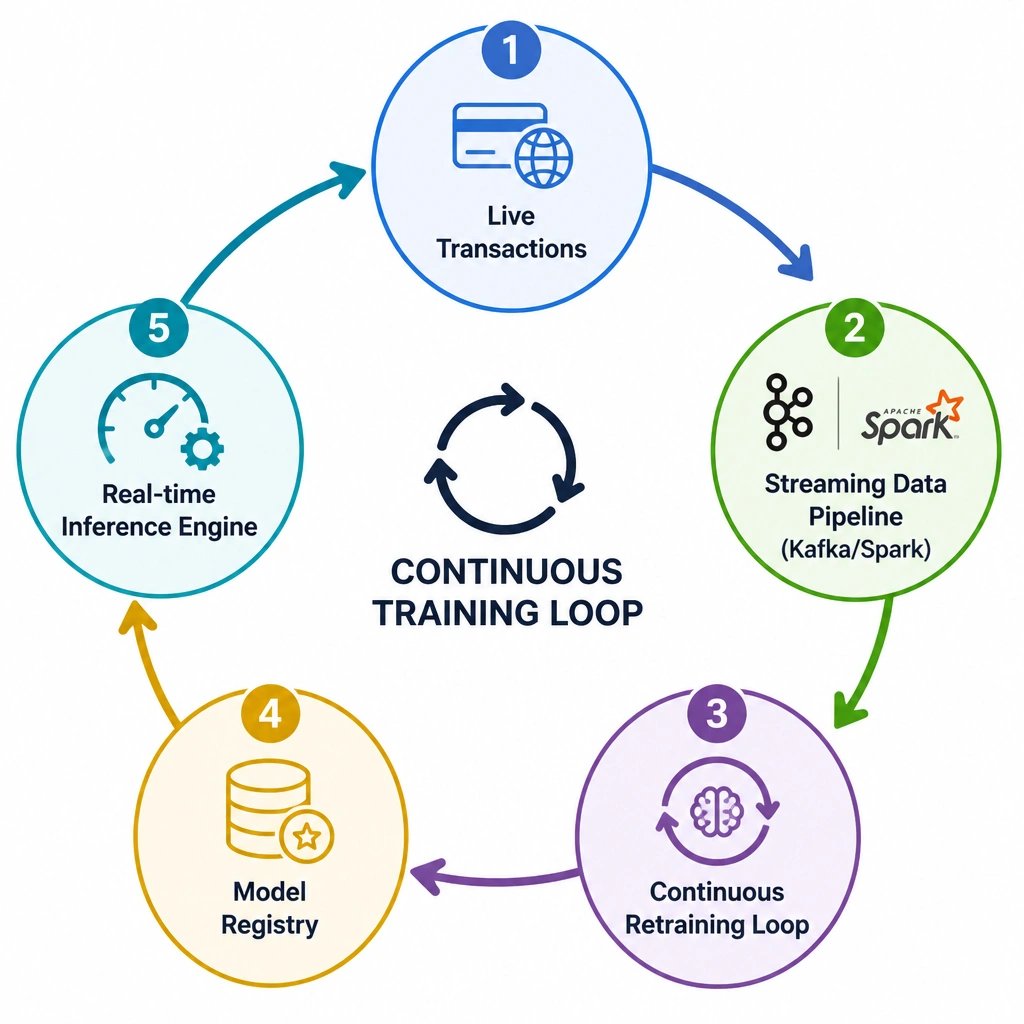
Check this out: in the fraud detection game, the bad guys are always moving the goalposts. If you deploy a model and just leave it alone (Option A), or retrain it once a month on old data (Option C), you're going to get cleaned out. The fraudsters will figure out your model's blind spots and exploit them. To beat them, your model has to learn as fast as they do. By setting up a streaming data pipeline, you feed fresh transaction data into the training loop continuously. This lets the model adapt to new fraud patterns in near real time, keeping your detection rates high and your false positives low. Trust me, in security and fraud, static is dead.
Full explanation below image
Full Explanation
In real-world machine learning deployments, data drift and concept drift represent significant challenges. Concept drift occurs when the statistical properties of the target variable change over time, rendering a model trained on historical data increasingly inaccurate. In adversarial domains like credit card fraud detection, this drift is accelerated by bad actors actively trying to evade detection.
To address concept drift, organizations must implement a continuous retraining architecture using a streaming data pipeline (Option B). This architecture continuously ingests new transactional data, labels it (via feedback loops, chargebacks, or manual reviews), and updates the model's weights in near real-time. This continuous loop ensures that the model learns new fraudulent patterns as they emerge, maintaining high precision and recall.
Analyzing the alternative methods: - Retraining only when accuracy drops significantly (Option A) is a reactive strategy. By the time a metric drop is identified at scale, significant financial damage has already occurred. - Periodic batch retraining using a static dataset (Option C) creates a lag between the emergence of a new fraud tactic and the model's ability to recognize it. During this lag window, the system is highly vulnerable. - Running a parallel rule-based system (Option D) helps catch known, static fraud patterns, but it does not prevent the underlying machine learning model from becoming stale and obsolete.
Continuous training via streaming data pipelines is the standard design pattern for maintaining model relevance in highly dynamic environments.