Your enterprise is building out a brand-new data center dedicated to training massive deep learning models from scratch. You need to procure the right mix of high-performance NVIDIA hardware and software tools optimized specifically for this heavy-duty training workload. Which combination should you select?
Select an answer to reveal the explanation.
Short Explanation and Infographic
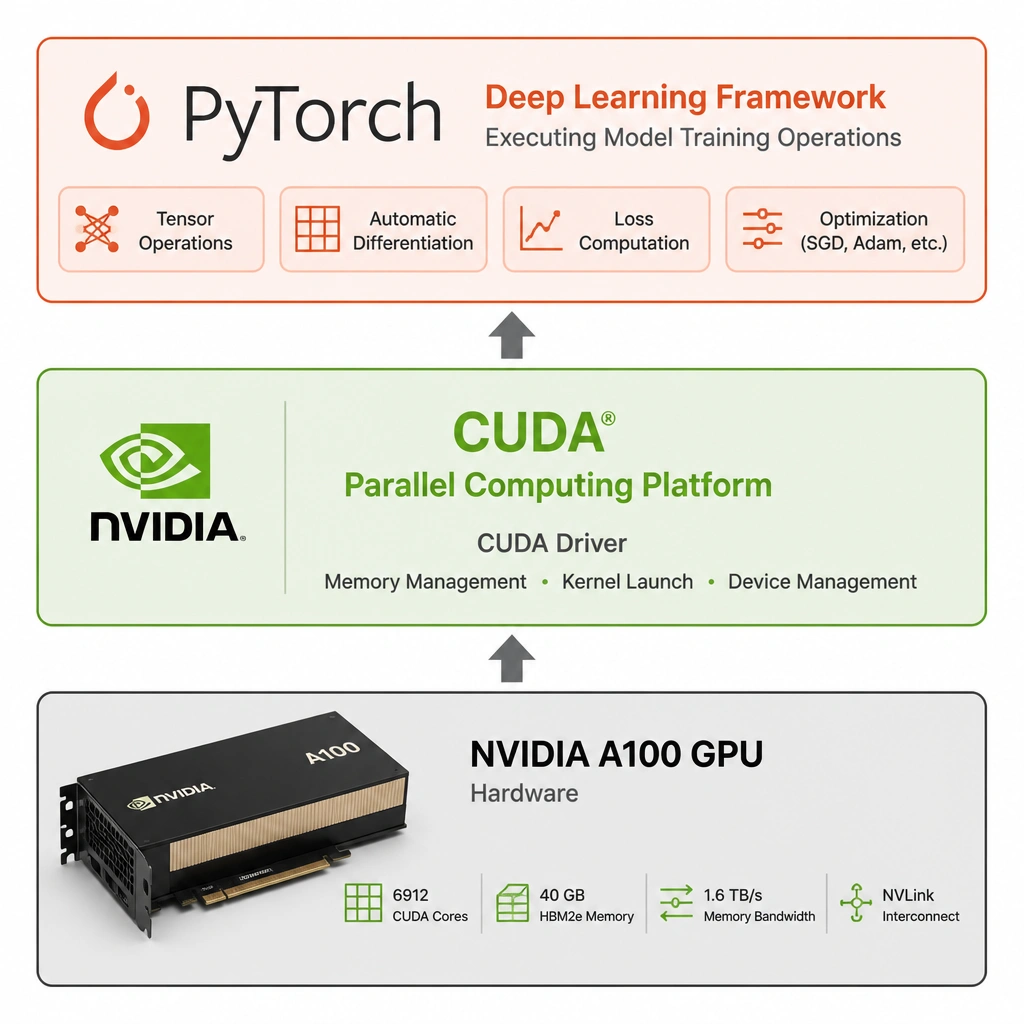
Here's the deal: you can't run data-center-scale deep learning on weak hardware. I've seen people get confused by the product names, so pay close attention. A Jetson Nano (Option A) is a cool little device, but it's for low-power edge devices, not training giant models in a data center. Quadro GPUs (Option C) are for professional workstations and rendering, not server rack training. The DGX Station (Option D) is a desktop workstation, not data center infrastructure. For the heavy lifting in a server room, you want NVIDIA A100 Tensor Core GPUs. Combine that brute-force hardware with PyTorch for your model design, and CUDA to compile the math directly onto the GPU, and you've got the ultimate training stack.
Full explanation below image
Full Explanation
Building a data center infrastructure for large-scale deep learning training requires a hardware and software stack designed for high throughput, massive parallel computation, and memory bandwidth.
- NVIDIA A100 Tensor Core GPUs: Designed specifically for data center AI workloads, the A100 features Third-Generation Tensor Cores, up to 80GB of high-speed HBM2e memory, and support for NVLink interconnects. It delivers the massive floating-point performance needed for backpropagation calculations in large neural networks. - PyTorch: A dynamic, open-source deep learning framework favored in research and production for its ease of use, strong ecosystem, and native support for distributed training. - CUDA: NVIDIA's parallel computing platform and programming model that allows PyTorch to execute mathematical operations directly on GPU cores, bypassing CPU latency and maximizing execution speed.
Let's look at the other combinations: - The NVIDIA Jetson Nano and TensorRT (Option A) are optimized for low-power edge deployment and high-speed inference execution, not for training models. - NVIDIA Quadro GPUs and RAPIDS (Option B/C) are designed for workstation visualization, computer-aided design (CAD), and data science/machine learning preprocessing, not for large-scale deep learning model training. - The DGX Station (Option D) is an office-friendly personal supercomputer (desktop form factor) rather than data center rack hardware, and "CPU-optimized CUDA libraries" is a contradictory term, as CUDA is a GPU acceleration platform.
Selecting the A100 GPU with PyTorch and CUDA provides the standard industry architecture for data center training.