Your team is deploying several AI models built with different frameworks, including PyTorch, TensorFlow, and ONNX, to a production environment. You need a production-grade software component that serves predictions from these models concurrently, utilizes dynamic batching to maximize throughput, and provides multi-GPU support. Which NVIDIA software should you implement?
Select an answer to reveal the explanation.
Short Explanation and Infographic
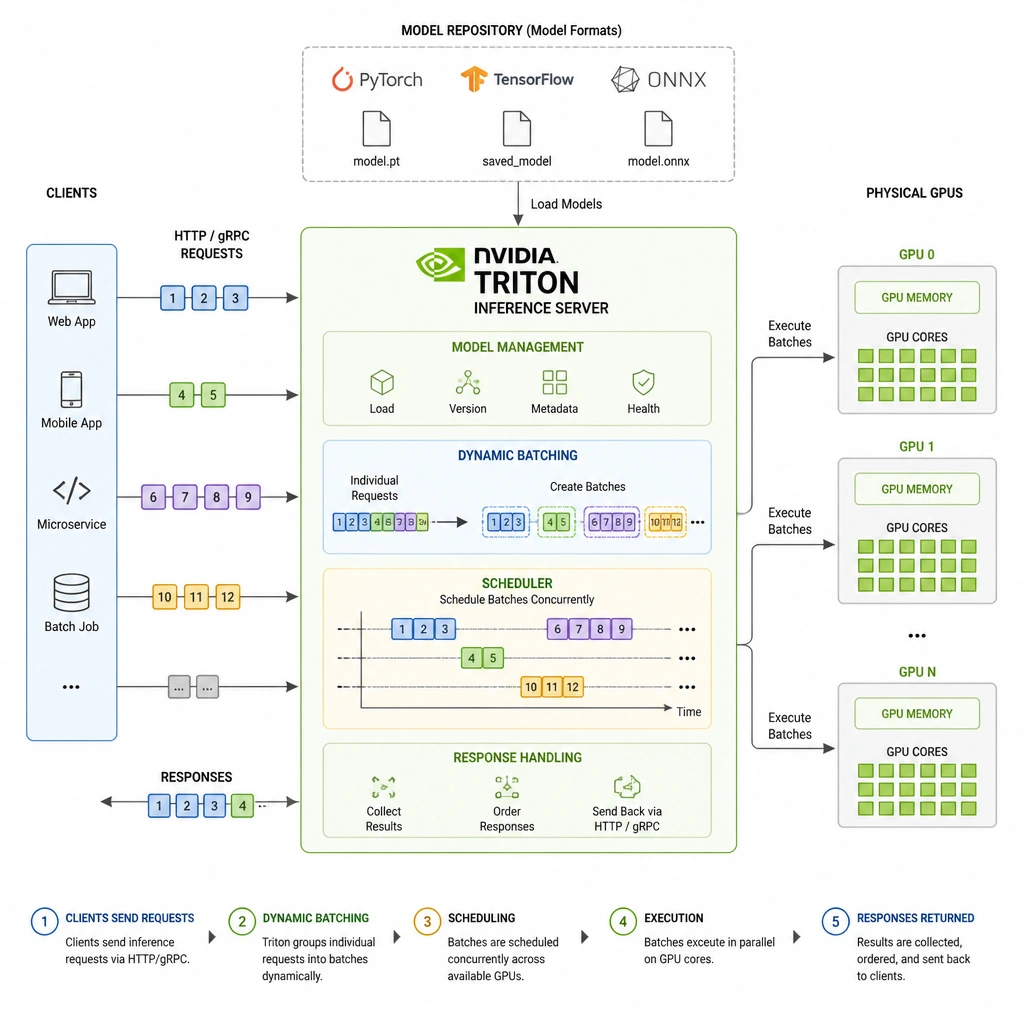
Here's the deal—once your data scientists are done training their models, you've got to actually run them in the real world. That's called inference. If you have PyTorch models, TensorFlow models, and ONNX models all running on different servers, your infrastructure is going to be a mess. Think of NVIDIA Triton Inference Server like a world-class traffic cop for AI. It sits in production and serves predictions for all of those frameworks at the same time on the same GPU. The cool thing is that it does dynamic batching—meaning it gathers up single requests from different users and groups them together to keep the GPU busy. Trust me, running models without Triton is like trying to manage an airport without an air traffic control tower. You'll end up with underutilized GPUs and slow response times.
Full explanation below image
Full Explanation
Deploying machine learning models into production environments presents several operational challenges, including supporting diverse frameworks, maintaining low latency, and optimizing GPU resource utilization. NVIDIA Triton Inference Server is an open-source inference serving software designed specifically to address these challenges. It allows teams to deploy, run, and scale trained AI models from any framework (such as TensorFlow, PyTorch, ONNX Runtime, TensorRT, and even custom C++ or Python backends) on both GPU and CPU-based infrastructure. A key feature of Triton is its support for concurrent model execution, enabling multiple models (or multiple instances of the same model) to run simultaneously on a single GPU to maximize utilization. It also implements dynamic batching, which automatically groups individual client inference requests together on the server side to create larger batches. This is critical because GPUs perform much more efficiently when processing batches of data rather than single inputs sequentially. Triton also manages model lifecycle features like hot-swapping and model versioning without downtime. Let's analyze the incorrect options: - NVIDIA CUDA Toolkit (Option A) is the foundational parallel computing platform and programming model, providing compilers and low-level libraries, but it does not serve or manage models in a production environment. - NVIDIA TensorRT-LLM (Option B) is a highly specialized library for optimizing and running Large Language Models specifically, but it is not a general-purpose model serving framework that natively hosts multiple non-LLM frameworks. - NVIDIA DeepStream SDK (Option D) is a streaming analytics toolkit focused on multi-sensor processing and video/audio AI pipelines, not a general model-serving server. Furthermore, Triton provides integrated model analyzer tools that help infrastructure engineers find the optimal configuration (such as the number of model instances and maximum batch size) to meet specific latency and throughput service-level agreements (SLAs). It integrates seamlessly with Kubernetes orchestrators using the Triton custom resource definition (CRD), making it highly scalable. Therefore, Triton is the correct component for managing and deploying multi-framework models for production inference.