You are architecting an onboard AI system for an autonomous vehicle. The system must process real-time streams from high-resolution LiDAR, radar, and camera sensors to make driving decisions with sub-millisecond latency. Because the system runs locally inside the vehicle, it requires power-efficient, ruggedized, and highly reliable hardware. Which two NVIDIA platforms are designed for this type of onboard edge AI and automotive deployment? (Select two)
Select all correct answers, then click Submit.
Short Explanation and Infographic
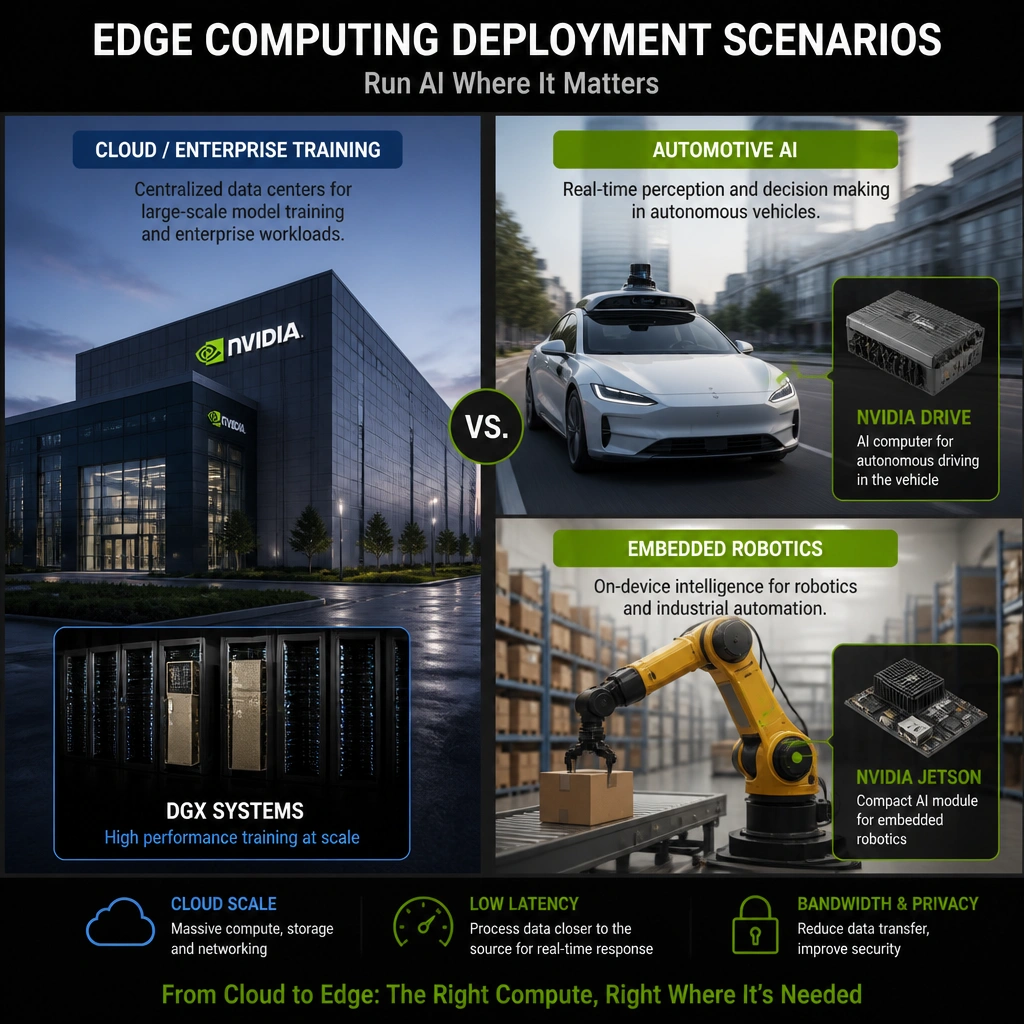
Think about this: you can't exactly fit a massive, 400-pound server rack like the DGX A100 (Option A) into the trunk of a passenger car, let alone plug it into the car's 12-volt battery without blowing a fuse! You also can't use a consumer gaming card like the GeForce RTX 3080 (Option E) or a standard data center card like the Tesla T4 (Option C) because they aren't built to handle the heat, vibration, and safety certifications required on the road. For real-world automotive deployments, NVIDIA built two specialized edge computing families. The first is DRIVE AGX Pegasus (Option B), which is purpose-built for self-driving cars and fully certified for functional safety. The second is Jetson AGX Xavier (Option D), a power-efficient system-on-module designed for robotics and edge AI. Both pack serious parallel computing power while keeping the power draw low enough to run on vehicle systems. Got it? Sweet!
Full explanation below image
Full Explanation
Deploying artificial intelligence models onboard autonomous vehicles introduces strict design constraints: low latency for safety-critical real-time processing, high energy efficiency to run on battery systems, and ruggedized physical designs to withstand extreme operating conditions (temperature, vibration).
1. NVIDIA DRIVE AGX Pegasus (Option B): This platform is architected specifically for autonomous vehicles (Level 4 and Level 5 autonomy). It features multiple Xavier SoCs and high-performance Turing GPUs, providing the parallel processing power needed to ingest and process massive data streams from LiDAR, cameras, and radar simultaneously. Crucially, the DRIVE platform is designed to meet ISO 26262 ASIL-D functional safety standards, which are mandatory for automotive control systems. 2. NVIDIA Jetson AGX Xavier (Option D): This is a high-performance system-on-module (SoM) designed for embedded edge AI applications, including robotics and autonomous machinery. Delivering up to 32 TOPS (Trillion Operations Per Second) of compute performance at configurable power levels (10W to 30W), it allows deep learning models to run locally at the edge with low latency and high energy efficiency.
Analyzing the incorrect options: - Option A (NVIDIA DGX A100) is a massive, high-power-draw (typically several kilowatts) data center supercomputer designed for training AI models in server rooms, not for vehicle installation. - Option C (NVIDIA Tesla T4) is an enterprise GPU designed for data center scale-out servers hosting inference or virtualization workloads. It lacks the safety, sensor-interface, and power-profile characteristics required for onboard automotive deployment. - Option E (NVIDIA GeForce RTX 3080) is a consumer-grade desktop graphics card designed for gaming and workstations, lacking the ruggedized design, specialized interfaces, and safety certifications required for vehicle integration.
Thus, DRIVE AGX Pegasus and Jetson AGX Xavier are the appropriate hardware platforms for onboard autonomous vehicle systems.