An engineering group is evaluating hardware accelerators for a deep learning project that requires massive tensor matrix multiplications. When comparing a high-end CPU to an enterprise GPU, which architectural difference makes the GPU significantly faster for executing these machine learning calculations?
Select an answer to reveal the explanation.
Short Explanation and Infographic
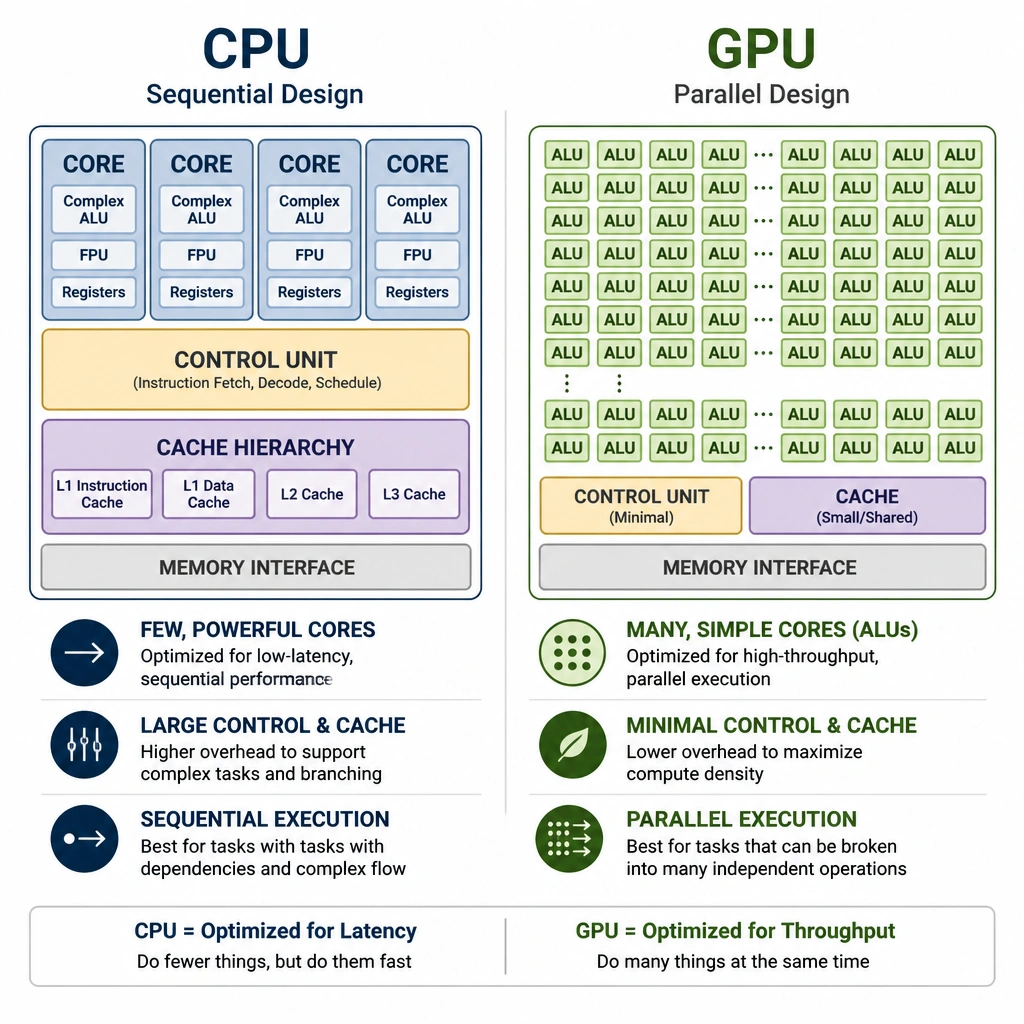
Think of it like this: a CPU is like a Ferrari—it can drive incredibly fast, but it can only carry one passenger. It's built to execute a single task or a few complex tasks sequentially as fast as possible. A GPU, on the other hand, is like a massive train carrying thousands of passengers at once. It might not move as fast as the Ferrari in a single line, but it can move a massive crowd of data simultaneously. In deep learning, you're performing millions of simple matrix multiplications at the exact same time. The GPU's secret weapon is its architecture: it contains thousands of smaller, simpler cores that work in parallel. While the CPU is busy processing one or two rows of a matrix, the GPU has already crunched the entire grid. And don't fall for the power myth—GPUs actually draw a ton of power under load, and their single-thread performance is way lower than a CPU's. The magic is in the parallelism. Got it? Let's keep rolling!
Full explanation below image
Full Explanation
The fundamental difference between CPUs and GPUs lies in their design philosophies, which are optimized for different types of computational tasks.
A Central Processing Unit (CPU) is designed for sequential processing and low-latency execution of complex serial instruction sets. It features a small number of powerful execution cores, large cache hierarchies (L1, L2, and L3), and complex control logic (such as branch prediction and out-of-order execution). This makes it highly efficient at running operating systems, databases, and serial application code.
A Graphics Processing Unit (GPU), conversely, is built for compute-intensive, highly parallel operations. It features a latency-tolerant, high-throughput architecture consisting of thousands of smaller, simpler cores designed to execute the same instruction simultaneously across multiple data points (Single Instruction, Multiple Data - SIMD or Single Instruction, Multiple Threads - SIMT). Because deep learning workloads consist primarily of dense matrix mathematics (such as matrix multiplication and convolution operations) that can be computed independently, the GPU's parallel architecture can process these arrays magnitudes faster than a CPU.
Let's look at the incorrect options: - Option A: While CPUs rely on large caches to reduce memory latency, GPUs dedicate most of their die area to arithmetic logic units (ALUs) rather than large cache structures or complex control units. - Option C: CPUs have much higher clock frequencies and far superior single-thread performance compared to individual GPU cores, which are relatively slow when executing serial tasks. - Option D: Under load, high-performance GPUs draw significant amounts of power (often 300W to 700W+ per card) and require robust power delivery and cooling systems. While they are more energy-efficient per computation for parallel workloads, they are not inherently low-power devices.
Therefore, the GPU's highly parallel design with thousands of cores is the primary reason it excels at deep learning workloads.