An infrastructure engineer is configuring an orchestrator for an AI training cluster containing a mix of NVIDIA H100, A100, and T4 GPUs. To maximize overall resource utilization efficiency and throughput for concurrent jobs, how should the orchestrator assign workloads to the different GPU resources?
Select an answer to reveal the explanation.
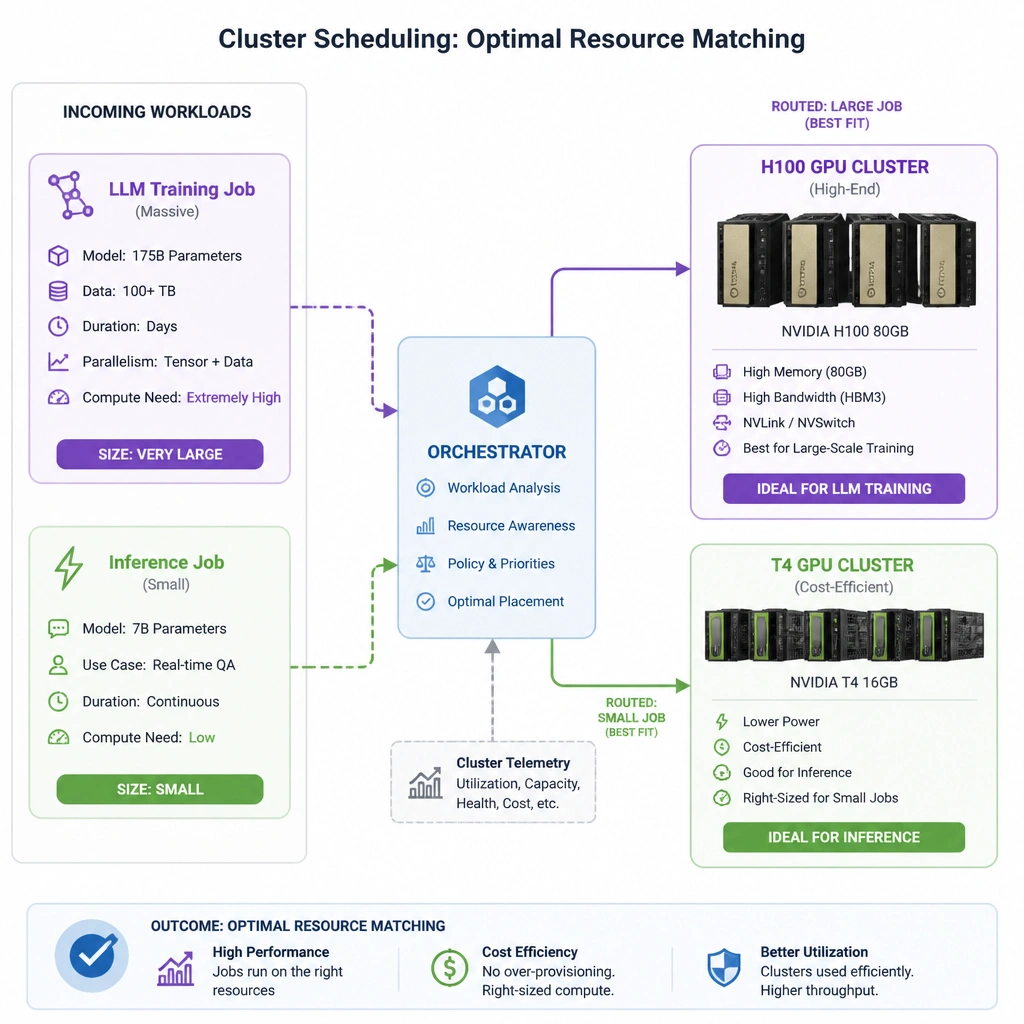
Short Explanation and Infographic
Think of it like this: if you need to run to the grocery store for a gallon of milk, you don't rent a semi-truck. You drive your car. But if you're moving your entire house, that semi-truck is exactly what you need. In an AI cluster, you’ve got different levels of horsepower—like H100s, A100s, and T4s. If you waste a high-end H100 on a tiny inference job, you’ve got a major resource bottleneck and a waste of money. You want to match the workload's compute intensity to the GPU's capacity. Put the massive training runs on the H100s, and let the T4s handle the smaller stuff. That's how you keep your cluster running at peak efficiency!
Full explanation below image
Full Explanation
Managing a heterogeneous AI cluster—one that contains various generations and tiers of GPUs—requires intelligent workload scheduling to maximize resource efficiency, reduce job completion times, and minimize costs. Different AI workloads have distinct hardware requirements: training large language models (LLMs) requires massive FP8/FP16 compute power and high-speed GPU-to-GPU interconnects (like NVLink), while simple inference tasks or light model tuning require far fewer resources.
An efficient scheduling strategy matches the compute intensity and memory requirements of a job with the capabilities of the GPU. Deploying massive, compute-heavy jobs on top-tier accelerators (like the NVIDIA H100 or A100) ensures they complete quickly and utilize the high-bandwidth memory (HBM3/HBM2e) effectively. Conversely, routing lighter tasks (like model evaluation or small-scale inference) to entry-level GPUs (like the NVIDIA T4 or L4) prevents resource waste and keeps high-end accelerators free for demanding workloads.
Let's evaluate the incorrect options: - Option A is inefficient because it underutilizes the A100 and T4 GPUs, creating a severe bottleneck on the H100 nodes while other expensive hardware remains idle. - Option C focuses on network proximity rather than compute requirements. While data locality is important, scheduling based solely on proximity ignores the fact that a T4 cannot run a massive LLM training job due to memory limitations, leading to out-of-memory (OOM) errors or extreme performance penalties. - Option D (strict FIFO serialization of the entire cluster) leads to extremely poor throughput. Small jobs would be blocked waiting for massive jobs to finish, and the cluster's GPUs would be under-utilized during phases of the job that do not scale to the entire cluster.
Matching compute intensity to GPU capability ensures the right resource is used for the right job, maximizing overall cluster efficiency.