A startup is setting up a cloud-based deep learning pipeline to train computer vision models. The training jobs have highly variable workloads: they experience intense compute demand during training cycles, followed by periods of relative inactivity when researchers are preparing new datasets. To optimize the cloud infrastructure for both cost-efficiency and training speed, which strategy should be implemented?
Select an answer to reveal the explanation.
Short Explanation and Infographic
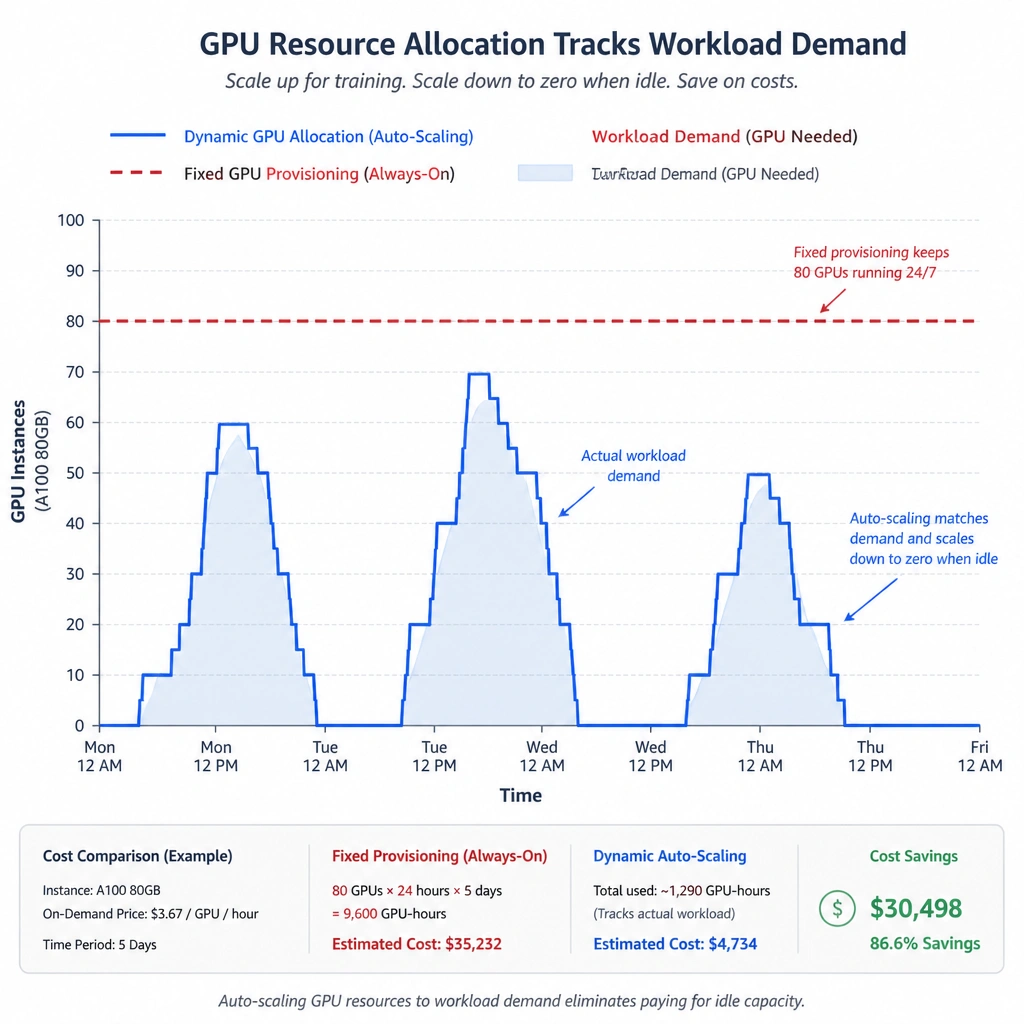
Here's the deal: cloud GPUs are fast, but they are definitely not cheap. If you leave a stack of NVIDIA A100s running over the weekend while your data scientists are out playing golf, you're going to get a massive bill for absolute zero work. On the flip side, if you under-provision your cluster to save money, your team will be sitting around waiting forever for their jobs to finish. Not very productive! The solution is autoscaling. You set up your cloud environment to monitor the job queue. When a researcher submits a big training job, the system spins up the GPU instances to handle the heat. As soon as the training finishes and the queue is empty, those expensive instances spin right back down to zero. You get maximum performance when you need it, and you don't pay a dime when you don't. That's how you keep both your finance team and your developers happy!
Full explanation below image
Full Explanation
Optimizing cloud infrastructure for large-scale AI workloads requires balancing compute performance with cost management. Deep learning pipelines typically exhibit highly variable demand patterns. During active training runs, the system needs maximum GPU acceleration, but between runs (during data preparation, model design, or hyperparameter analysis), the compute nodes sit idle.
Dynamic autoscaling is the most effective way to optimize this environment. By configuring an autoscaler (often managed via Kubernetes/K3s or cloud-native scaling groups), the system monitors the workload queue. When training tasks are submitted, the autoscaler dynamically provisions GPU-accelerated instances to meet the demand, ensuring high performance and fast completion times. Once the tasks finish, the autoscaler automatically de-provisions the idle instances. This direct matching of resource supply to workload demand ensures that the organization only pays for GPU compute when it is actively generating value.
Let's analyze the incorrect options: - Provisioning a fixed cluster of maximum-performance instances ensures high speed but results in extreme waste and high costs during periods of inactivity. - Purchasing long-term reserved instances reduces hourly rates, but if the cluster is underutilized (e.g., idle during nights, weekends, or dataset preparation phases), the organization still pays for the idle capacity, which often outweighs the discount. - Deploying nodes close to the office minimizes local latency to the developers, but training is a background batch process where minor latency in model loading or user access is negligible compared to the massive data transfer costs and compute charges of running unoptimized GPU clusters.